
The 7 Value Drivers That Push Your Multiple Above the Midpoint
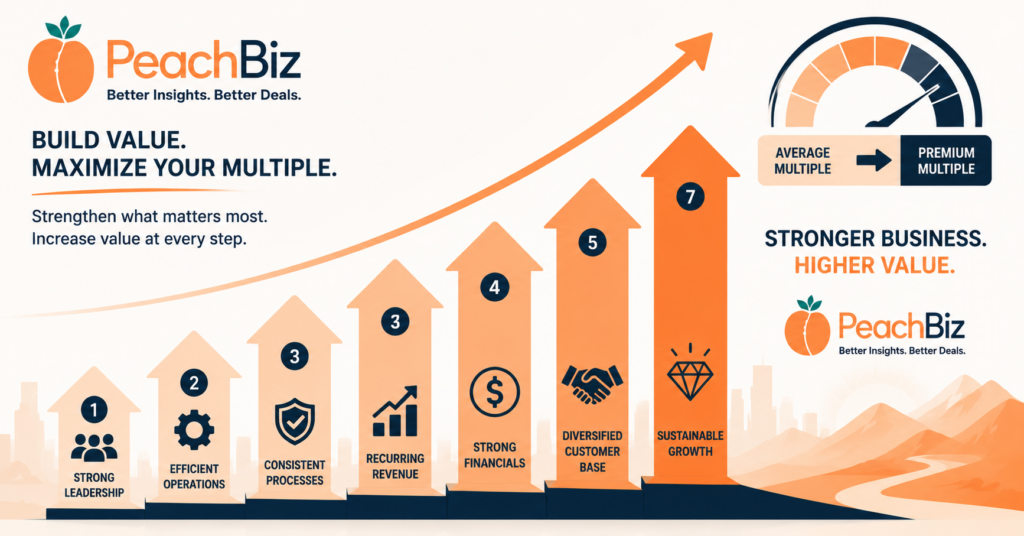
Every industry has a multiple range. In home services, it might be 2.5x–5.0x SDE. In manufacturing, 4.0x–7.0x EBITDA. In professional services, 3.0x–6.0x. The range is set by the market — by what buyers in aggregate are willing to pay for businesses in that sector.
Where your business lands inside that range is set by you.
The gap between the bottom of a range and the top isn’t random. It isn’t luck. It isn’t negotiating skill or timing the market perfectly. It’s a specific set of business characteristics — things you can identify, measure, and deliberately build — that buyers recognize and pay for consistently, across every industry and every deal size.
We call these value drivers. And understanding them isn’t just useful when you’re 90 days from a sale. It’s most useful when you’re 24–36 months out — when you still have enough runway to actually build them into your business and let them compound before you go to market.
This article covers the seven value drivers that most consistently move businesses from the midpoint of their industry range toward the top — with specific guidance on what each one means, how buyers measure it, and what you can do right now to start building it.
Why the Midpoint Isn’t Enough
Before we get into the drivers, let’s establish what’s actually at stake financially — because the dollar difference between midpoint and top-of-range is larger than most sellers realize.
Take a business earning $500,000 in SDE in the professional services sector, where the multiple range is 3.0x–6.0x.
- At the bottom of the range (3.0x): $1,500,000
- At the midpoint (4.5x): $2,250,000
- At the top of the range (6.0x): $3,000,000
The difference between midpoint and top of range is $750,000 on the same earnings. The difference between bottom and top is $1,500,000 — a 100% increase in value with no change in revenue or profitability.
That’s the financial argument for value driver work. A 20% improvement in revenue would increase earnings — but not by $1,500,000. The most direct path to dramatically more value in a business sale is moving your multiple, and the most reliable way to move your multiple is building the characteristics buyers pay a premium for.
Here are the seven that matter most.
Value Driver 1: Recurring Revenue
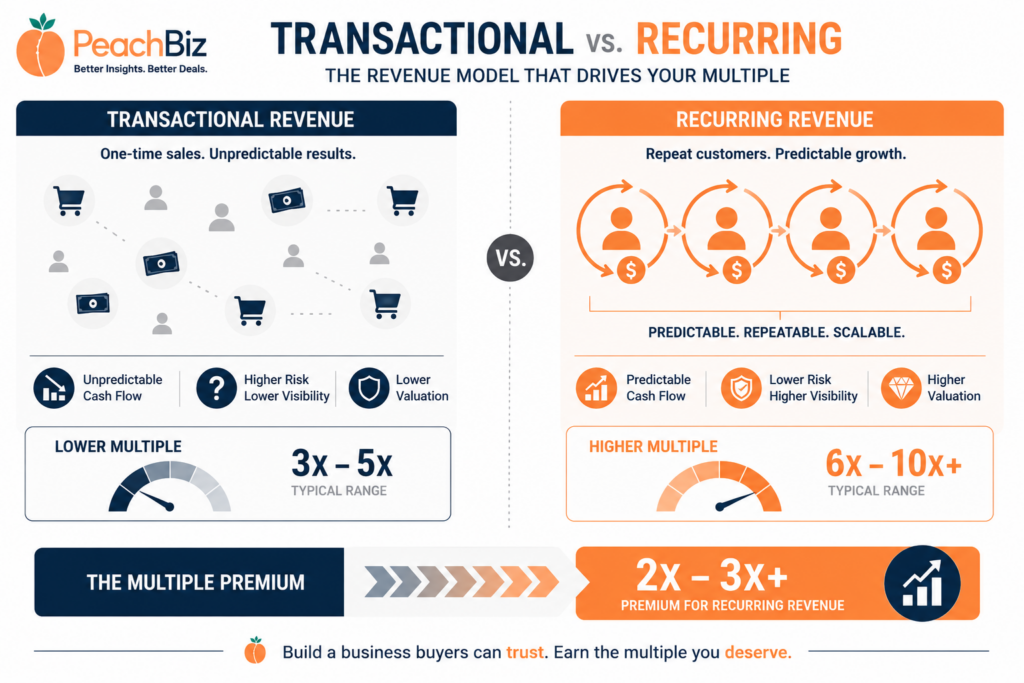
If there’s one value driver that moves multiples more consistently and more dramatically than any other — across every industry, every deal size, every buyer type — it’s recurring revenue.
Recurring revenue is any revenue that renews automatically or contractually without requiring the business to re-earn it from scratch each period. Service contracts, subscriptions, retainers, maintenance agreements, membership fees, auto-renewal programs — any structure where the customer has committed to ongoing payments rather than making a new purchase decision each time.
Why buyers pay a premium for it:
Recurring revenue reduces risk. A business where 60% of next year’s revenue is already committed on January 1 is fundamentally less risky than one where every dollar of next year’s revenue must be sold from scratch. Buyers — especially those using financing — need confidence in future cash flows. Recurring revenue provides that confidence in a way that transactional revenue cannot.
The premium is real and measurable. In most industries, businesses with 50%+ recurring revenue trade at 1.0x–2.0x higher multiples than comparable businesses with primarily transactional revenue. In some sectors — HVAC, pest control, IT managed services — recurring revenue is so dominant in the buyer’s calculus that businesses without significant recurring components struggle to attract institutional buyers at all.
How to build it:
Look at every revenue stream in your business and ask: can this be converted to a recurring structure?
- Service businesses: annual or multi-year service contracts, maintenance agreements, retainer arrangements
- Product businesses: subscription boxes, auto-replenishment programs, membership pricing
- Professional services: monthly retainers instead of project billing, annual advisory agreements
- Trades and home services: preventive maintenance contracts, priority service memberships
Even moving from 20% recurring to 40% recurring over 18 months is a meaningful multiple improvement. Start with your best customers — the ones most likely to say yes to a recurring arrangement — and build from there.
How buyers measure it: Recurring revenue as a percentage of total revenue (trailing 12 months). They’ll also look at your recurring revenue retention rate — what percentage of last year’s recurring contracts renewed this year. High recurring percentage plus high retention rate is the premium combination.
Value Driver 2: Management Team Depth
A business that can operate, grow, and serve customers without the owner in the building is worth dramatically more than one that can’t. This is true in every industry at every size — and it’s one of the value drivers most owners underinvest in because building it requires giving up control, which feels counterintuitive when you’ve spent years building the business.
Why buyers pay a premium for it:
Management depth solves the buyer’s biggest post-acquisition challenge: transition risk. A buyer who takes over a business with a capable, experienced management team can focus on learning and growing the business. A buyer who takes over a business where they are now the only capable manager is immediately overwhelmed and immediately at risk of service degradation that affects the very earnings they paid for.
Beyond transition, management depth enables growth. A buyer with ambitions to scale the business — through organic growth, geographic expansion, or acquisition — needs a team that can execute. Owner-dependent businesses cap the buyer’s growth potential along with their own.
How to build it:
Identify the two or three operational roles most critical to your business’s performance. For most small businesses, this is some combination of: operations lead, sales lead, and a finance/administrative lead. If you currently fill all three roles personally, your goal over the next 18–24 months is to develop or hire people who can own each of those functions independently.
This doesn’t require building a full corporate org chart. It requires identifying, developing, and genuinely empowering one or two key people who can run things without you. Give them real responsibility. Let them make decisions. Let them have the customer relationships. Document what they do so it survives their departure too.
How buyers measure it: They’ll interview your key employees during due diligence. They’ll ask: has this person made decisions independently? Do customers know them? Would they stay after the sale? The answers to those questions — from your employees, not from you — are what they’re evaluating.
Value Driver 3: Customer Diversification
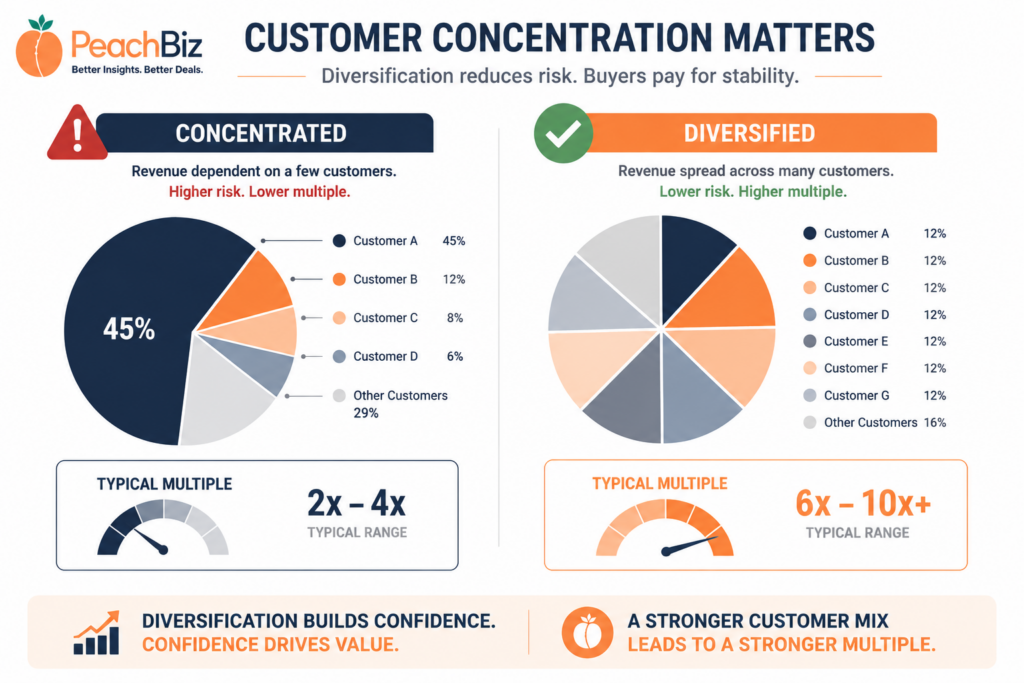
Customer concentration is one of the fastest multiple-killers in any industry. Customer diversification — its opposite — is one of the most reliable multiple-builders.
Buyers think about customer concentration risk in very simple terms: if your top customer left the day after closing, how much of the revenue they paid for would disappear? The higher that number, the lower the multiple they’re willing to pay — because they need a margin of safety against a scenario that is entirely outside their control.
The thresholds that matter:
- Top customer under 10% of revenue: no concentration discount
- Top customer 10–20%: flagged, may require explanation or structural accommodation
- Top customer 20–40%: meaningful multiple discount or earnout structure
- Top customer over 40%: SBA financing risk, reduced buyer pool, significant multiple discount
How to build it:
Customer diversification is a long-term strategic initiative, not a pre-sale tactic. The most effective approaches:
- Deliberately pursue smaller customers in adjacent segments that you’ve previously underweighted in favor of your large accounts
- Implement a customer acquisition system — referral programs, digital marketing, strategic partnerships — that generates new customer relationships independent of the owner
- Cap account sizes proactively, or at least be aware of when a single customer approaches 15–20% of revenue and take steps to grow other accounts to compensate
- Convert key customers to multi-year contracts — even if they represent 25% of revenue, a customer under a three-year contract with renewal terms is a very different risk profile than one operating month-to-month on a handshake
How buyers measure it: Top customer as a percentage of trailing 12-month revenue. Top 3 customers combined. Top 5 customers combined. They’ll request a customer-by-customer revenue breakdown sorted by size and will calculate the concentration ratios themselves.
Value Driver 4: Documented Systems and Scalable Processes
Businesses that run on systems rather than on people command higher multiples because they represent lower risk and higher scalability. A documented, repeatable process can be followed by a new owner, trained into a new employee, and scaled without proportional cost increases. An undocumented process that lives in someone’s head can’t.
Why buyers pay a premium for it:
Systems and documentation solve two buyer concerns simultaneously: transition risk (can the new owner operate the business effectively?) and growth potential (can the business scale beyond its current level?). A business with strong systems answers both questions affirmatively before the buyer has to ask.
There’s also a financing dimension: SBA lenders, when evaluating a buyer’s ability to operate the acquired business, look more favorably on businesses with documented operations. A business that clearly can be run by someone other than the current owner is a lower-risk loan.
How to build it:
Start with your highest-volume, highest-impact processes — the ones your business executes most frequently and that most directly affect customer experience. For most businesses, this means:
- Customer acquisition process: How does a new customer find you, what happens from first contact through signed agreement, who is responsible for each step?
- Service delivery process: How does your product or service get delivered, what are the quality checkpoints, what does “done” look like?
- Hiring and onboarding process: How do you find, evaluate, and train new employees?
- Financial management process: How are invoices issued, how are payments collected, how are expenses approved and categorized?
You don’t need a 500-page operations manual. You need documented processes in each of these areas that someone other than you can follow. Start with simple checklists and step-by-step guides. Build from there.
How buyers measure it: They’ll ask to see your operational documentation during due diligence. They’ll also assess it indirectly by talking to your employees and watching how they operate during site visits. Employees who know the process without being told what to do signal strong systems. Employees who constantly reference what the owner would do signal no systems.
Value Driver 5: Clean, Consistent Financial History

We covered clean books in depth in Why Clean Books Are Worth More Than a Higher Multiple — but it bears repeating in the context of value drivers because it is one of the seven factors most consistently associated with premium multiple outcomes.
The mechanism is straightforward: buyers pay for certainty. Clean, consistent, verifiable financial history gives them certainty that the earnings they’re paying for are real, that the trend is what it appears to be, and that due diligence will confirm rather than contradict the financial presentation.
What premium-multiple financial history looks like:
- Three years of monthly P&L statements that reconcile precisely to tax returns
- A fully documented SDE recast with every add-back sourced
- Bank statements that confirm monthly revenue
- No unexplained variance greater than 10% between comparable periods
- A clear, documented narrative for every significant year-over-year change
- A CPA who has been involved in the financial presentation and can confirm its accuracy
How to build it:
If your financial history is currently clean, maintain it and protect it. If it isn’t, start the cleanup process now — and understand that it takes 12–24 months to produce the three-year clean history that commands a premium.
The investment is worth it: businesses with clean, CPA-confirmed financial presentations consistently receive offers 15–25% higher than comparable businesses with documentation gaps, and they close faster and with fewer contingencies.
Value Driver 6: Demonstrated Growth Trajectory
A business growing at 15% per year commands a fundamentally different buyer interest than one that’s flat — even at the same current earnings level. Buyers are purchasing the future, and a demonstrated growth trajectory is the most credible evidence of what that future looks like.
Why buyers pay a premium for it:
Growth changes the underwriting math. A business earning $400,000 in SDE and growing at 15% per year will earn approximately $460,000 next year and $529,000 the year after — without any operational changes by the new owner. Buyers who can underwrite that trajectory are effectively paying today’s multiple on tomorrow’s earnings, which is a compelling proposition.
Growth also attracts a broader and more competitive buyer pool. PE firms, strategic acquirers, and growth-oriented individual buyers all weight trajectory heavily. More buyer competition means better terms and less negotiating leverage for buyers.
What counts as demonstrated growth:
- Year-over-year revenue growth (3-year trend)
- Year-over-year SDE or EBITDA growth
- New customer acquisition rate
- Expansion revenue from existing customers (upsells, increased spend)
- Geographic or service line expansion that’s already generating revenue
What doesn’t count:
Projected growth that hasn’t materialized. Pipeline deals that haven’t closed. Plans for new services or markets that haven’t launched. Buyers will not pay a premium multiple for growth that exists only on a slide deck. They pay for growth that shows up in three years of financial statements.
How to build it:
The most reliable way to demonstrate growth is to actually grow the business — which takes time. If you’re 24–36 months from a sale, focus on the growth levers most likely to produce measurable results in your financial statements: customer acquisition systems, retention improvements, pricing strategy, geographic expansion. Start now so the growth shows up in the three-year window buyers will evaluate.
If you’re closer to market, document the growth story you do have as clearly as possible — even modest but consistent growth (8–10% per year) is a positive signal when presented clearly and consistently.
Value Driver 7: Transferable Competitive Advantage
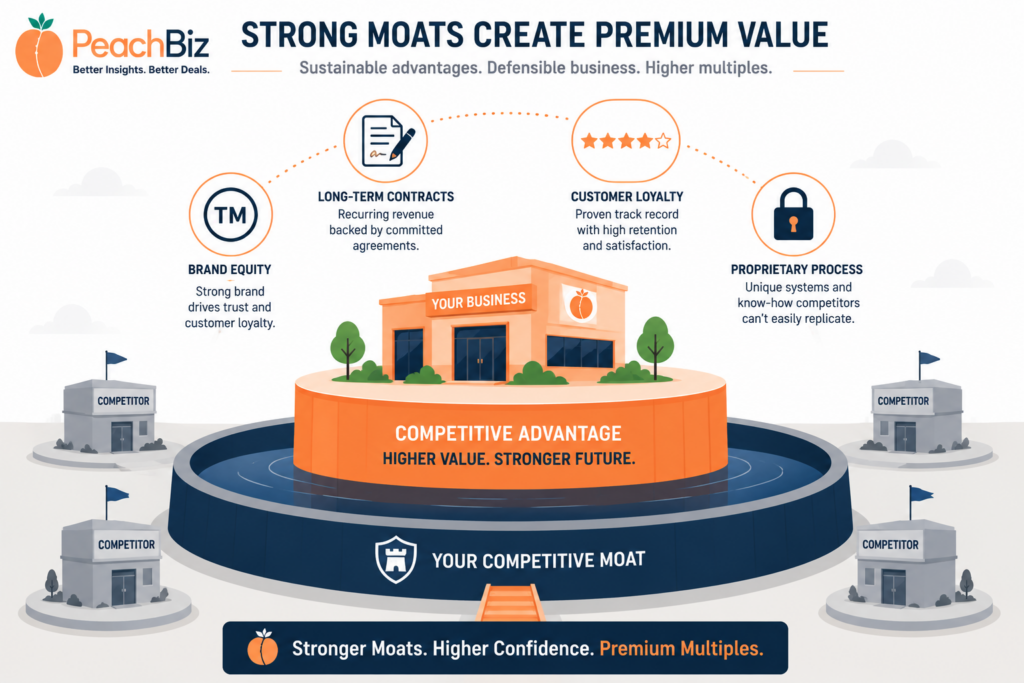
The final value driver — and in some ways the most powerful — is a competitive advantage that transfers to a new owner. Not an advantage that lives in the owner’s relationships or reputation, but one that’s embedded in the business itself and will continue to generate superior returns regardless of who owns it.
Why buyers pay a premium for it:
Transferable competitive advantages reduce competition risk. A business without differentiation competes on price in a crowded market — which means margins are under constant pressure and customers can leave for a lower-cost alternative. A business with a genuine, transferable moat has pricing power, customer loyalty, and competitive insulation that persists beyond the founder.
These businesses are rarer, more valuable, and command the highest multiples in any industry.
What transferable competitive advantages look like:
- Brand and reputation embedded in systems — not the owner’s personal reputation, but a brand that customers seek out independent of who owns it. This is built through consistent quality, documented service standards, and deliberate brand investment.
- Proprietary processes or technology — a unique method of delivering your product or service that competitors can’t easily replicate. Documented, protected, and demonstrably superior in outcome.
- Exclusive agreements — exclusive distribution rights, preferred supplier agreements, licensed territories, franchise rights, or long-term customer contracts with exclusivity provisions.
- Regulatory barriers — licenses, certifications, permits, or approvals that are difficult to obtain and create a barrier to new competitive entry in your market.
- Network effects — businesses where the product or service becomes more valuable as more people use it (common in platform businesses, marketplaces, and some professional networks).
- Location advantages — a retail or service location that competitors cannot easily replicate due to scarcity, proximity to customers, or long-term lease protections.
How to build it:
Not every business can build a moat — and the ones that can’t still sell. But most businesses have more transferable advantage than their owners recognize, because owners are too close to the business to see what’s genuinely difficult for competitors to replicate.
Ask yourself: what do my best customers say when I ask them why they chose us and why they stay? Those answers often reveal genuine competitive advantages — quality consistency, responsiveness, specialized expertise, community trust — that can be systematized, protected, and presented clearly to buyers.
The key word is transferable. An advantage that leaves when you do is not a value driver — it’s an owner dependency. Make sure the competitive advantages you’re presenting survive your exit.
Putting the Drivers Together: The Multiple Premium Calculator
Here’s a practical framework for estimating where your business sits in its multiple range today — and what specific improvements would do to that position.
Start with your industry’s midpoint multiple. For each value driver below, score your business honestly:
| Value Driver | Your Score (1–5) | Multiple Impact per Point |
|---|---|---|
| Recurring Revenue % | ___ | +0.15x–0.25x per point above midpoint |
| Management Team Depth | ___ | +0.10x–0.20x per point above midpoint |
| Customer Diversification | ___ | +0.10x–0.15x per point above midpoint |
| Documented Systems | ___ | +0.08x–0.15x per point above midpoint |
| Financial History Quality | ___ | +0.10x–0.20x per point above midpoint |
| Growth Trajectory | ___ | +0.15x–0.25x per point above midpoint |
| Transferable Competitive Advantage | ___ | +0.10x–0.20x per point above midpoint |
A business scoring 4–5 on most of these drivers consistently reaches the top quartile of its industry range. A business scoring 2–3 on most drivers typically lands at or below the midpoint.
The practical exercise: identify your two lowest-scoring drivers. Those are your highest-ROI improvement priorities. For most businesses, those two drivers represent the biggest gap between current multiple and potential multiple — and closing that gap is worth far more in sale proceeds than any other pre-sale investment you could make.
👉 Use our free Business Valuation Calculator to see how your current profile translates into a valuation range — and what moving your multiple by even 0.5x would mean in dollars.
👉 Run our EBITDA Growth Calculator to model how specific operational improvements — margin expansion, revenue growth, cost optimization — compound with a higher multiple to dramatically increase your total enterprise value.
Frequently Asked Questions
How long does it take to build value drivers into a business?
It depends on the driver. Recurring revenue structures can be implemented and begin showing in financials within 6–12 months. Management team development takes 12–24 months of consistent effort. Customer diversification, depending on your sales cycle, typically takes 18–36 months to meaningfully shift concentration ratios. Financial history quality requires 12–24 months of clean operations to show in a three-year presentation window. Plan for a minimum of 18–24 months of focused value driver work before going to market.
Which value driver has the biggest impact on multiple?
Recurring revenue consistently shows the largest and most measurable multiple impact across industries. In sectors where recurring revenue is common (HVAC, pest control, IT services, professional services), the difference between low and high recurring percentages can be 1.5x–2.0x multiple. That said, the value drivers compound — a business with strong recurring revenue and a capable management team and clean financials gets a larger premium than one that has only the recurring revenue.
Can I build value drivers even if I’m not planning to sell soon?
Absolutely — and the businesses that benefit most from value driver work are the ones whose owners aren’t thinking about selling yet. The value drivers described in this article make your business more profitable, more resilient, and more enjoyable to operate regardless of whether you ever sell. The sale is just where you realize the financial premium for having built them.
What if my industry naturally has low recurring revenue?
Some industries are inherently more transactional than others — construction, retail, event services. In these sectors, buyers understand the model and price accordingly. The strategy isn’t to force a subscription model onto a business where it doesn’t belong — it’s to find the recurring elements that do exist (maintenance services, warranty programs, preferred customer relationships) and build them as much as your business model allows, while compensating with strength in the other six drivers.
Do value drivers matter more in some markets than others?
Value drivers matter more in competitive buyer markets — where multiple businesses are available and buyers have options. In seller’s markets (where quality businesses are scarce and buyers are competing aggressively), strong businesses at any quality level tend to command good multiples. In buyer’s markets (where inventory is high and buyers have leverage), the gap between high-driver and low-driver businesses widens significantly. Building value drivers protects you regardless of market conditions.
The Bottom Line
Your multiple is not fixed by your industry. It’s set by your business — by the specific, measurable characteristics that buyers recognize and pay for consistently.
The seven value drivers in this article are what separate the businesses at the top of their industry’s multiple range from the ones at the midpoint or below. They’re not secrets. They’re the same factors every experienced buyer evaluates when they sit down with your financials and your CIM.
The difference between knowing what they are and having built them is the difference between a good exit and a great one. And the time to build them is now — not six months before you list, when it’s too late to move the needle.
Start with your two lowest scores. Build a plan. Give yourself the runway. The multiple — and the value it creates — will follow.
👉 Get your baseline valuation and start understanding your value driver profile with our free Business Valuation Calculator.
Related Reading
- EBITDA Multiples by Industry: What Buyers Are Actually Paying Right Now
- Owner Dependency: The Single Biggest Value Killer in Small Business Sales
- How Customer Concentration Tanks a Valuation (And How to Fix It Before You Sell)
- Recurring Revenue vs. Project Revenue: How Buyer Perception Changes the Math
- Why Clean Books Are Worth More Than a Higher Multiple
- The 10 Factors Buyers Score Before They Make an Offer
- What Is a Business Worth? The 4 Valuation Methods Explained
- Explore All Free PeachBiz Business Calculators