
The 10 Factors Buyers Score Before They Make an Offer
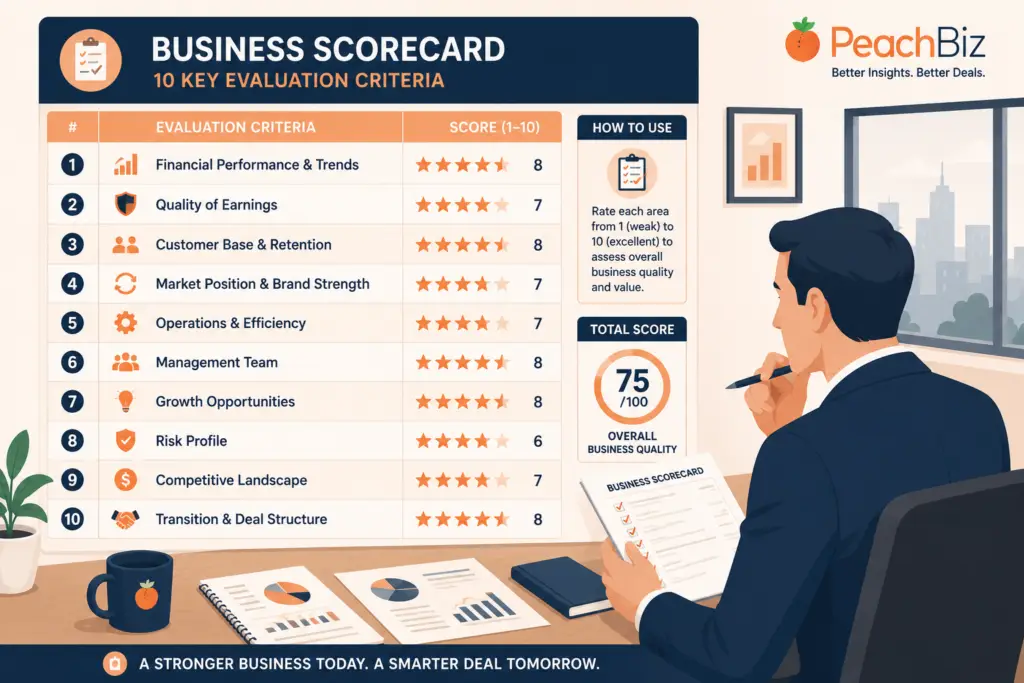
Every buyer who sits across the table from you — whether they’re an individual operator, a private equity firm, or a strategic acquirer — is running a scorecard on your business before they ever write a number on a piece of paper.
Most sellers don’t know the scorecard exists. They think the conversation is about price. It isn’t — at least not yet. Before price, buyers are making a fundamental go/no-go decision based on a set of factors that determine whether your business is worth pursuing at all, and if so, at what level of risk.
Understanding that scorecard is one of the most valuable things you can do as a seller, an advisor, or a broker preparing a client for market. Because the businesses that score well on these ten factors don’t just get offers — they get better offers, faster, with fewer contingencies and less renegotiation.
Here’s what buyers are actually scoring.
Why Buyers Use a Scorecard Approach
Buyers — particularly experienced ones — see dozens or hundreds of businesses before they make an acquisition. They develop a rapid triage process: identify the opportunities worth pursuing deeply, and eliminate the ones that aren’t as quickly as possible.
That triage process is a scorecard, even when it isn’t written down. It’s built from experience, from deals that worked and deals that didn’t, from the due diligence horror stories every serious buyer carries with them.
When your business shows up in their pipeline — as a listing, a referral, or a direct approach — they start scoring immediately. The Confidential Information Memorandum (CIM), the initial financials, the first meeting with the broker — all of it is feeding their scorecard before you ever know they’re evaluating you.
The ten factors below are what they’re looking for. We’ve organized them from the ones that matter most — the ones that create instant red flags or green lights — down to the supporting factors that refine the score once a buyer is interested.
Factor 1: Revenue Trend
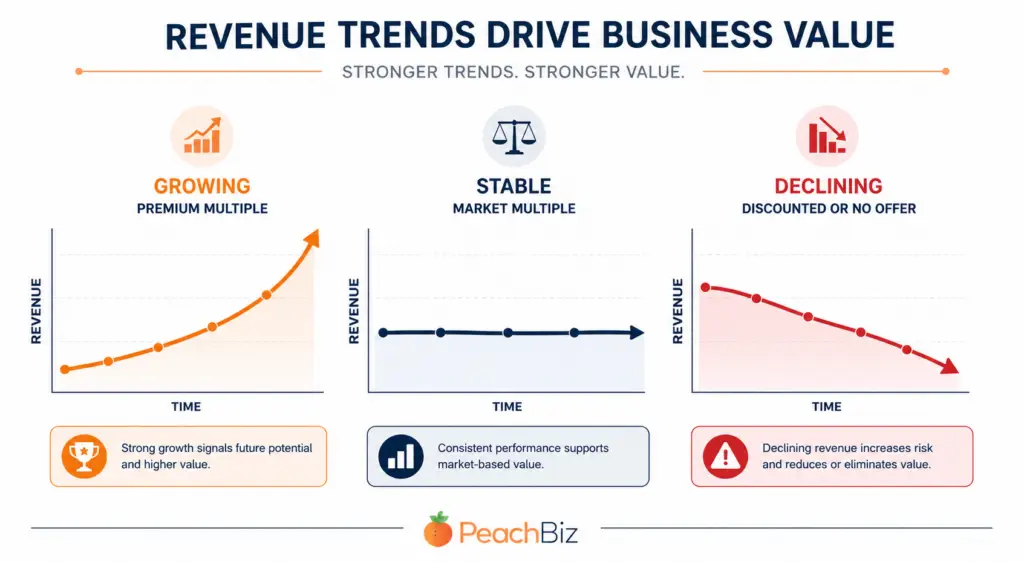
The first thing a buyer does with your financials is look at the trend, not the current year number. Three years of revenue — are they going up, flat, or down?
A business showing 10–20% year-over-year revenue growth tells a buyer they’re buying into a rising tide. A flat business tells them they’re buying a stable income stream. A declining business immediately raises the question: why is it declining, is it structural, and will it continue?
Declining revenue doesn’t automatically kill a deal — but it changes every other variable. The buyer’s offer will be lower, the due diligence will be more intensive, and the deal structure will typically include more seller risk in the form of earnouts or seller financing.
What you can do: If your revenue has been flat or declining, the best thing you can do before going to market is identify and document the cause — and demonstrate that it’s been addressed. A business that declined in 2023 due to a specific one-time factor and rebounded in 2024–2025 tells a very different story than one that’s been slowly eroding for three consecutive years.
Factor 2: Earnings Quality and Consistency
Revenue is the top line. Buyers care more about what falls to the bottom.
Earnings quality refers to how reliable, consistent, and well-documented your profitability actually is. Buyers aren’t just looking at your SDE or EBITDA number — they’re evaluating how much confidence they can place in that number continuing after they take over.
High earnings quality looks like:
- Consistent margins over three or more years
- Clean, well-organized financial statements
- Add-backs that are clearly documented and defensible
- No large, unexplained swings in profitability year to year
Low earnings quality looks like:
- Significant variance in margins without clear explanation
- Financials that don’t reconcile cleanly to tax returns
- Add-backs that are aggressive or poorly documented
- Revenue recognition practices that inflate current-period earnings
Buyers will recast your financials during due diligence regardless. The question is whether what they find confirms your presentation — or contradicts it. Contradictions kill deals. Confirmations build confidence and close them.
👉 Make sure your baseline earnings number is solid before you go to market. Our free Business Valuation Calculator walks through proper normalization so you understand what buyers will actually be looking at.
Factor 3: Revenue Concentration Risk
This is one of the fastest deal-killers in any buyer’s scorecard, and it’s one of the factors sellers most consistently underestimate.
Customer concentration risk means your revenue is disproportionately dependent on a small number of customers. If your top customer accounts for 30% of your revenue and decides to leave after the sale — because their relationship was with you personally, or because they simply find a new vendor — the buyer just lost 30% of what they paid for.
Buyers don’t ignore concentration risk. They price it in — aggressively.
The thresholds buyers typically use:
- Under 10% from any single customer: Clean. No concentration discount.
- 10–20% from a single customer: Flagged. Buyer will ask questions and may adjust structure.
- 20–40% from a single customer: Significant risk. Expect a lower multiple and deal structure that puts risk back on you via earnouts.
- Over 40% from a single customer: Deal may not be financeable via SBA. Some buyers walk entirely.
The same logic applies to supplier concentration — if you have a single source supplier for a critical input and no backup, that’s a concentration risk too.
What you can do: If you have concentration risk, start diversifying your customer base before you go to market. Even moving your top customer from 35% to 22% of revenue over 18 months materially changes how buyers view your risk profile. And if concentration is unavoidable in your business model, prepare documentation showing the depth and longevity of the relationship — multi-year contracts, personal introductions to the buyer, transition planning evidence.
We cover customer concentration in detail in How Customer Concentration Tanks a Valuation (And How to Fix It Before You Sell).
Factor 4: Owner Dependence
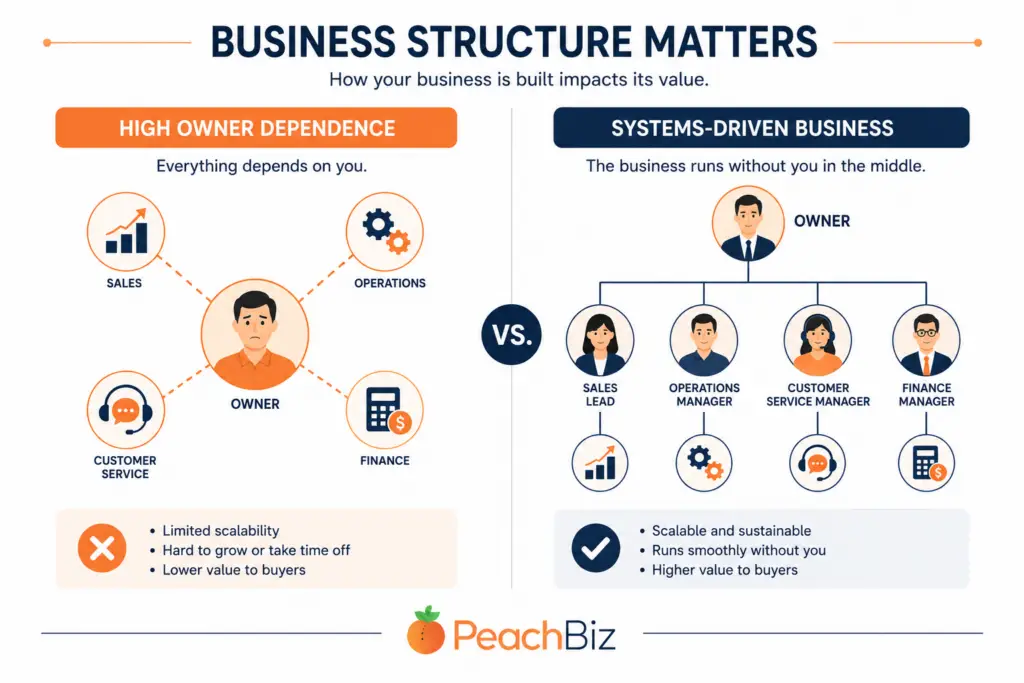
If the business is you — if you are the primary salesperson, the key relationship holder, the technical expert, and the daily decision-maker — buyers will price in the risk that you walk out the door and take the business with you.
This is one of the most common value killers in small business sales, and it manifests in two specific ways:
Revenue dependence: Customers buy from you personally. Your relationships, your reputation, your phone number. When you leave, some percentage of them may leave too. Buyers model this risk and discount their offers accordingly.
Operational dependence: The business can’t function at its current level without your daily involvement. There’s no manager who can run operations, no documented processes that allow someone else to step in, no institutional knowledge that lives anywhere but your head.
Buyers score this factor heavily because it directly affects their ability to operate and grow the business after acquisition. The more dependent the business is on you, the more risk the buyer is taking on — and the lower the multiple they’re willing to pay.
What you can do: Start extracting yourself from the business before you go to market. Document your processes. Elevate a key employee into a general manager or operations lead role. Let them run customer relationships with you coaching from behind. Even 12–18 months of demonstrated non-dependence changes the conversation dramatically.
We cover this in depth in Owner Dependency: The Single Biggest Value Killer in Small Business Sales.
Factor 5: Recurring Revenue Percentage
If there’s a single metric that gets buyers most excited — across every industry, every deal size, every buyer type — it’s the percentage of revenue that recurs automatically without having to be re-earned every period.
Recurring revenue means contracts, subscriptions, retainers, maintenance agreements, membership fees, auto-renewal programs — any structure where the customer commits to ongoing payments rather than making a new purchase decision every time.
Here’s why buyers love it so much: it reduces risk. A business where 60% of next year’s revenue is already under contract on January 1 is a fundamentally different risk profile than a business where every dollar of next year’s revenue has to be sold from scratch.
That difference in risk translates directly into multiple. Businesses with strong recurring revenue components consistently sell at 1–3 turns higher than comparable businesses with purely transactional revenue in the same industry.
What you can do: Before you sell, look at every revenue stream and ask whether it can be converted to a recurring structure. Service contracts, annual maintenance agreements, subscription pricing models, retainer arrangements — if any of these make sense for your business model, implementing them 12–24 months before a sale can materially move your multiple.
Factor 6: Documented Systems and Processes
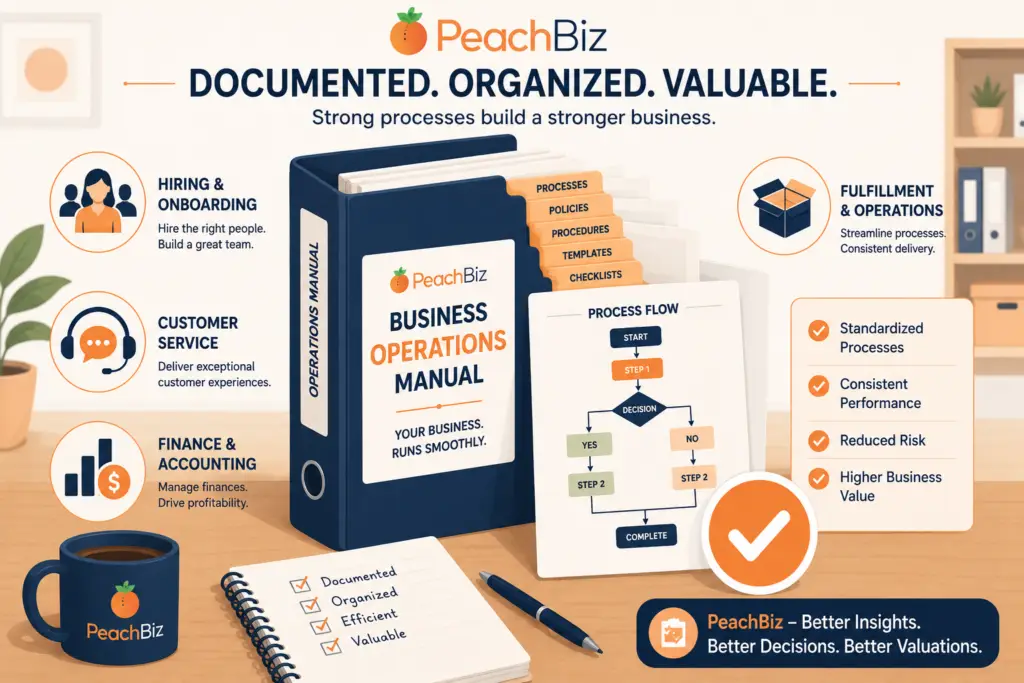
When a buyer imagines taking over your business on day 31 — after you’ve transitioned out — what happens? Do things run? Do employees know what to do? Do customers get served at the same level?
The answer to those questions lives in your systems and processes. Written SOPs, training materials, operations manuals, documented workflows — these are what allow a business to function and grow beyond the founder.
Buyers score this factor because it directly affects their transition risk. A business with strong documented systems can be handed off relatively cleanly. A business that runs entirely on institutional knowledge in the owner’s head requires a much longer, more expensive transition — and carries significantly more risk that something gets lost in the handoff.
This doesn’t mean you need a 300-page operations manual. It means the key processes in your business — how you acquire customers, how you deliver your product or service, how you hire and train, how you handle finances — are written down somewhere and followed consistently.
What you can do: Start documenting now. Even a simple set of Google Docs covering your core operational processes is infinitely better than nothing. If you have employees, involve them in the documentation process — they often know the actual workflow better than you think, and getting it out of their heads and into a document is part of the same exercise.
Factor 7: Management Team Depth
Closely related to owner dependence, but distinct: management team depth looks at whether your business has capable, experienced leaders below the owner level who could run the business — or key departments within it — independently.
For smaller businesses, this might just mean one or two key employees who own their domain and have demonstrated they can operate without daily direction. For mid-market businesses, it means a functional leadership team across operations, finance, sales, and service delivery.
Buyers value management depth for two reasons. First, it reduces transition risk — if there’s a capable team in place, the buyer can learn the business from them while the owner transitions out. Second, it enables growth — a buyer who wants to scale the business needs people who can execute the growth strategy, not just maintain the status quo.
A business where the owner is the only capable manager is a job, not a company. Buyers pay company multiples for companies.
Factor 8: Market Position and Competitive Differentiation
Buyers want to understand where your business sits in its market — and whether that position is defensible.
This isn’t about being the biggest player in your industry. Most small and mid-size businesses aren’t. It’s about whether your business has something that makes it meaningfully difficult for a customer to simply go elsewhere.
Defensible market positions include:
- A recognized local or regional brand with strong reputation
- Proprietary technology, processes, or formulas
- Exclusive supplier or distribution agreements
- Long-term customer contracts with switching costs
- Licenses, certifications, or permits that create barriers to entry
- A specialized niche that larger competitors don’t serve well
- A dominant position in a specific geography
Businesses without any differentiation — commodity providers competing purely on price in a crowded market — are harder to sell and sell at lower multiples. Not because they’re bad businesses, but because they’re more replaceable and therefore carry more risk.
What you can do: Before going to market, be able to articulate clearly — in one or two sentences — why customers choose you over the alternatives and why they stay. If you can’t answer that question clearly, buyers won’t be able to either, and that ambiguity costs you.
Factor 9: Growth Potential and Market Tailwinds
Buyers aren’t just buying today’s business — they’re buying what the business can become under their ownership. That means they’re evaluating the size and trajectory of the market you operate in, and whether there are credible paths to grow revenue and earnings after the acquisition.
This factor scores high when:
- Your market is growing (demographic tailwinds, regulatory changes, technology shifts)
- There are clear, executable growth levers that haven’t been fully pursued (new geographies, adjacent services, underserved customer segments)
- The business has untapped capacity — it could handle more volume without proportional cost increases
- There are acquisition opportunities in a fragmented market
This factor scores low when:
- Your market is declining or being disrupted
- The business is already at capacity and growth requires significant capital investment
- The competitive landscape is intensifying with no clear differentiator
An important note: You don’t need to be in a high-growth market to sell well. Stable, cash-generating businesses in steady markets sell every day at good multiples. But if you can point to specific, credible growth opportunities the next owner can pursue, it strengthens the buyer’s underwriting and their willingness to pay.
Factor 10: Clean Legal, Compliance, and Operational History
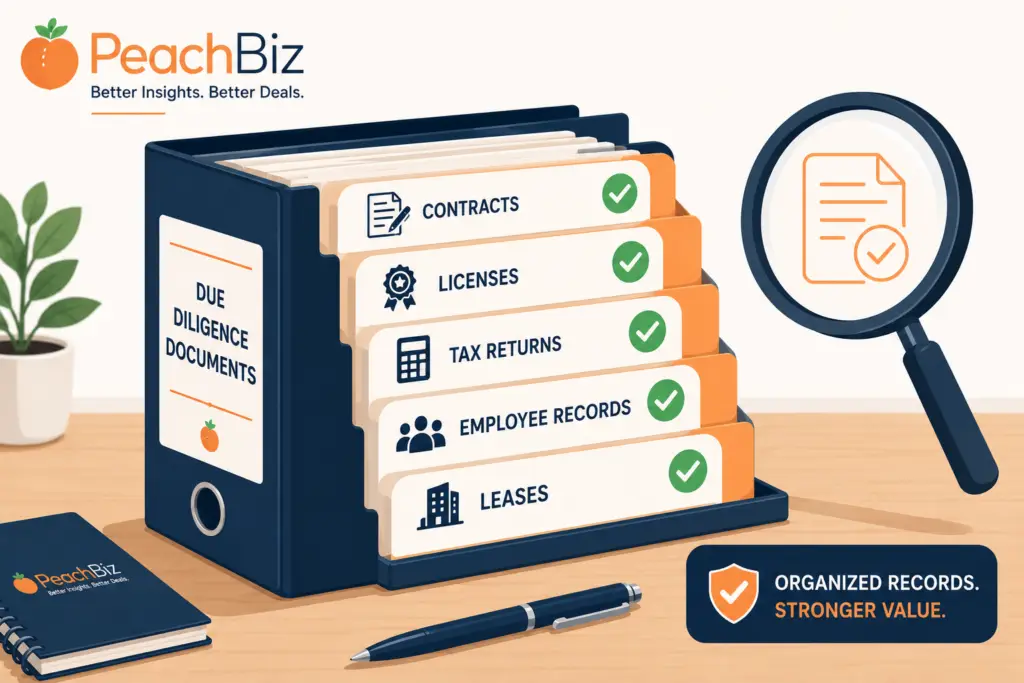
The last factor on the scorecard is the one buyers hope is clean and dread finding isn’t: your legal, compliance, and operational history.
Buyers and their attorneys will review:
- Pending or historical litigation
- Regulatory compliance history (OSHA, EPA, licensing, permits)
- Tax compliance — federal, state, payroll, sales tax
- Employee classification (1099 vs. W-2 misclassification is a significant liability)
- Lease terms and assignability
- Contracts with customers, suppliers, and employees
- Intellectual property ownership and protection
Any significant issue in this category — a pending lawsuit, a history of regulatory violations, payroll tax delinquency, a lease that can’t be assigned to a new owner — creates what buyers call a “hair on the deal.” Sometimes it’s a negotiating point. Sometimes it’s a deal-killer.
What you can do: Conduct your own pre-sale legal review before you go to market. Have your attorney review your contracts for assignability. Make sure your licenses and permits are current and transferable. Confirm your payroll tax filings are current. Address any known issues before a buyer’s attorney finds them in due diligence — because finding them yourself and disclosing them proactively is dramatically better than having a buyer find them and question what else you’re hiding.
How to Use This Scorecard Right Now
The most valuable thing you can do with this list is score yourself honestly — before a buyer does it for you.
Go through each of the ten factors. Ask yourself: if a qualified buyer with ten years of acquisition experience looked at my business on each of these dimensions, what would they see? Where are my green lights? Where are my yellow flags? Where are my red flags?
Be ruthless. The buyers will be.
For each red flag you identify, ask: can I fix this before I go to market? How long would it take? What would it cost? What would it do to my valuation if I did?
In most cases, a 12–24 month improvement plan targeting your two or three weakest scorecard factors will do more for your sale proceeds than any amount of negotiating at the LOI stage. The time to improve your score is before the buyer sees it — not after.
👉 Want to see how your business stacks up? Use our free Business Valuation Calculator to get a baseline value estimate that reflects many of these factors.
👉 Run our Margin Health Check to see how your profitability profile compares to buyer expectations in your industry.
For Brokers and Exit Planners: Using This Framework With Clients
This ten-factor scorecard is one of the most useful frameworks you can bring into an initial seller consultation. It shifts the conversation from “what’s my business worth?” — a number that can feel arbitrary — to “how does my business score on the factors that determine what buyers will pay?” — a diagnostic that empowers the seller to take action.
We recommend walking through each factor with a new client in the discovery meeting, scoring each one simply (strong / average / weak), and then identifying the top two or three improvement priorities. That becomes the foundation of an exit readiness roadmap — and positions you as the advisor who helps them actually get there, not just the one who tells them their number.
For a more structured version of this process, see How to Run an Exit Readiness Assessment on Your Client’s Business.
Frequently Asked Questions
What do business buyers look for first?
Most experienced buyers triage on three factors immediately: revenue trend, earnings quality, and owner dependence. If any of these three are severely problematic, many buyers won’t pursue further regardless of how strong the other factors are. Revenue trends and earnings quality come from the financials; owner dependence comes from the first conversation with the broker or seller.
How long does it take to improve your buyer scorecard?
It depends on which factors you’re improving. Financial documentation and legal cleanup can happen in 3–6 months. Reducing owner dependence typically takes 12–18 months of deliberate effort. Diversifying customer concentration depends on your sales cycle but generally requires 12–24 months of consistent effort. Building recurring revenue structures can take 6–18 months depending on your industry and customer relationships.
Do all buyers use the same scorecard?
Not formally — but the underlying factors are remarkably consistent across buyer types. Individual buyers focus heavily on owner dependence and transition risk. Private equity buyers emphasize recurring revenue, management team depth, and growth potential. Strategic acquirers weight market position and competitive differentiation. The specific priorities vary, but all ten factors appear on every sophisticated buyer’s evaluation in some form.
What’s the single most important factor for getting a premium offer?
If we had to pick one, it’s recurring revenue. No other single factor moves multiples as consistently or as dramatically across industries. A business with 50%+ recurring revenue almost always trades in the top quartile of its industry multiple range. That said, recurring revenue doesn’t compensate for collapsing earnings or severe owner dependence — the scorecard factors work together, and severe weakness in any one area can undermine strength in others.
Can a business with weaknesses still sell for a good price?
Absolutely. Almost every business has weaknesses on this scorecard — the question is whether they’re dealbreakers or deal-shapers. Most weaknesses become negotiating points rather than exit points when they’re disclosed proactively, explained honestly, and priced appropriately. The businesses that struggle to sell are usually the ones where sellers try to hide weaknesses rather than address or disclose them.
The Bottom Line
Buyers score your business before they make an offer. They always have. The only question is whether you know what’s on the scorecard before they do.
The ten factors above aren’t secrets — they’re the standard framework every experienced buyer uses to evaluate risk and opportunity. The sellers who understand this framework — and spend the time before their exit improving their score — are the ones who get to the closing table with strong offers, reasonable terms, and the feeling that they got what their business was worth.
That’s the goal. And it starts with knowing where you stand today.
👉 Get your baseline valuation and start understanding your score with our free Business Valuation Calculator.
Related Reading
- What Is a Business Worth? The 4 Valuation Methods Explained
- EBITDA Multiples by Industry: What Buyers Are Actually Paying Right Now
- How to Run an Exit Readiness Assessment on Your Client’s Business
- Red Flags That Kill Deals Before the LOI: A Pre-Sale Checklist
- Owner Dependency: The Single Biggest Value Killer in Small Business Sales
- How Customer Concentration Tanks a Valuation (And How to Fix It Before You Sell)
- The 7 Value Drivers That Push Your Multiple Above the Midpoint
- Explore All Free PeachBiz Business Calculators