
How Customer Concentration Tanks a Valuation (And How to Fix It Before You Sell)
You’ve spent years building a business. Revenue is strong. Margins are healthy. You’re ready to sell.
Then your broker runs the customer analysis and finds it: one customer accounts for 38% of your revenue. Maybe two customers together account for 55%.
Suddenly the conversation changes. The multiple you expected starts shrinking. Your broker starts talking about deal structure accommodations you didn’t anticipate. Some buyers who seemed interested go quiet.
What happened?
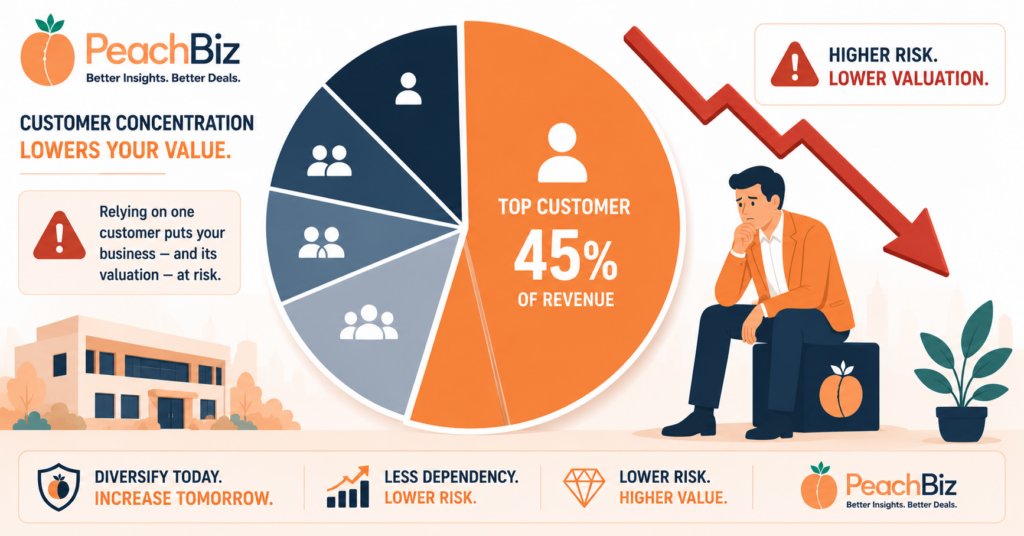
Customer concentration happened. And it’s one of the fastest, most reliable valuation killers in any business sale — not because it makes your business less profitable, but because it makes your business more risky than your earnings suggest. A business whose revenue is heavily dependent on one or two customers is fundamentally more fragile than its income statement reveals, and buyers price that fragility in.
The good news is that customer concentration is fixable — with time, with strategy, and with deliberate effort before you go to market. This article tells you exactly how buyers measure it, what it costs you in valuation, where the critical thresholds are, and what to do about it with the runway you have.
Why Customer Concentration Is a Valuation Problem
To understand why buyers react so strongly to customer concentration, you need to understand what they’re actually buying.
When a buyer acquires your business, they’re buying a revenue stream — the future cash flows your business will generate under their ownership. The multiple they pay reflects their confidence in those cash flows continuing.
Customer concentration creates a specific, quantifiable threat to that confidence: if one customer leaves, how much of the revenue stream disappears? If the answer is 30%, 40%, or more — the buyer is effectively making a bet on the stability of a single relationship they didn’t create and may not be able to sustain.
That bet changes everything about how they price the deal.
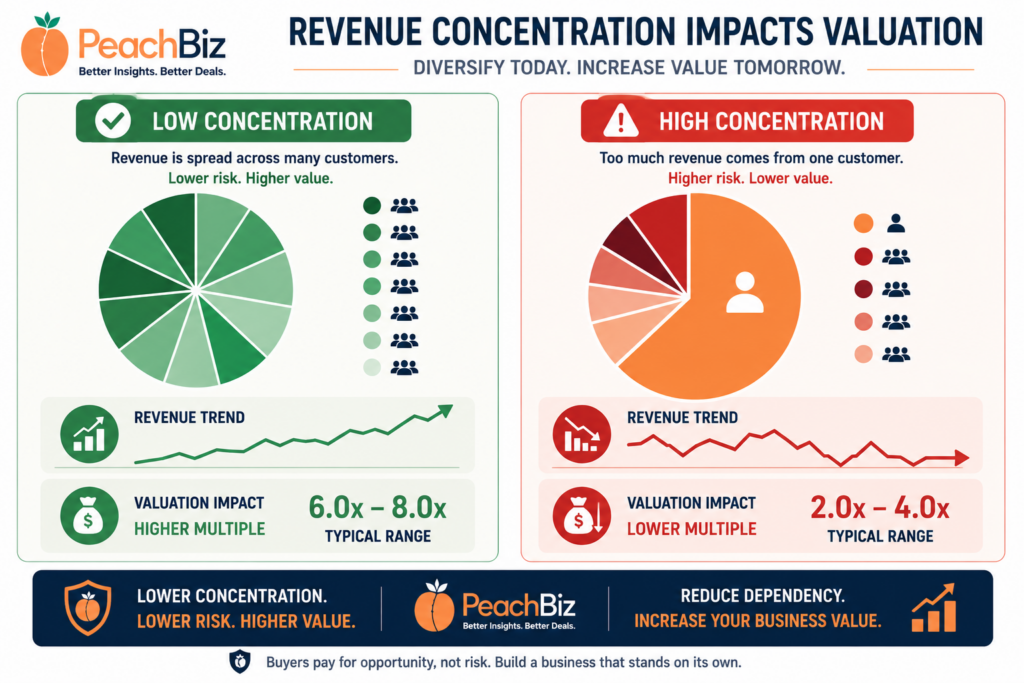
The math is simple and brutal:
Imagine your business generates $500,000 in SDE annually, and your top customer accounts for 35% of revenue. In a typical home services business, the industry multiple range might be 3.0x–5.0x.
A well-diversified version of your business might attract a 4.0x offer — $2,000,000.
Your concentrated version might attract a 3.0x offer — $1,500,000.
Same earnings. Same industry. Same owner. $500,000 less in value — entirely because of customer concentration.
And that’s before accounting for the deal structure accommodations buyers often demand: earnout provisions, extended seller involvement, seller notes with risk-sharing provisions. These further reduce what you actually receive versus what the headline number suggests.
The Thresholds That Matter
Not all concentration is equal. Buyers — and particularly SBA lenders — think about concentration in specific threshold bands, each with different implications for deal structure and valuation.
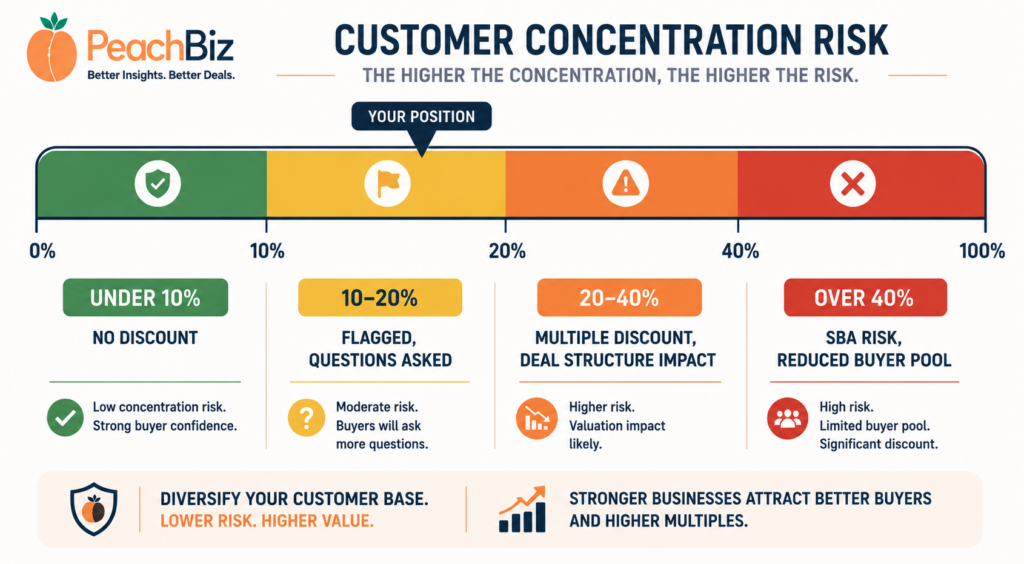
Under 10% — No Concentration Discount
When no single customer represents more than 10% of revenue, buyers treat your customer base as diversified. There’s no concentration discount applied to the multiple, no special due diligence around individual customer relationships, and no structural accommodations required. This is the clean zone.
10–20% — Flagged, Questions Asked
A top customer in the 10–20% range will be noted and questioned, but it typically doesn’t create a significant multiple impact on its own. Buyers will want to understand the nature of the relationship, the length of tenure, whether there’s a written contract, and whether the customer’s business with you has been growing, stable, or declining. Good answers to these questions keep the deal moving without structural concessions.
20–40% — Multiple Discount and Deal Structure Impact
This is where concentration starts to materially affect both valuation and deal structure. Buyers at this level typically apply a 0.5x–1.5x multiple discount to account for the concentration risk. They may also build structural accommodations into the offer: an earnout provision tied to the concentrated customer’s continued revenue for 12–24 months post-closing, a seller note with conditions tied to customer retention, or an extended transition period requiring seller involvement specifically to manage the relationship transfer.
SBA lenders also begin scrutinizing deals more carefully in this range. Some SBA preferred lenders have internal policies around concentration thresholds, and a business with a 30%+ customer may face more demanding underwriting requirements that affect the buyer’s financing terms.
Over 40% — Serious Buyer Pool Reduction
Above 40% concentration in a single customer, you’re in territory that creates real financing and buyer pool challenges. Many SBA lenders will flag this level of concentration and may require additional underwriting, personal guarantees from the buyer, or larger down payments to offset the risk. Some will decline to finance the deal entirely.
The buyer pool narrows significantly at this level — you’re largely limited to buyers who either don’t need SBA financing, who have specific expertise in your industry and are confident in the customer relationship, or who are willing to accept significant risk for a discounted price. Competitive offer dynamics — which drive better terms and higher prices — become much less likely.
The top-5 cumulative threshold:
Beyond the single-customer threshold, buyers also look at cumulative concentration. A business where the top 5 customers represent 70%+ of revenue has meaningful concentration risk even if no single customer is above 15%. The standard that generally avoids concern: no single customer above 15–20%, and top 5 customers combined below 50%.
How Buyers Verify Concentration in Due Diligence
Understanding that buyers will investigate concentration directly should inform how you present it — and why proactive disclosure is always better than having buyers discover it.
What buyers request:
- Customer-by-customer revenue breakdown for the trailing 12 months and the prior two years
- Revenue by customer sorted by size, with percentage of total revenue calculated
- Contract status for each major customer (written agreement vs. verbal/handshake)
- Length of relationship for each major customer
- Revenue trend by customer — is the top customer’s business growing, stable, or declining?
- Any changes in the customer relationship anticipated post-sale
What they’re looking for beyond the percentage:
Raw concentration percentage is just the starting point. Buyers also want to understand:
- Contract protection: A customer representing 25% of revenue under a three-year contract with auto-renewal is a very different risk profile than the same customer on a month-to-month verbal arrangement.
- Relationship nature: Is the customer relationship with you personally, or with the business broadly? Do they know your team? Have they worked with others in your organization?
- Tenure and stability: A customer who has been with you for 12 years and has never reduced their spend is less risky than one who’s been with you for 18 months and represents a recent revenue surge.
- Customer’s own business health: A concentrated customer who is a large, stable enterprise is less risky than one who is a small business themselves or who operates in a volatile sector.
This context can meaningfully mitigate the concentration risk in a buyer’s mind — which is why proactive, well-prepared disclosure of concentration is far better than hoping a buyer won’t notice.
What Concentration Costs You: The Full Accounting
We’ve covered the multiple discount. But concentration affects your proceeds in more ways than just the offer price.
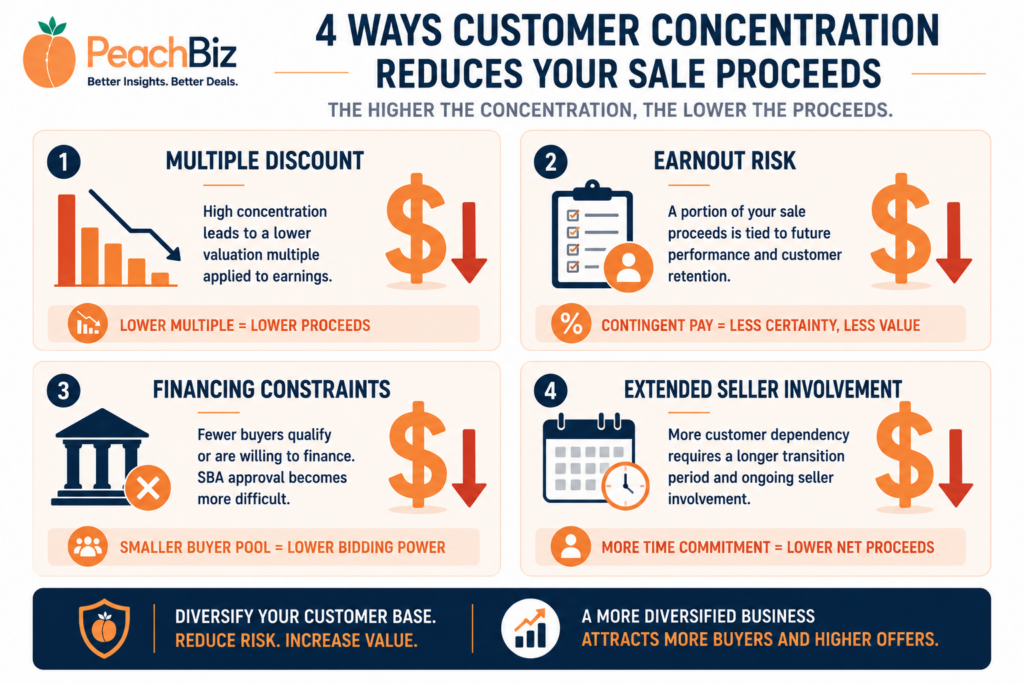
The multiple discount: As discussed — typically 0.5x–1.5x below where a diversified business would trade, applied to your full earnings base.
Earnout provisions: If a buyer insists on an earnout tied to the concentrated customer’s continued revenue, you’re accepting that a portion of your sale proceeds is contingent on something you can no longer control after closing. If that customer reduces their business or leaves in the first 12 months — regardless of the reason — you may not receive that portion of the earnout.
Reduced financing options: A smaller buyer pool means less competitive pressure on offer terms. Fewer competing offers means lower prices, less favorable terms, and more buyer leverage throughout the negotiation.
Extended seller involvement: Buyers who are nervous about a key customer relationship leaving will often require a longer, more intensive transition period — sometimes 12–18 months rather than the standard 60–90 days. This has real costs: your time, your continued involvement in a business you’ve already sold, and the personal stress of an extended post-sale period.
Combined impact example:
On a $2,000,000 potential enterprise value business with significant concentration:
- Multiple discount: −$400,000 (0.5x on $400K SDE)
- Earnout at risk: −$150,000 (contingent on customer retention)
- Extended transition costs (time and opportunity): −$50,000+
- Total concentration penalty: $600,000+
That’s the real cost of customer concentration in a business sale. And that’s before accounting for the stress, complexity, and timeline extension that concentration-related deal complications introduce.
The Customer Diversification Playbook
Here’s the practical strategy for reducing customer concentration before you go to market — organized by timeline and priority.
If You Have 24+ Months
You have the most valuable resource available: time. Use it to build a genuine, sustainable diversification in your customer base.
Implement a systematic new customer acquisition program.
Relationship-based selling — the model most concentrated businesses rely on — naturally concentrates revenue because you can only maintain so many personal relationships. To diversify, you need to add channels that generate new customers independent of your personal network.
What this looks like depends on your business:
- Inbound marketing: Content, SEO, and digital advertising that generates inquiries from customers who find you, rather than customers you find
- Referral systems: Formalized referral programs with existing customers, strategic partners, and complementary service providers that generate referrals to the business rather than to you personally
- Strategic partnerships: Agreements with complementary businesses that create systematic referral flows with documented terms
- Sales team development: A salesperson or sales process that generates new business independent of your direct involvement
Set and enforce account size targets.
Define a maximum percentage of revenue any single customer should represent — typically 15%. When an existing customer approaches that threshold, implement an intentional strategy: either cap their growth, expand the total customer base faster, or consciously accept the concentration and plan for it.
Prioritize mid-size customers over large ones.
A natural concentration-reduction strategy is to deliberately target customers who will each represent 3–8% of revenue rather than pursuing the occasional whale that will represent 25%. This feels counterintuitive — larger customers often have higher deal value and are worth more per sale. But a portfolio of 15 mid-size customers representing 5% each is worth dramatically more in a business sale than a portfolio of 3 large customers representing 20% each.
If You Have 12–18 Months
You have meaningful runway but not unlimited time. Focus on the highest-impact moves.
Aggressively grow your smallest existing customers.
Your fastest path to diversification may not be acquiring new customers — it may be growing the customers you already have but have underserved. Look at your bottom 50% of customers by revenue. Are there opportunities to expand what you do for them? Service line expansions, more frequent engagement, upsells into adjacent needs?
Growing a customer from 2% of revenue to 5% is faster than acquiring a new customer from zero, and it reduces concentration by growing the denominator (total revenue) faster than the numerator (top customer revenue).
Convert top customer relationships to multi-year contracts.
If your top customer represents 25% of revenue and you can get them signed to a three-year contract with auto-renewal provisions, you’ve transformed an unsecured concentration risk into a contracted revenue stream. Buyers treat these very differently — a customer under contract is a predictable cash flow, not an at-risk relationship.
Build business-level relationships with key customers.
If your top customer’s relationship is primarily personal — they buy from you, not from your business — begin deliberately building business-to-business touchpoints. Introduce your team. Have your operations lead handle their service delivery. Get another person copied on communications and involved in meetings.
The goal is that when a buyer asks your key customer “do you know anyone other than the owner at this company?” the answer is yes — with specifics.
If You Have 6–12 Months
Your options for structural change are limited. Focus on presentation, documentation, and honest pricing.
Document everything that mitigates the concentration risk.
For each concentrated customer relationship, build a comprehensive brief: length of tenure, revenue history and trend, contractual status, relationship depth (who else on your team knows them), any formal renewal commitments, and the buyer’s specific plan for transitioning the relationship.
A well-documented concentration story — “our top customer has been with us for 11 years, their spend has grown 8% annually, they’re under a three-year contract that renews next June, and our operations manager has a direct relationship with their facilities director” — is dramatically more credible than an undocumented one.
Prepare your transition plan for the concentrated relationship.
Buyers worried about a key customer leaving will be reassured — at least partially — by a detailed, specific plan for how you will manage the transition. Who will you introduce the buyer to? What’s the timeline? What’s your plan for supporting the relationship through the first year post-close?
Having this plan documented and ready to present proactively signals that you’ve thought about the risk and have a strategy — rather than hoping the buyer won’t notice.
Price to reflect current reality.
If concentration can’t be meaningfully reduced before going to market, price the business accordingly. Work with your broker to establish a price that reflects the actual risk profile — one that attracts buyers rather than discourages them. A correctly priced concentrated business will sell. An overpriced one won’t, and the extended time on market makes the eventual sale even harder.
👉 Use our free Business Valuation Calculator to understand your baseline valuation and see how reducing concentration could move your multiple.
👉 Use our EBITDA Growth Calculator to model how growing your revenue base — which directly reduces concentration percentages — affects your total enterprise value.
A Note on Supplier Concentration
Everything in this article about customer concentration applies equally to supplier concentration — a risk that gets less attention but creates real problems in business sales.
If you have a single-source supplier for a critical input, buyers see the same kind of fragility they see in customer concentration: one relationship failure and a significant portion of the business is at risk.
Before going to market, audit your supplier relationships the same way you audit your customer relationships. For any critical input with a single supplier:
- Identify and qualify at least one alternative supplier
- Document your assessment of alternatives, even if you don’t actively use them
- Where possible, formalize your relationship with your primary supplier through a written supply agreement with pricing commitments
The same logic applies to any single-source dependency: a sole referral partner who drives 40% of your leads, a single platform or marketplace that generates 60% of your e-commerce revenue, a single government contract that represents the majority of a service company’s work.
Buyers will identify these dependencies during due diligence. Finding them yourself and addressing or documenting them proactively is always better than having a buyer discover them and draw their own conclusions.
Frequently Asked Questions
What is an acceptable customer concentration level for a business sale?
The standard that generally avoids a concentration discount: no single customer above 15–20% of revenue, and the top 5 customers combined below 50%. Businesses that meet these thresholds are generally considered diversified from a buyer and lender perspective. Businesses above these thresholds face increasing scrutiny and discount the further they go above them.
Does customer concentration affect SBA loan eligibility?
Yes — significantly. SBA lenders have internal policies on concentration risk, and a business where a single customer represents 30%+ of revenue will face heightened underwriting scrutiny. Some lenders will require larger down payments, additional collateral, or personal guarantees to offset the concentration risk. Some will decline to finance the deal entirely above certain thresholds. This matters because SBA financing is the primary financing vehicle for most small business acquisitions — businesses that aren’t SBA-financeable face a dramatically smaller buyer pool.
Can I disclose concentration proactively in my CIM?
Absolutely — and you should. Proactive disclosure in your Confidential Information Memorandum, accompanied by context that mitigates the risk (contract terms, tenure, relationship depth, transition plan), is far better than having buyers discover it during due diligence. Buyers who feel a seller has been transparent about risks are more confident in the overall financial presentation — which benefits you beyond just the concentration issue.
What if my concentrated customer is under a long-term contract?
A long-term contract meaningfully mitigates concentration risk in buyers’ and lenders’ minds. A customer under a three-to-five-year contract with auto-renewal provisions is a predictable revenue stream rather than an at-risk relationship. If your concentrated customer is under contract, lead with that in your financial presentation and make the contract terms clearly visible. If they’re not under contract, getting them under one — even a simple annual agreement — before going to market is one of the highest-ROI pre-sale actions you can take.
Is revenue concentration different from customer concentration?
Revenue concentration (one customer representing a high percentage of revenue) and customer concentration (a small number of customers generating most of your business) are related but distinct. A business with 100 customers where the top customer is 35% of revenue has concentration risk concentrated in one relationship. A business with 8 customers where the top 3 are 25% each has broad concentration across multiple relationships. Both are problems, but they manifest differently in buyer conversations and require different mitigation strategies.
The Bottom Line
Customer concentration doesn’t make your business bad. It makes it risky — in a specific, quantifiable way that buyers and their advisors identify immediately and price accordingly.
The multiple discount, the earnout provisions, the reduced buyer pool, the extended transition requirements — these are all the market’s rational response to the risk that a key revenue relationship doesn’t survive an ownership change. They’re not arbitrary. They’re the price of dependency.
The path to avoiding them is diversification — deliberate, systematic, and started early enough to actually change the concentration ratios that buyers will see in your three-year financial history.
Start now. Not when you decide to sell. Now — because the diversification work you do today is what shows up in the financial history that determines your multiple when you eventually do.
👉 See how your current customer concentration is affecting your valuation with our free Business Valuation Calculator.
Related Reading
- The 7 Value Drivers That Push Your Multiple Above the Midpoint
- Owner Dependency: The Single Biggest Value Killer in Small Business Sales
- EBITDA Multiples by Industry: What Buyers Are Actually Paying Right Now
- Red Flags That Kill Deals Before the LOI: A Pre-Sale Checklist
- The 10 Factors Buyers Score Before They Make an Offer
- Recurring Revenue vs. Project Revenue: How Buyer Perception Changes the Math
- What “Deal-Ready” Actually Looks Like — And How Long It Takes to Get There
- Explore All Free PeachBiz Business Calculators