
What Is a Business Worth? The 4 Valuation Methods Explained

If you’ve ever wondered what your business is actually worth — not what you hope it’s worth, not what your gut tells you — you’re not alone. It’s one of the most common questions we hear from business owners, and honestly, it’s one of the most misunderstood.
Here’s the uncomfortable truth: your business isn’t worth a single fixed number. It’s worth what a qualified buyer will pay for it under current market conditions, structured in a way that works for both sides of the table. That number can shift dramatically depending on how you calculate it — and which method you use.
That’s what this guide is about. We’re going to walk you through the four main business valuation methods — what they are, how they work, when each one applies, and what that means for you whether you’re a business owner thinking about an exit, a broker representing a seller, a CPA helping a client plan ahead, or an M&A advisor putting a deal together.
By the end, you’ll know exactly which method fits your situation and why.
Why Business Valuation Isn’t One-Size-Fits-All
Before we get into the four methods, it helps to understand why there are four in the first place.
Different businesses generate value in completely different ways. A landscaping company with $800K in revenue and a loyal customer base generates value through its cash flow and the owner’s relationships. A manufacturing firm with $4M in specialized equipment generates value through its hard assets. A SaaS company with 500 recurring subscribers generates value through predictable, scalable revenue. A dental practice generates value through patient records, equipment, and the goodwill attached to its location and doctor.
One method doesn’t fit all of those scenarios. Applying the wrong valuation method to your business is like using the wrong measuring tape — you’ll get a number, but it won’t reflect reality, and it will cause problems when a buyer’s advisor looks at it.
That’s why professional business brokers, M&A advisors, and exit planners use different approaches depending on the type of business, the size of the deal, and the purpose of the valuation.
Let’s break down each one.
The 4 Business Valuation Methods
Method 1: The Income-Based Approach (SDE and EBITDA Multiples)
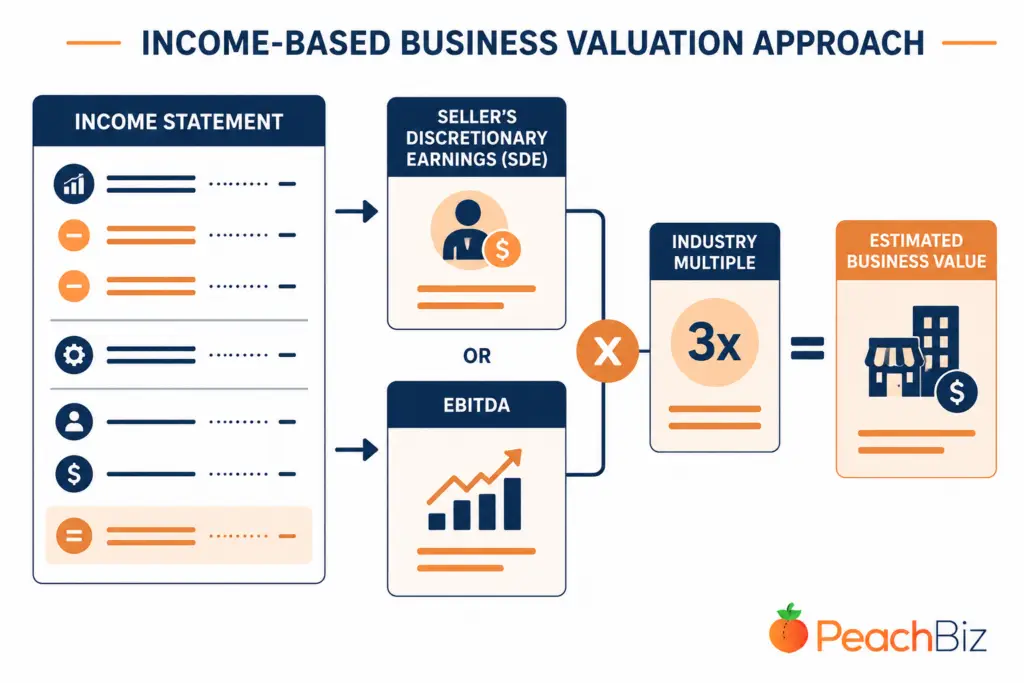
This is the method you’ll encounter most often for small and mid-size businesses, and it’s almost certainly the one most relevant to you.
The idea is simple: buyers are purchasing future earnings. So the value of a business is directly tied to how much money it generates — specifically, how much it puts in the owner’s pocket or produces before certain expenses.
There are two main income metrics used depending on the size of the business:
Seller’s Discretionary Earnings (SDE) — Used primarily for businesses generating under $1M–$2M in EBITDA. SDE takes net profit and adds back the owner’s salary, owner perks, depreciation, amortization, interest, and any one-time or non-recurring expenses. The idea is to show what a single full-time owner-operator would actually earn from the business.
EBITDA — Used for larger businesses, typically those with $1M+ in earnings. EBITDA stands for Earnings Before Interest, Taxes, Depreciation, and Amortization. It strips out financing and accounting decisions to show the true operating profitability of the business. This is the number institutional buyers and private equity groups focus on.
Once you have SDE or EBITDA, you apply an industry multiple — a number that reflects what buyers in that industry are currently willing to pay per dollar of earnings. Multiples vary widely by industry, business size, growth rate, customer concentration, and a dozen other factors.
A simple example:
A retail business with $300,000 in SDE sells at a 2.5x multiple → Business value: $750,000
A manufacturing company with $1.2M in EBITDA sells at a 4x multiple → Business value: $4.8M
The multiple is where most of the negotiation happens. Buyers push multiples down; sellers push them up. Understanding what drives multiples in your industry is one of the most valuable things you can do before going to market.
👉 We built a free Business Valuation Calculator that uses this method to give you a fast, data-driven estimate of your business’s value — no signup required. Try it.
Method 2: The Market-Based Approach (Comparable Sales)
If the income approach is about what your business earns, the market approach is about what similar businesses have actually sold for. Think of it like a real estate comps report — instead of valuing a house based only on its square footage, you look at what comparable houses in the neighborhood actually sold for.
In business sales, this means looking at databases of comparable transactions — businesses in the same industry, similar size, similar geography — and applying those sale ratios to your business.
The most commonly used metric in market-based valuation is the Price-to-Revenue (P/R) ratio or Price-to-EBITDA ratio from comparable transactions.
This method works best when:
- There are enough comparable sales in the database to draw meaningful conclusions
- The business operates in an industry with consistent, benchmarkable transaction data
- The business being valued has relatively straightforward financials
For most small business transactions, the market approach is used to validate the income-based valuation rather than replace it. A broker might say “our income-based valuation gives us $1.1M, and comparable sales in this industry support a range of $900K–$1.3M” — which gives the seller confidence and gives the buyer a benchmark.
The limitation of this approach is data access. The best transaction databases (BizComps, Pratt’s Stats, DealStats) are subscription-based tools used by professional brokers and M&A advisors. If you’re a business owner going it alone, your access to reliable comps is limited.
Method 3: The Asset-Based Approach
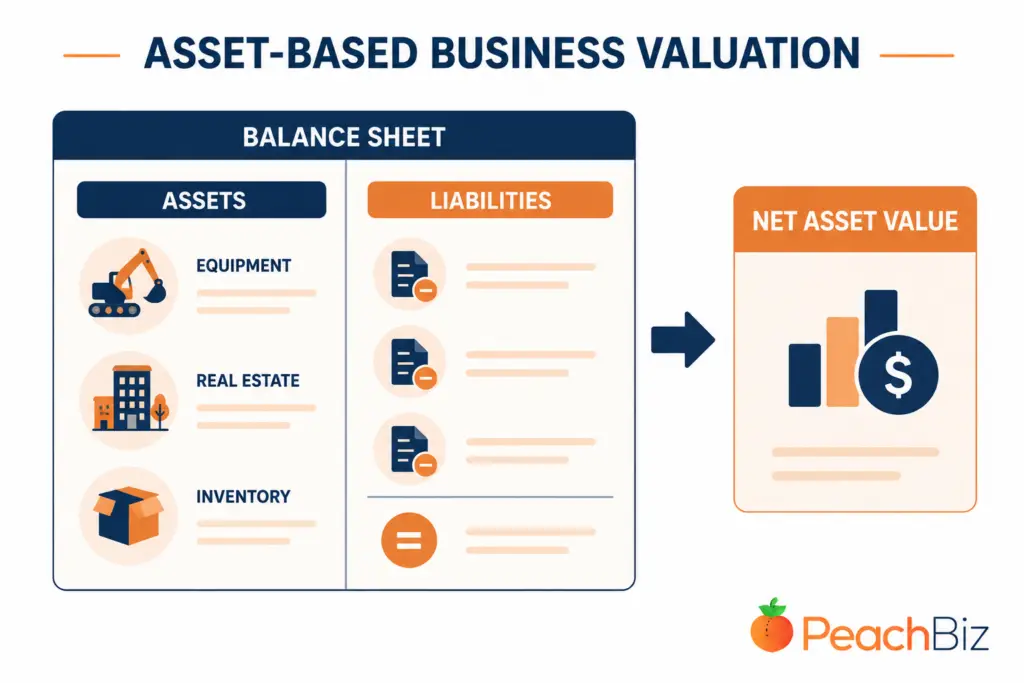
The asset-based approach values a business based on what it owns, minus what it owes. It’s the book-value approach — add up all the assets (equipment, inventory, real estate, receivables, intellectual property), subtract all the liabilities, and you have the net asset value.
This sounds simple, but there’s an important distinction:
Book value uses the accounting value of assets as recorded on the balance sheet — which often doesn’t reflect what those assets are actually worth today.
Adjusted book value (or liquidation value) recalculates each asset at its current fair market value, which gives a more realistic picture.
The asset-based approach is most appropriate for:
- Capital-intensive businesses where the primary value is in physical assets (manufacturing, trucking, real estate holding companies)
- Businesses being liquidated rather than sold as going concerns
- Holding companies where earnings don’t tell the whole story
- Situations where the business earns very little relative to its assets — making income-based methods produce artificially low valuations
For most operating businesses that generate consistent cash flow, the asset-based approach will actually undervalue the business because it doesn’t capture the goodwill — the value of customer relationships, reputation, systems, and brand that don’t show up on a balance sheet.
Here’s a useful mental model: if a pizzeria has $80,000 in equipment and assets but generates $200,000 in SDE per year, valuing it at $80,000 would be a massive undervaluation. The income approach would put it somewhere around $400,000–$600,000 at a 2–3x multiple. The asset value is the floor, not the ceiling.
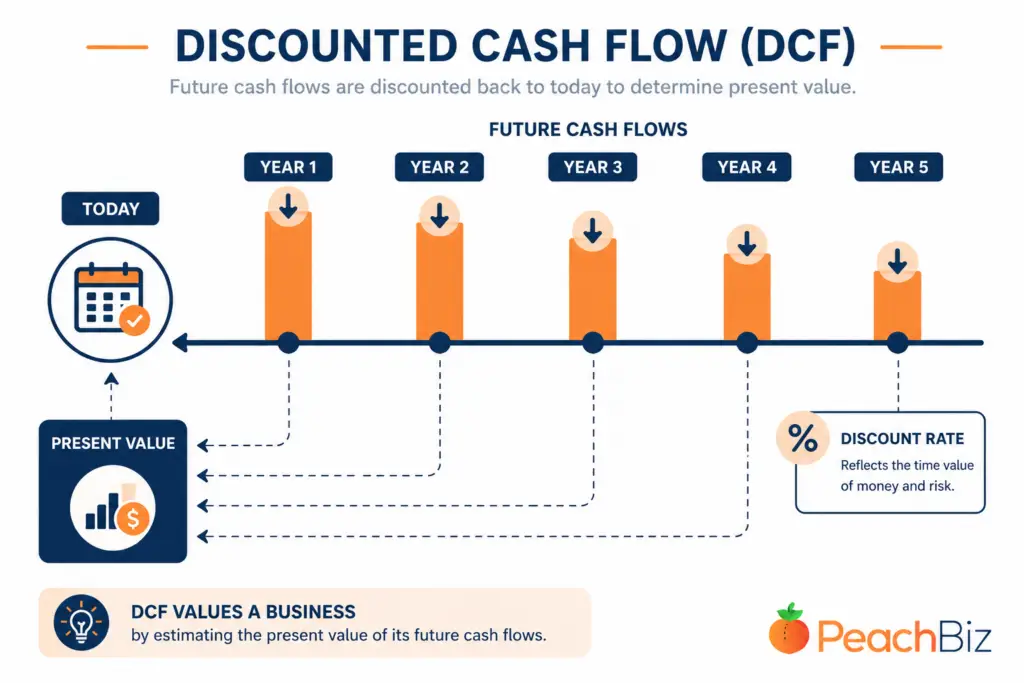
Method 4: The Discounted Cash Flow (DCF) Approach
The discounted cash flow method is the most mathematically complex of the four, and it’s used most often in larger transactions, private equity deals, and situations where the business has a strong, predictable growth trajectory.
The core idea: instead of looking at what the business earns today, DCF projects what the business will earn in the future — typically 5–10 years out — and then discounts those future cash flows back to their present value using a “discount rate” that accounts for the risk and time value of money.
In plain terms: a dollar of profit five years from now is worth less than a dollar of profit today, because of inflation, risk, and opportunity cost. DCF quantifies that difference.
When DCF makes sense:
- The business has 3–5 years of clean, documented financial history
- Future growth is reasonably predictable (recurring revenue, contract-based income, growing markets)
- The buyer or their advisors want to stress-test different growth scenarios
- The deal involves institutional buyers or outside financing that requires detailed financial modeling
Where DCF gets tricky:
DCF is only as good as the projections it’s built on — and projections are only as good as the assumptions behind them. Overly optimistic revenue growth assumptions can make almost any business look attractive on paper. That’s why experienced buyers and their advisors scrutinize DCF models carefully and apply conservative discount rates.
For most small business transactions under $5M, DCF is more of a supplemental tool than the primary valuation method. But if you’re selling a growing online business, a SaaS company, or any business with strong recurring revenue and documented growth, a well-built DCF model can actually work in your favor by capturing future value that a straight EBITDA multiple might miss.
👉 Use our free EBITDA Growth Calculator to project how improvements to your earnings could affect your business’s value before you go to market.
Which Valuation Method Should You Use?
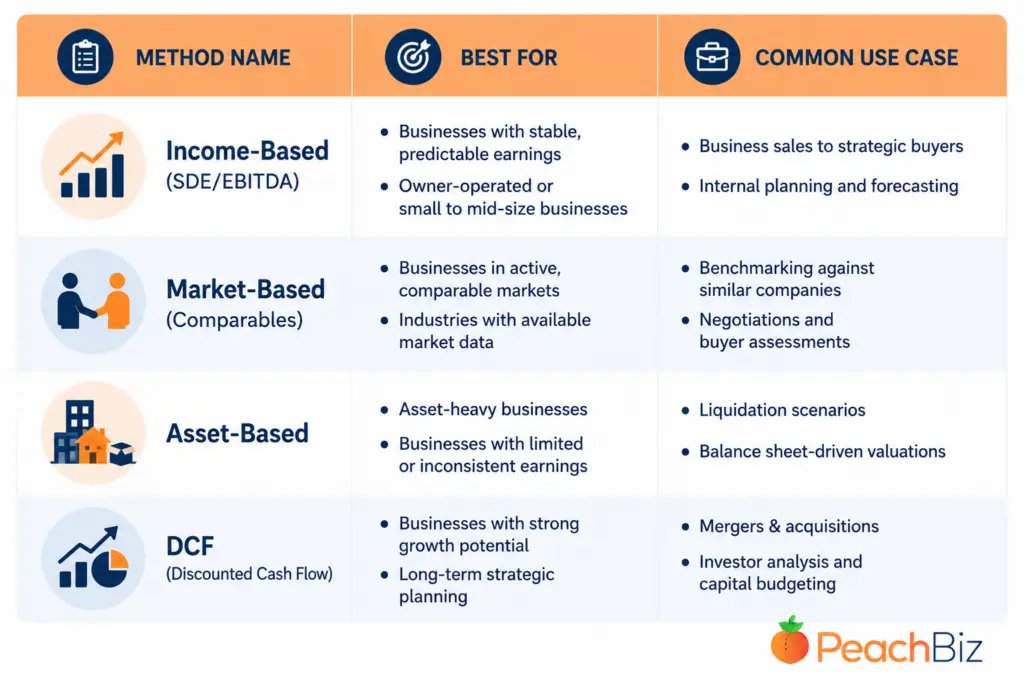
Here’s the honest answer: in most small to mid-size business transactions, the income-based approach (SDE or EBITDA multiple) is the starting point, the market-based approach validates it, and the asset-based approach sets the floor. DCF comes into play for larger or more complex deals.
A quick guide:
| Your Situation | Best Method(s) |
|---|---|
| Small business, under $2M in earnings | SDE multiple |
| Mid-market business, $1M–$10M in EBITDA | EBITDA multiple + market comps |
| Capital-heavy business (equipment, real estate) | Asset-based + income hybrid |
| High-growth business with recurring revenue | DCF + EBITDA multiple |
| Business being liquidated or closed | Asset-based (liquidation value) |
| Verifying a broker’s asking price | Market comps |
If you’re a business owner who isn’t sure where to start, the income approach gives you the fastest, most practical baseline. Know your SDE or EBITDA. Know your industry’s typical multiple range. That gives you a defensible number to take into any conversation.
If you’re a broker or M&A advisor, you’re likely already blending methods — using income as your anchor, comps as your validation, and assets as your floor. The art is in the weighting.
What Affects the Multiple? (The Part Most Owners Miss)
Knowing your EBITDA is step one. Knowing what multiple you deserve is step two — and it’s where most business owners leave money on the table.
Multiples aren’t fixed by industry. They move up and down based on factors specific to your business. Here are the biggest ones buyers look at:
Factors that push your multiple UP:
- Recurring or contracted revenue
- Low customer concentration (no single customer over 15–20% of revenue)
- Owner not required for day-to-day operations
- Clean, audited or reviewed financials
- Strong online presence and brand
- Documented systems and processes
- Year-over-year revenue and margin growth
Factors that push your multiple DOWN:
- Heavy owner dependency (“the business is you”)
- Customer concentration risk
- Declining revenue trends
- Messy or inconsistent financials
- Seasonal or cyclical revenue with no smoothing mechanisms
- Deferred maintenance or capex needs
- Undocumented processes
We dig into each of these in detail in The 7 Value Drivers That Push Your Multiple Above the Midpoint and Owner Dependency: The Single Biggest Value Killer in Small Business Sales.
A Note on DIY Valuations vs. Professional Valuations
We want to be upfront about something: there’s a meaningful difference between a ballpark estimate and a formal business valuation.
A ballpark estimate — using our calculator, applying an industry multiple to your SDE — is a great starting point. It tells you whether you’re in the right zip code and helps you prepare for conversations with brokers and buyers. It’s what you use when you’re thinking about an exit in the next 2–3 years and want to understand your options.
A formal business valuation — performed by a Certified Valuation Analyst (CVA) or Accredited in Business Valuation (ABV) professional — is a detailed, defensible document used in legal proceedings, partnership disputes, estate planning, SBA loan applications, and formal sale processes. It costs $3,000–$10,000+ depending on the complexity of the business.
For most business owners reading this, the ballpark estimate is where to start. Get your number, understand the factors that affect it, and then decide whether a formal valuation makes sense for your situation.
👉 Get a fast ballpark estimate right now with our Business Valuation Calculator — free, no email required.
Frequently Asked Questions
How do I calculate the value of my business?
Start with your Seller’s Discretionary Earnings (SDE) or EBITDA, then apply the appropriate industry multiple. For most small businesses, SDE × 2–3x is a reasonable starting range, though multiples vary significantly by industry, size, and business quality. Use our Business Valuation Calculator for a data-driven starting point.
What is the most common business valuation method?
For small and mid-size businesses, the income-based approach using SDE or EBITDA multiples is by far the most common. It’s what most business brokers and M&A advisors use as their primary method.
What’s the difference between SDE and EBITDA?
SDE is used for smaller businesses and includes the owner’s salary as an add-back, reflecting what a single owner-operator would earn. EBITDA is used for larger businesses and strips out interest, taxes, depreciation, and amortization to show true operating profitability. The right choice depends on your business size and buyer type.
Does the valuation method affect my asking price?
Yes — significantly. Applying the wrong method can dramatically undervalue or overvalue a business. A capital-intensive business valued only on income might look cheap. A service business valued only on assets might look overpriced. Using the right method for your business type is essential to arriving at a defensible, market-appropriate number.
What multiple is my business worth?
It depends on your industry, your earnings level, and the specific characteristics of your business. Most main street businesses sell at 2–3x SDE. Mid-market companies sell at 4–7x EBITDA. High-growth technology and SaaS businesses can command 8–15x or more. Check out EBITDA Multiples by Industry: What Buyers Are Actually Paying Right Now for a deeper breakdown.
The Bottom Line
Business valuation isn’t a single formula — it’s a toolkit. The right method depends on your business type, your size, your buyer, and your purpose. But for most business owners, the path to a credible number starts in the same place: know your earnings, understand your multiple, and get honest about the factors that move it.
The goal isn’t to find the highest number you can justify. It’s to find the number that a qualified buyer will agree with — and then spend the time before your exit making sure the factors that drive your multiple are working in your favor.
That’s exactly what The Orchard is here to help you do.
👉 Ready to see where you stand? Try our free Business Valuation Calculator and get your baseline number in minutes.
Related Reading
- EBITDA Multiples by Industry: What Buyers Are Actually Paying Right Now
- Why Your Asking Price and Your Business Value Are Two Different Numbers
- The 7 Value Drivers That Push Your Multiple Above the Midpoint
- The 10 Factors Buyers Score Before They Make an Offer
- Explore All Free PeachBiz Business Calculators