
Why Clean Books Are Worth More Than a Higher Multiple

Ask most business owners what they want to improve before selling, and they’ll tell you they want a higher multiple.
It makes sense on the surface. If your business earns $400,000 in SDE and you can get a 3.5x multiple instead of a 3.0x, that’s $200,000 more in your pocket. Who wouldn’t want that?
The problem is that multiples are largely outside your control. Your industry, the current buyer market, interest rate environment, private equity activity in your sector — these set the range your business will trade in, and there’s very little you can do to move the ceiling significantly. You can position your business toward the top of the range, but you can’t manufacture a 5x multiple in a market that’s paying 3x.
Clean financial records, on the other hand, are entirely within your control. And their impact on your actual sale proceeds is, in most cases, larger than a meaningful multiple improvement.
This article makes that case with real math — and explains exactly what “clean books” means, what it’s actually worth in dollars at the closing table, and what you need to do to get there.
The Math Most Sellers Never Run
Let’s start with a comparison that makes the point clearly.
Scenario A: The Multiple Chase
A business owner with $400,000 in SDE and messy financials spends six months trying to improve his business’s profile to command a higher multiple. He succeeds modestly — his multiple improves from 3.0x to 3.3x. His gross valuation goes from $1,200,000 to $1,320,000. He’s up $120,000 on paper.
But because his financials are disorganized — add-backs that can’t be clearly documented, tax returns that don’t reconcile cleanly to his P&Ls, bank statements that tell a different story than his income statement — buyers and their advisors spend 60 days in due diligence trying to verify his numbers. His deal almost falls apart twice. The buyer’s final offer comes in with a $75,000 price reduction to account for the financial documentation risk, a $50,000 escrow holdback for 18 months, and a seller note for $100,000 of the purchase price because the SBA lender discounted his earnings by 15%.
His actual day-one proceeds: significantly less than his headline number suggested.
Scenario B: The Clean Books Strategy
A business owner with the same $400,000 in SDE and the same 3.0x market multiple spends six months doing something different: she gets her books genuinely clean. Three years of monthly P&Ls that reconcile precisely to her tax returns. A fully documented SDE recast with every add-back sourced. Bank statements that confirm her revenue. An AR aging report showing 92% of receivables current.
Her multiple doesn’t change — she still gets 3.0x. Her gross valuation is the same $1,200,000. But due diligence closes in 21 days. Her buyer’s SBA lender accepts her financials without adjustment. Her offer comes in clean — no price reduction, no escrow holdback, standard seller note at her negotiated terms.
Her actual day-one proceeds: nearly her full gross valuation, net only of transaction costs.
Same earnings. Same multiple. Dramatically different outcomes.
What “Clean Books” Actually Means
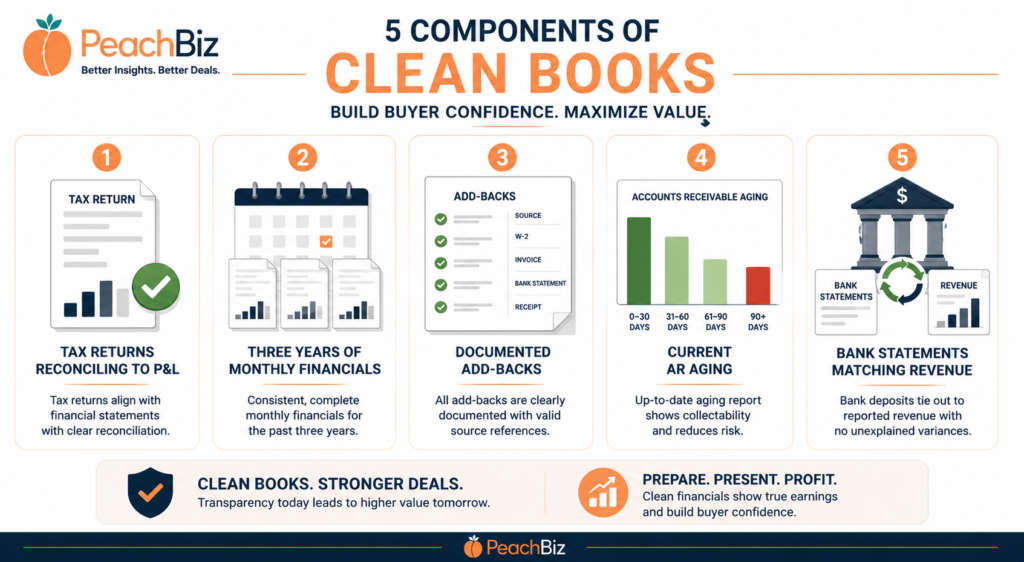
“Clean books” is one of those phrases that gets used often and defined rarely. Let’s be specific about what it means in the context of a business sale — because the definition matters for knowing what to actually work on.
Clean books means five specific things:
1. Tax returns that reconcile to your P&L statements. For every year in your three-year presentation window, a buyer or their advisor should be able to start from your tax return net income and arrive at your P&L net income through a clear, documented reconciliation. Differences exist — cash vs. accrual accounting, timing differences, book vs. tax depreciation — but those differences should be explainable and traceable, not mysterious.
2. Monthly P&L statements for the past 36 months. Not annual summaries. Monthly statements that allow a buyer to see seasonal patterns, identify specific months where something changed, and build confidence that the annual numbers are built from accurate underlying data. Monthly financials are the difference between a buyer who trusts your numbers and one who spends three months trying to verify them.
3. A fully sourced SDE or EBITDA recast. Every add-back on your normalized earnings statement has a corresponding document: a W-2, a payroll record, a tax return line, an invoice, a mileage log. The recast is built from your tax return, not your P&L, and moves logically from reported income to normalized earnings in a format a buyer’s advisor can follow and confirm independently.
4. Bank statements that confirm your revenue. Monthly business bank statements showing deposits that correspond to your P&L revenue. Significant discrepancies — even explainable ones — need to be proactively reconciled and documented before a buyer discovers them and draws their own conclusions.
5. Accounts receivable aging that’s current and accurate. An AR aging report showing the age distribution of outstanding receivables, with no significant unrecognized collection issues. A current AR book — mostly under 30 days — signals a well-managed business. An aging AR book with large 90+ day balances signals collection problems that will affect your working capital adjustment at closing.
That’s it. Clean books isn’t about having perfect financial performance. It’s about having financial records that can be verified, reconciled, and trusted.
The Five Ways Clean Books Increase Your Actual Proceeds
The math isn’t just theoretical. Here are the five specific mechanisms through which clean financial documentation directly increases what you walk away with at closing.
📸 IMAGE PLACEHOLDER — Five Value Mechanisms Visual
Place: Below this H2 heading, before Mechanism 1.
ChatGPT Image Prompt: “A clean flat-design infographic showing five numbered mechanisms flowing downward like a value chain: (1) Higher Buyer Confidence → More Offers, (2) Shorter Due Diligence → Lower Deal Costs, (3) SBA Lender Acceptance → Larger Buyer Pool, (4) No Documentation Discount → Full Valuation, (5) Fewer Holdbacks → More Day-One Cash. Each with a small relevant icon. Arrows connecting each step. Peach-orange accent color for numbers, navy text, white background. Professional, clear, logical design.”
Mechanism 1: More Offers From More Buyers
Qualified buyers — especially those working with experienced advisors — pre-screen businesses based on the quality of the financial presentation before they invest time in a deeper evaluation. A business with a clean, organized financial package signals that the seller is professional, the business is well-managed, and the due diligence process will be efficient.
Businesses with unclear or incomplete financial presentations generate fewer initial inquiries from sophisticated buyers — the ones most likely to close. They tend to attract buyers who don’t know enough to be concerned by the missing documentation, which is not the buyer pool you want.
More qualified buyers means more competitive pressure on the offer. More competitive pressure means better terms, better price, and more seller leverage in negotiations.
Mechanism 2: Shorter Due Diligence Means Lower Transaction Costs
Due diligence has a direct cost — your attorney’s time, your accountant’s time, your broker’s time, your own time away from running the business. The longer due diligence runs, the more those costs accumulate.
More importantly, extended due diligence creates deal risk. Every additional week in due diligence is another week for the buyer to develop cold feet, for a competing opportunity to appear, for interest rates to change, or for something in your business to shift that gives the buyer a reason to renegotiate or walk.
Businesses with clean financial documentation routinely complete due diligence in 30–45 days. Businesses with messy or incomplete records routinely run 90–120 days — with significantly higher rates of deal failure or renegotiation before closing.
The cost difference between a 30-day and a 90-day due diligence — in professional fees alone — can easily run $15,000–$40,000 on a $1M–$2M transaction. On top of that, the extended timeline increases the probability that something changes and the deal falls apart entirely.
Mechanism 3: SBA Lender Acceptance Expands Your Buyer Pool
The majority of small business acquisitions under $5M are financed at least partially through SBA loans. SBA lenders have specific documentation requirements — three years of business tax returns, three years of business financial statements, a completed SBA form 4506-C tax transcript authorization — and they will independently verify your financials against IRS records.
A business whose financial presentation doesn’t reconcile cleanly to the tax returns is a problem for SBA financing. The lender may discount the reported earnings, reduce the loan amount, or decline to finance the transaction entirely. Any of those outcomes either reduces the buyer pool to cash buyers only (a significantly smaller pool) or forces a deal structure change that reduces the seller’s proceeds.
Clean books that reconcile precisely to tax returns remove the SBA underwriting risk. They expand your buyer pool to include the largest segment of qualified buyers — SBA-financed individuals and searchers — and they remove a significant source of deal restructuring risk late in the process.
Mechanism 4: No Documentation Discount
When a buyer or their advisor can’t fully verify your financial presentation — when add-backs can’t be documented, when bank statements don’t match P&L revenue, when tax returns don’t reconcile to financials — they do one of two things: they walk, or they discount.
The documentation discount is the price reduction buyers build into their offer to account for the risk that the unverified earnings aren’t real. It’s essentially a margin of safety for uncertainty. If a buyer can’t verify $400,000 in SDE with confidence, they might underwrite to $340,000 — which at a 3x multiple is a $180,000 reduction in your offer.
That $180,000 discount is the price of unclean books. Clean books eliminate it.
Mechanism 5: Fewer Holdbacks and Cleaner Deal Structure
Escrow holdbacks — where a portion of the purchase price is held for 12–24 months to cover potential indemnification claims — are more common and larger in deals where the buyer has uncertainty about the financial presentation.
A buyer who has thoroughly verified your financials and found them accurate has less reason to demand a large holdback. A buyer who found three unexplained discrepancies during due diligence and had to take the seller’s word for it will push for a larger holdback as insurance.
The difference between a 5% holdback and a 15% holdback on a $1.5M transaction is $150,000 in day-one cash — money you don’t see for 12–24 months, and that you may never see in full if any claim is filed.
Clean books reduce holdback risk by reducing uncertainty. The buyer’s advisor has less to argue for a large holdback when the financials are verified, reconciled, and accurate.
The Timeline for Getting Your Books Clean
Here’s the part that surprises most sellers: getting your books genuinely clean is not a 30-day project. Depending on where you’re starting from, it’s a 12–24 month process.
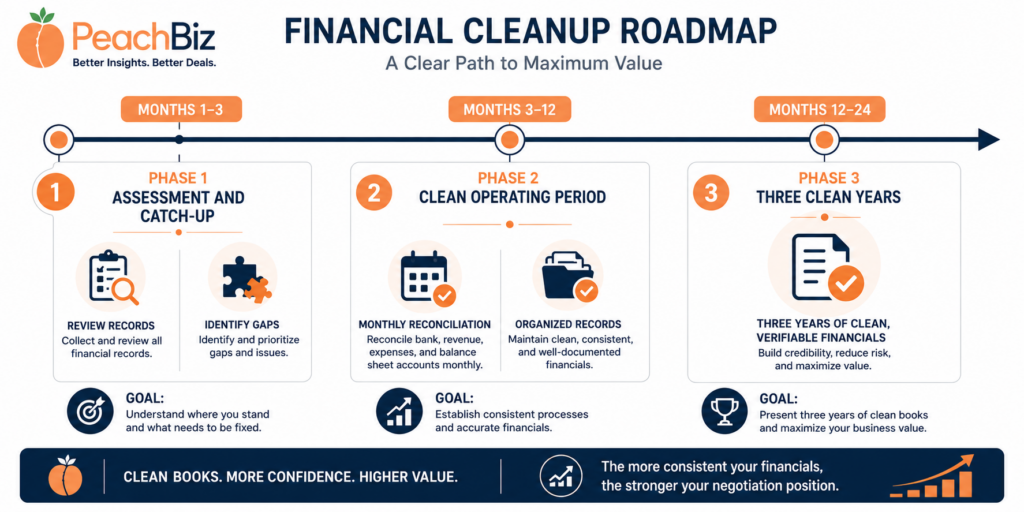
Here’s why the timeline matters:
You need three years of clean records — not one clean year preceded by two messy ones. A buyer’s financial review covers the past three years. If Year 3 is clean but Years 1 and 2 are disorganized and inconsistent, you’ve addressed only one third of the problem.
You can’t retroactively fix what’s already filed. Your tax returns for prior years are fixed documents — you can amend them in some cases, but you can’t rewrite the history of how your business ran. The cleanup work for prior years is documentation and reconciliation — building the supporting records that explain and verify what was already reported. For the current year and forward, you’re implementing the practices that produce clean records going forward.
The cleanup process itself takes time to stabilize. Implementing monthly reconciliations, organizing expense documentation, building the SDE recast — these processes need to run for a few months before they produce the consistent, reliable outputs that a buyer’s advisor will trust.
The practical minimum: If you’re planning to sell in the next 12–18 months, start the cleanup process today. Engage a bookkeeper or CPA with business transaction experience, implement monthly reconciliations, and begin organizing the documentation file for your add-back schedule. Even 12 months of demonstrably clean records — combined with a well-documented reconciliation of the prior two years — is significantly better than zero.
The ideal scenario: If you’re 24–36 months from your target sale date, use the full runway. Implement clean bookkeeping practices now, run them consistently for two to three years, and go to market with a financial package that’s impeccable from the ground up.
What to Do If Your Books Are Currently a Mess
Let’s be direct: if you know your books are disorganized, that’s not a reason to panic and it’s not a reason to lower your expectations for a sale. It’s a reason to start today.
Here’s a practical sequence for getting from messy to clean:
Step 1: Get an honest assessment of where you are. Sit down with a CPA who has business transaction experience — not just your regular tax preparer — and have them review your last three years of records. Ask them specifically: what would a buyer’s advisor find, and what would they question? That gap analysis is your starting point.
Step 2: Prioritize the reconciliation work. The highest-priority cleanup is the reconciliation between your tax returns and your P&Ls, and the reconciliation between your P&Ls and your bank statements. These are the first things buyers check. Getting these reconciled and documented — even for prior years — removes the biggest source of buyer uncertainty.
Step 3: Implement clean processes going forward. Monthly bank reconciliations. Consistent expense categorization. Organized digital filing of all invoices and supporting documents. These aren’t complicated — they just need to be done consistently. A part-time bookkeeper ($500–$1,500/month) can implement and maintain these processes if you don’t have the time or inclination to do it yourself.
Step 4: Build your documentation file for add-backs. Start gathering the source documents for every item on your anticipated SDE recast: W-2s, payroll records, vehicle mileage logs, insurance invoices, retirement contribution records. Build this file now while the documents are accessible — not in a scramble six weeks before you list the business.
Step 5: Engage your CPA in the process. Your CPA should know you’re preparing for a sale. That context changes how they approach your work — they’ll flag issues that have sale implications, help you structure the SDE recast correctly, and position themselves to confirm the financial package to buyers and their advisors. A CPA who is surprised by your sale process during due diligence is a liability. One who’s been part of the preparation is an asset.
👉 Once your books are clean and your SDE is normalized, use our free Business Valuation Calculator to see how your documented earnings translate into a market valuation — and what specific improvements would do to that number.
👉 Use our Margin Health Check to benchmark your margin profile against industry standards — the same comparison buyers and their lenders will run when they review your financials.
The Counterintuitive Truth About Multiples
We want to close with the point that makes this article’s argument complete.
Chasing a higher multiple and building clean books are not mutually exclusive. You should do both. But if you have limited time and limited bandwidth for pre-sale preparation, here’s the honest prioritization:
Clean books first. Multiple optimization second.
Here’s why: a higher multiple on a poorly documented earnings number is worth less than a market multiple on a fully verified earnings number. The multiple is the multiplier. The earnings base is what gets multiplied. An accurate, defensible earnings number at market multiple will almost always outperform an inflated, unverifiable earnings number at a premium multiple — because the premium multiple evaporates in due diligence when the buyer can’t verify the earnings.
The sellers who get the best outcomes aren’t always the ones with the highest multiples. They’re the ones whose financial presentations survive due diligence intact — where the number the buyer offered is the number that closes, because the documentation said exactly what it needed to say.
That’s what clean books do. And that’s why they’re worth more than a higher multiple.
Frequently Asked Questions
How much does messy financial documentation actually cost in a business sale?
The cost shows up in multiple places: a documentation discount on the offer price (often 10–20% of gross valuation), extended due diligence (adding $15,000–$40,000+ in professional fees on a mid-market transaction), a reduced SBA loan amount if the lender discounts unverified earnings, and larger escrow holdbacks that delay receipt of a portion of proceeds. Combined, these costs can easily represent $100,000–$300,000 on a $1M–$2M transaction — far exceeding what it would have cost to maintain clean records in the first place.
Can a bookkeeper get my records clean enough for a business sale?
A skilled bookkeeper can implement and maintain the monthly processes — reconciliations, expense categorization, organized filing — that produce clean records going forward. For the historical cleanup and SDE recast work, a CPA with business transaction experience adds a layer of credibility and technical accuracy that a bookkeeper alone may not provide. The ideal team is a bookkeeper handling ongoing monthly accuracy and a transaction-experienced CPA handling the presentation and normalization for sale purposes.
What if I’ve been running personal expenses through the business — does that hurt me?
Running legitimate personal expenses through the business is common and, when done with proper documentation, doesn’t hurt you in a sale — those expenses are added back in your SDE recast. What hurts you is running personal expenses through the business without documentation and then trying to add them back without being able to prove they were personal rather than business costs. The solution is documentation, not elimination.
Will buyers accept QuickBooks or basic accounting software records?
Yes — the format of your financial records matters far less than their accuracy and completeness. QuickBooks, Xero, Wave, FreshBooks — any accounting software that produces monthly P&Ls, balance sheets, and reconciles to bank statements is fine. What buyers and lenders need is accurate data, not a specific software platform.
How far back do buyers look at financial records?
The standard presentation window is three years. However, buyers may request records going back further if something in the three-year window raises questions — for example, if a major customer was lost two years ago that’s still affecting current revenue, they may want to see what the business looked like before that loss. Having organized records going back four to five years, even if you don’t present them proactively, is a reasonable precaution.
The Bottom Line
The highest-leverage thing most business owners can do before a sale has nothing to do with their multiple, their revenue growth strategy, or their customer acquisition. It’s making sure their financial records are clean, organized, verifiable, and reconciled.
Clean books don’t just make due diligence easier. They make your earnings credible. They expand your buyer pool. They protect your offer price from documentation discounts. They reduce holdbacks. They shorten your time to close. And they make the entire experience — for you, your buyer, and your advisors — significantly less painful.
The multiple is what the market gives you. Clean books are what you give yourself. And in most transactions, what you give yourself matters more.
👉 Start with a clear picture of your current value — use our free Business Valuation Calculator to see what your documented earnings are worth at current market multiples.
Related Reading
- The EBITDA Add-Backs Buyers Accept vs. The Ones That Blow Up Deals
- How to Build a Seller’s Discretionary Earnings (SDE) Statement That Holds Up Under Due Diligence
- 3 Years of Financials: What Buyers Read, What They Ignore, and What Scares Them
- Why Your Asking Price and Your Business Value Are Two Different Numbers
- What Is a Business Worth? The 4 Valuation Methods Explained
- Red Flags That Kill Deals Before the LOI: A Pre-Sale Checklist
- Explore All Free PeachBiz Business Calculators