
How to Run an Exit Readiness Assessment on Your Client’s Business

Most business owners who say they want to sell aren’t actually ready to sell.
That’s not a criticism — it’s just reality. The average business owner spends 10, 20, sometimes 30 years building their company and maybe six months thinking seriously about how to exit it. They arrive at your office with a number in mind, a vague timeline, and a lot of assumptions about how the process works — most of which are wrong.
Your job as their advisor — whether you’re a business broker, an exit planner, a CPA, or an M&A advisor — isn’t just to take their listing or file their taxes. It’s to tell them the truth about where they stand, what their business is actually worth in the current market, and what it would take to close the gap between where they are and where they want to be.
The tool for doing that honestly and systematically is an exit readiness assessment.
Done well, an exit readiness assessment accomplishes four things at once: it sets realistic expectations, it identifies the highest-value improvement opportunities, it builds trust by demonstrating genuine expertise, and it creates a roadmap that keeps you central to the client’s exit process for months or years to come.
This article walks you through exactly how to run one — from the first client conversation through the final deliverable.
What an Exit Readiness Assessment Is (and Isn’t)
Before we get into the process, let’s be clear about what we’re building.
An exit readiness assessment is a structured evaluation of a business’s current position across the key factors that determine its marketability, valuation, and likelihood of a successful sale. It’s a diagnostic — like a pre-sale inspection on a house — that tells the owner what they have, what needs work, and what it’s likely to sell for in its current condition versus its potential condition after improvements.
It is not a formal business valuation. A certified valuation (CVA or ABV) is a legal document prepared for specific purposes — estate planning, litigation, partner buyouts, SBA lending. An exit readiness assessment is a strategic planning tool. The distinction matters because it affects how you present it, how you price it, and what you’re responsible for professionally.
It is also not a sales pitch for your listing services disguised as an assessment. The moment a client senses that the “assessment” is really a funnel toward a listing agreement, you’ve lost the trust that makes the whole process valuable. The assessment has to be genuinely useful — honest about weaknesses, not just enthusiastic about the business — to do its job.
When to Run an Exit Readiness Assessment
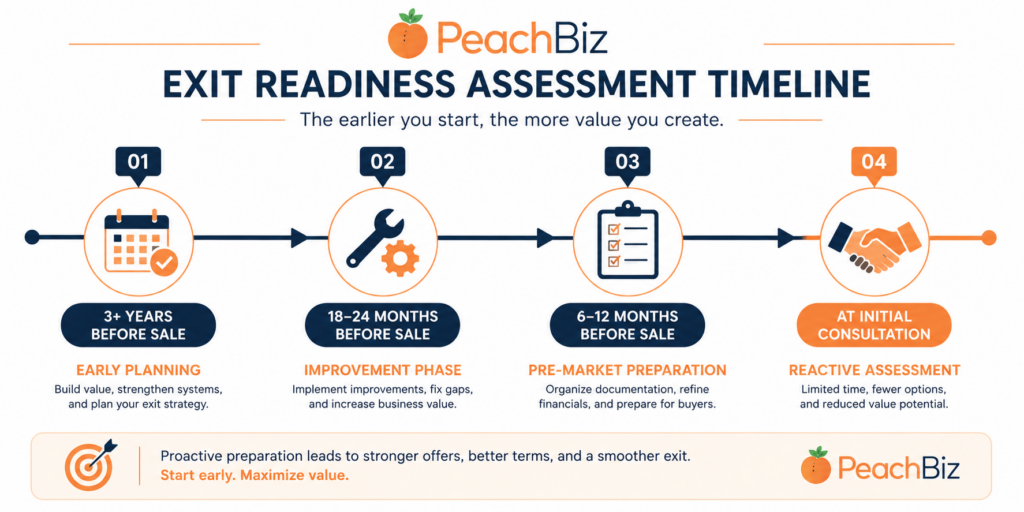
The ideal time to run an exit readiness assessment is 18 to 36 months before the target sale date. This window gives the business owner enough time to actually act on what the assessment reveals — to address weaknesses, build systems, reduce owner dependence, clean up financials — before those issues affect their valuation and marketability.
That said, a useful assessment can be run at any stage:
3+ years out: Strategic planning assessment. Focus is on the full value-building roadmap. The client has time to make structural changes — building recurring revenue, developing management depth, diversifying customer base. This is where the highest-ROI advisory work happens.
18–24 months out: Course correction assessment. The client has a reasonably firm timeline. Focus is on identifying and executing the improvements that will most move the needle in the available time, and beginning the financial documentation cleanup process.
6–12 months out: Pre-market preparation assessment. The timeline is fixed. Focus shifts to presenting the business in its best current light — proper financial normalization, documentation organization, story development — rather than trying to fix structural issues that take years to change.
At initial consultation: Reactive assessment. The owner walked in the door ready to list. This is still worth doing — it sets expectations, identifies disclosure items, and may reveal issues that need to be addressed before going to market to avoid deal blow-ups in due diligence.
Each of these has a different emphasis, but the underlying framework is the same.
The Five-Phase Exit Readiness Assessment Framework
Here’s the process we recommend, built around five sequential phases that move from information gathering through client deliverable.
Phase 1: The Discovery Conversation
Before you look at a single document, sit down with the owner and have an honest conversation. The goal of this conversation is threefold: understand their goals and timeline, surface the emotional context that will shape the whole engagement, and begin identifying the key areas to investigate in the assessment.
Key questions to ask:
On goals and timeline:
- What does a successful exit look like for you — is it maximum price, fastest close, right buyer, or some combination?
- What’s your target timeline for being out of the business?
- Do you have a specific number in mind, and where did that number come from?
- What does life after the sale look like for you?
On the business:
- Who runs things when you’re not there?
- What percentage of your revenue comes from your top three customers?
- How have revenue and profitability trended over the last three years?
- Have you had any legal issues, regulatory problems, or disputes in the last five years?
- Are there any leases, contracts, or agreements that might be complicated to transfer?
On the owner’s role:
- If you were hit by a bus tomorrow, what would happen to the business?
- Which customers would leave if you left?
- Is there anyone on your team who could run this business without you?
These questions aren’t just information-gathering — they’re also diagnostic. The owner’s answers will tell you immediately which factors on the readiness scorecard are likely to be problems, and they’ll surface the emotional context (retirement timeline, financial needs, family dynamics) that shapes everything that follows.
Phase 2: Financial Document Review
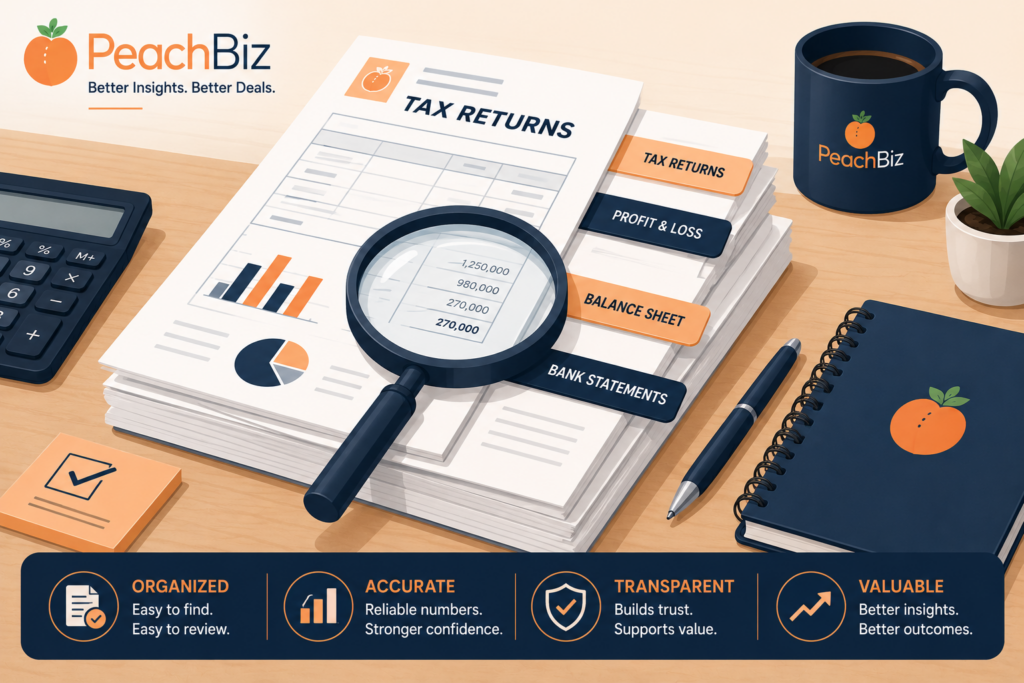
Request and review the following documents before conducting your scoring assessment:
Financial documents:
- Three years of business tax returns (federal)
- Three years of profit and loss statements (monthly preferred, annual minimum)
- Most recent balance sheet
- Three years of bank statements (business accounts)
- Current accounts receivable aging report
- Current accounts payable aging report
- Any existing business valuation or appraisal
Operational documents:
- Current customer list with revenue by customer (last 12 months)
- Any customer contracts or service agreements
- Lease agreements (real property and equipment)
- Key vendor and supplier contracts
- Employee roster with tenure, compensation, and role
- Any existing operations manual or process documentation
Legal documents:
- Business entity documents (articles of incorporation, operating agreement, bylaws)
- Any pending or historical litigation
- Intellectual property registrations (trademarks, patents, copyrights)
- Existing NDAs or non-compete agreements with employees or former owners
You won’t always get all of these immediately — some owners have better records than others, and part of the assessment process is identifying where documentation gaps exist. But request everything upfront and note what’s missing. Missing documentation is itself a finding.
Phase 3: Scoring the Business Across Eight Dimensions
With the discovery conversation complete and documents in hand, you’re ready to score the business. We recommend an eight-dimension framework that covers the full range of factors buyers evaluate.
Score each dimension on a simple 1–5 scale:
- 5 — Exceptional: Top quartile of businesses in this category. Likely to attract premium buyer interest.
- 4 — Strong: Above average. Minor issues, nothing that will significantly affect marketability or price.
- 3 — Average: Meets baseline buyer expectations. Won’t command a premium but won’t create a discount.
- 2 — Below Average: Notable weakness. Will be flagged by buyers, affect multiple, or complicate deal structure.
- 1 — Significant Issue: Deal-level risk. Must be addressed or disclosed; may require structural solutions in the deal.
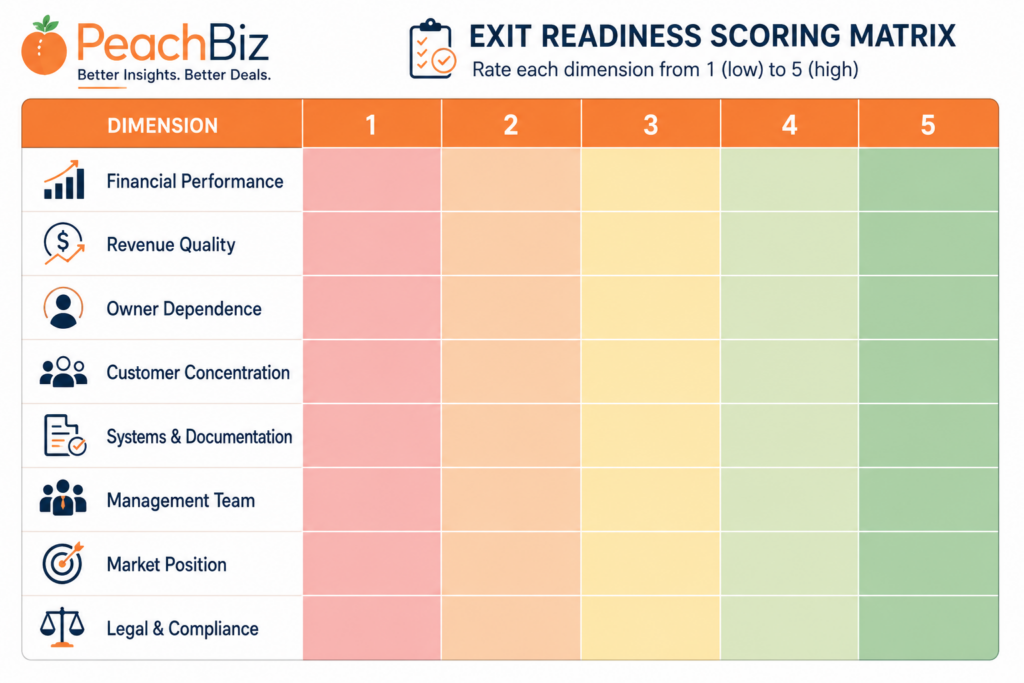
Dimension 1: Financial Performance Review three-year revenue trend, EBITDA or SDE trend, and margin consistency. Score higher for consistent growth and stable margins. Score lower for volatility, declining trends, or margins that vary significantly without explanation.
Key metrics to calculate:
- Year-over-year revenue growth rate (3-year average)
- EBITDA or SDE margin (3-year average and trend)
- Variance in annual earnings (coefficient of variation)
Dimension 2: Revenue Quality and Recurring Revenue What percentage of revenue recurs automatically? What is the revenue concentration profile? Score higher for high recurring percentages and diversified customer base. Score lower for purely transactional revenue or significant concentration in any single customer or segment.
Key metrics to calculate:
- Recurring revenue as a percentage of total revenue
- Top customer as a percentage of total revenue
- Top 5 customers as a percentage of total revenue
Dimension 3: Owner Dependence How operationally and commercially dependent is the business on the current owner? Score higher for businesses with capable management, documented processes, and customers who buy from the brand rather than the person. Score lower for businesses where the owner is the primary salesperson, key relationship holder, and daily operational decision-maker.
Dimension 4: Management Team and Human Capital Does the business have capable people below the owner level? Are key employees likely to stay through and after a transition? Score higher for businesses with a strong management team, competitive compensation, and documented retention incentives. Score lower for businesses where all knowledge and capability lives with the owner or a single key employee without succession depth.
Dimension 5: Systems and Documentation Are the business’s core processes written down and followed? Could a new owner step in and operate the business using existing documentation? Score higher for businesses with comprehensive SOPs, training materials, and operational documentation. Score lower for businesses where processes exist only in people’s heads.
Dimension 6: Market Position and Competitive Differentiation Does the business have something that makes it difficult to replace? Score higher for businesses with strong brand, proprietary processes, exclusive agreements, licensing barriers, or dominant niche positions. Score lower for commodity providers competing primarily on price with no structural differentiation.
Dimension 7: Growth Potential Are there credible, executable paths to grow revenue and earnings after the sale? Score higher for businesses in growing markets with identified but unpursued growth opportunities. Score lower for businesses in declining markets or at natural capacity ceilings without significant investment.
Dimension 8: Legal and Compliance Is the business’s legal, regulatory, and compliance history clean? Score higher for businesses with no pending litigation, current licenses and permits, clean tax compliance, and assignable leases and contracts. Score lower for businesses with unresolved legal issues, compliance gaps, or contracts that complicate a transfer.
Phase 4: Valuation Range Estimate
With scoring complete, build a preliminary valuation range for the client. This is not a formal certified valuation — it’s a market-informed estimate based on normalized earnings and current transaction data.
The process:
Step 1: Normalize the financials. Recast three years of P&Ls to calculate true SDE or EBITDA after appropriate add-backs. Document every add-back clearly — this is what you’ll need to defend to a buyer’s advisor later.
Step 2: Identify the appropriate multiple range for this business’s industry and size using current transaction data. (See EBITDA Multiples by Industry: What Buyers Are Actually Paying Right Now for current benchmarks.)
Step 3: Apply the assessment score to position the business within the range. A business scoring 4.0+ across dimensions lands at the top of its industry range. A business averaging 2.5 lands at the low end or below it.
Step 4: Build a current value range and a potential value range — what the business is worth today versus what it could be worth after 12–18 months of targeted improvements. The gap between these two numbers is the dollar value of your advisory work. Make it visible.
👉 Use our free Business Valuation Calculator as your starting point for normalization and multiple application — it’s built on real transaction data and walks through the add-back process step by step.
Phase 5: The Client Deliverable — The Exit Readiness Report
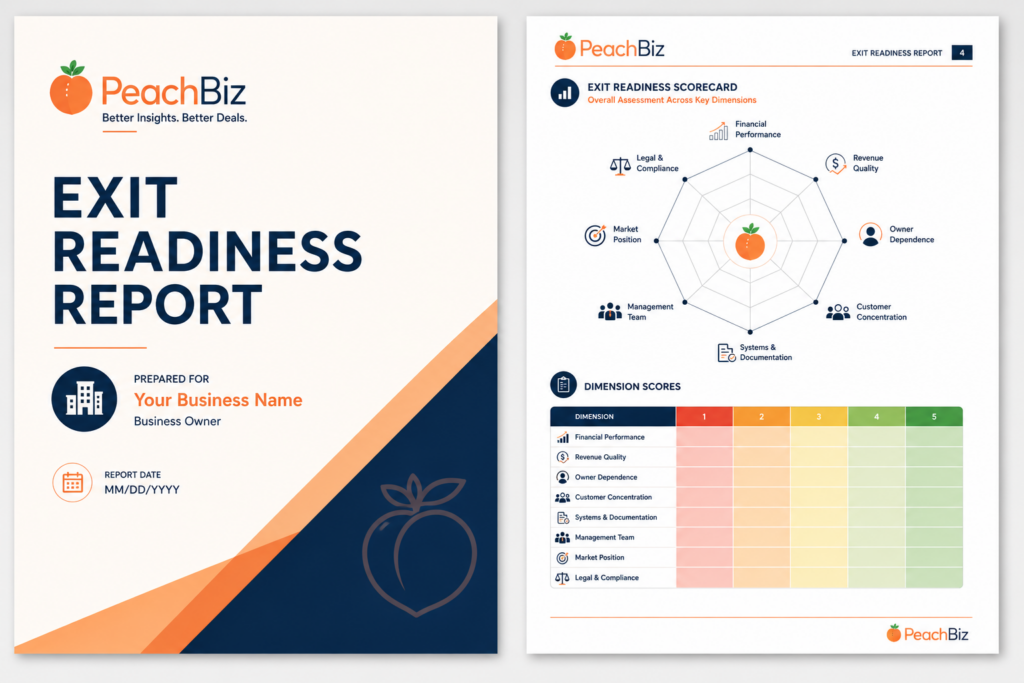
The assessment is only as valuable as what you do with it. The deliverable — the Exit Readiness Report you present to the client — is where all of your analysis becomes actionable.
A well-structured Exit Readiness Report includes:
Executive Summary One page. Current valuation range, overall readiness score, top three strengths, top three improvement priorities. This is what the client will remember and reference.
Scoring Summary The eight-dimension scorecard with scores and brief explanations for each. Visual format works best — a simple color-coded table or spider chart makes the pattern immediately clear.
Detailed Findings For each dimension, a brief narrative explaining the score: what you found, what it means for marketability and value, and what a buyer will think when they see it.
Valuation Analysis Current normalized earnings, multiple range, current value range, and potential value range after improvements. Show the math. Show what each major improvement is worth in dollars.
Improvement Roadmap Prioritized list of recommended actions, organized by impact and time required. Focus on the two or three highest-ROI improvements — don’t overwhelm the client with a 20-item list. Each recommendation should include: what to do, why it matters, approximately how long it takes, and estimated impact on value.
Timeline and Next Steps Clear recommended timeline mapped to the client’s target exit date. What needs to happen in the next 90 days, 6 months, 12 months, and 18 months to get them market-ready at their target value.
Presenting the Assessment to the Client
How you present the findings matters as much as what you found. A few principles that make the difference between a client who takes action and one who gets defensive:
Lead with strengths. Start the conversation with what the business does well. Even a business with significant weaknesses has genuine strengths — acknowledge them first. This establishes that your assessment is balanced, not just a list of problems.
Present weaknesses as opportunities, not verdicts. “Your customer concentration is a challenge we can address” lands very differently than “your customer concentration is a problem.” The facts are the same. The client’s emotional response — and their likelihood of taking action — is very different.
Show the dollar value of improvement. Abstract recommendations don’t move people. “Reducing owner dependence could increase your multiple by 0.5–1.0 turns, which at your current SDE level is worth $150,000–$300,000” moves people. Make the math visible and personal.
Be honest about what can’t be fixed in the available timeline. If the client has six months before their planned sale date and their financials are a mess, tell them what that means for their price and their options. Honesty now prevents disappointment — and blame — at the closing table.
End with clear next steps. The client should leave the meeting knowing exactly what they need to do in the next 30 days and who is responsible for each action — them, you, their CPA, or their attorney.
How Often Should You Reassess?
An exit readiness assessment isn’t a one-time event — it’s the beginning of an ongoing advisory relationship. We recommend a formal reassessment every six months for clients who are actively working toward a sale, and annually for clients in an earlier planning phase.
Each reassessment should track progress on improvement priorities, update the valuation range based on current financial performance and market conditions, and adjust the roadmap based on what’s changed.
This cadence keeps you central to the client’s exit process, provides clear evidence of the value your advisory work is delivering, and ensures you’re the natural choice when the client is ready to actually go to market.
Frequently Asked Questions
How long does an exit readiness assessment take?
For a straightforward small business, plan for 8–15 hours of total work: 1–2 hours for the discovery conversation, 3–5 hours for document review and financial normalization, 2–3 hours for scoring and analysis, and 2–4 hours for report preparation and presentation. Complex businesses or those with incomplete records will take longer.
Should I charge for an exit readiness assessment?
Yes — in most cases. Charging for the assessment, even a modest fee, accomplishes two things: it compensates you for a genuine professional service, and it creates a commitment from the client that signals they’re serious about the process. Advisors who give away free assessments often find clients who aren’t ready or willing to take the findings seriously. A fee of $500–$2,500 depending on business complexity and your market is reasonable.
What if the assessment reveals the business isn’t sellable?
This happens. Sometimes a business has structural issues — no transferable value, severe legal problems, financials that can’t be reconstructed — that make a traditional sale impractical in any near-term timeframe. Your job is to tell the client this honestly and help them understand their options: a longer improvement timeline, a different type of transaction (management buyout, family transfer, liquidation), or a different definition of “exit.” Delivering hard news clearly and professionally is one of the highest-value things an advisor can do.
How is this different from what a business broker does during a listing process?
A listing process assessment is focused on how to present the business to the market right now. An exit readiness assessment is focused on maximizing the value of the business before it goes to market. The earlier you’re engaged, the more value you can create for the client — and the more of that value is attributable to your advisory work rather than market conditions.
Can business owners run their own exit readiness assessment?
A business owner can absolutely use the framework in this article to self-assess — and we encourage it as a starting point. The 10 Factors Buyers Score Before They Make an Offer is a great companion resource for owners doing a preliminary self-evaluation. That said, a self-assessment has inherent blind spots — owners are too close to their business to score certain dimensions objectively, particularly owner dependence and market position. A professional assessment adds the outside perspective that makes the findings actionable.
The Bottom Line
An exit readiness assessment is one of the highest-value services you can offer a business owner client — and one of the most effective ways to build a long-term advisory relationship that positions you at the center of their exit.
Done well, it’s not a commodity service. It’s a personalized, data-driven roadmap that helps a business owner close the gap between what their business is worth today and what it could be worth on the day they sell.
That gap — measured in time, effort, and dollars — is where the real advisory value lives. And it all starts with an honest conversation and a structured framework for knowing where you stand.
👉 Use our free Business Valuation Calculator as your starting point for client financial normalization and preliminary valuation estimates.
👉 Run our EBITDA Growth Calculator to model how specific financial improvements translate into valuation impact — a powerful tool for making your improvement roadmap tangible to clients.
Related Reading
- The 10 Factors Buyers Score Before They Make an Offer
- What Is a Business Worth? The 4 Valuation Methods Explained
- EBITDA Multiples by Industry: What Buyers Are Actually Paying Right Now
- Red Flags That Kill Deals Before the LOI: A Pre-Sale Checklist
- Why Your Asking Price and Your Business Value Are Two Different Numbers
- What “Deal-Ready” Actually Looks Like — And How Long It Takes to Get There
- Explore All Free PeachBiz Business Calculators