
Why Your Asking Price and Your Business Value Are Two Different Numbers

Here’s a conversation that happens thousands of times a year in business brokers’ offices across the country.
A business owner walks in, sits down, and says: “I’ve been running this business for 22 years. I’ve put everything into it. I know what it’s worth.”
The broker nods, pulls up the financials, runs the numbers — and comes back with a valuation that’s 40% lower than what the owner had in mind.
The owner is stunned. Offended, even. How can a business they’ve dedicated two decades of their life to be worth that?
The answer lies in a fundamental disconnect that derails more business sales than any other single factor: your asking price and your business’s market value are two completely different things — and they’re calculated using two completely different frameworks.
Understanding the difference isn’t just academic. It’s the difference between a successful exit and a business that sits on the market for 18 months before you pull it back, frustrated and no closer to retirement.
What Your Asking Price Is Based On
Your asking price — the number in your head when you think “this is what I want for my business” — is almost always built on a combination of the following:
What you need. You’ve done the math on retirement. You know what the house is worth, what the 401(k) looks like, and what number from the business sale would let you walk away comfortably. That target retirement number backward-engineered into a sale price isn’t a valuation — it’s a financial goal.
What you’ve invested. You remember every dollar that went in. The equipment you bought in 2019. The buildout in 2021. The marketing budget that finally started working last year. Owners naturally anchor their price to their total investment — but buyers don’t buy what you put in. They buy what comes out.
What you’ve been told. A friend sold their plumbing company for $2.1M. Your neighbor got 4x for his accounting practice. You’ve heard numbers that feel comparable to yours. But without knowing the specifics of those deals — the financials, the terms, the buyer type, the market conditions — those numbers are anecdotes, not comps.
What the business means to you. This one is the most human and the most understandable — and the hardest to work around. You built something. You sacrificed for it. You know the team, the customers, the story. Emotional value is real. It’s just not something a buyer can finance or put on a balance sheet.
None of these inputs are wrong. They’re just not how buyers calculate value.
What Your Business Value Is Actually Based On
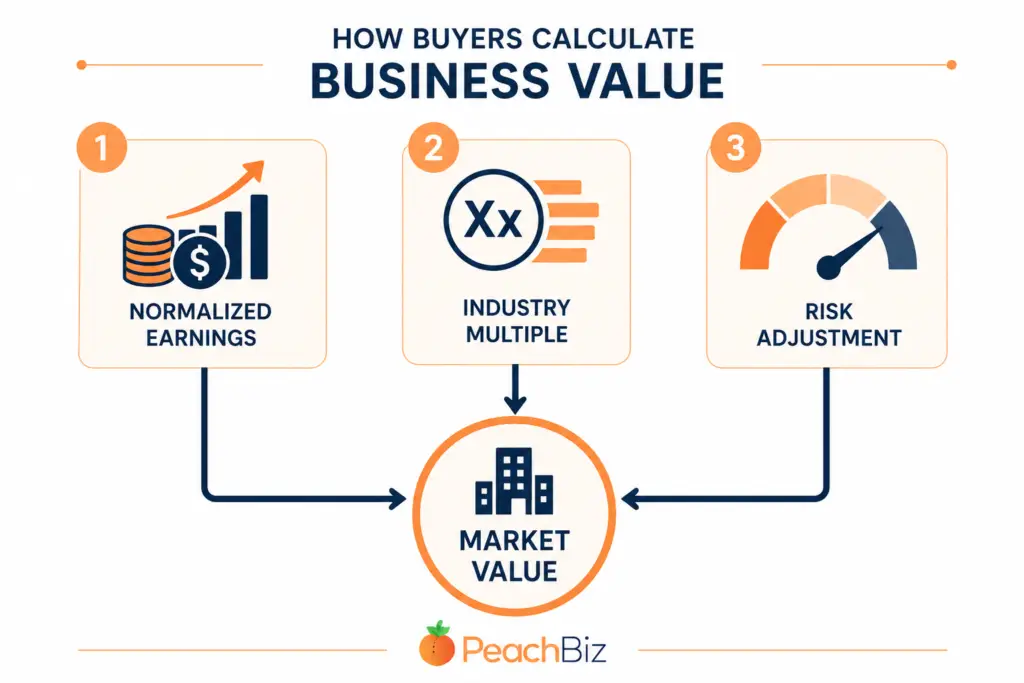
Buyers — whether they’re individual owner-operators, private equity firms, or strategic acquirers — calculate business value using a standardized methodology that has nothing to do with what you’ve invested or what you need for retirement.
Here’s the framework they use:
1. Normalized Earnings The first thing a buyer does is reconstruct your financials. They take your reported net income and add back the owner’s salary, personal expenses run through the business, one-time costs, and non-recurring items. What they’re left with is a clean picture of what the business actually earns — not what the tax return shows, not what you told your accountant to minimize, but the real economic output of the business.
This number — SDE or EBITDA depending on business size — is the foundation of the valuation. Everything else is built on top of it.
2. Industry Multiple Once they have normalized earnings, buyers apply a multiple that reflects what comparable businesses in your industry have recently sold for. That multiple already factors in the inherent risks and opportunities of your sector. It’s a market-derived number — not an opinion, not a negotiating position.
3. Risk Adjustment Here’s where it gets personal. Within the industry multiple range, buyers adjust up or down based on your specific business’s risk profile. Owner dependency, customer concentration, revenue trends, financial documentation quality, and the strength of your systems and team all affect where inside the range your business lands.
The resulting number is your market value — what a qualified buyer, using standard methodology, would pay for your business under current market conditions.
The Four Most Common Sources of the Gap
When an owner’s asking price and the buyer’s calculated value don’t match, it almost always comes from one of these four places:
1. The “Sweat Equity” Miscalculation
Owners frequently add the value of their labor to the value of the business. If you’ve been paying yourself $80,000 a year when the market rate for your role is $120,000, you might feel like the business “owes” you $40,000 a year in deferred compensation. Over 10 years, that feels like $400,000 of additional value.
Buyers see it differently. They see a business where the owner has been underpaid — which means the reported cash flow is artificially high. A proper normalization actually adds back your below-market salary to show what a real replacement would cost, which can shrink the apparent earnings.
2. Valuing Assets That Don’t Transfer
Owners sometimes price in assets that don’t actually convey to a buyer the way they expect. Your reputation in the community is real — but a buyer can’t carry it across town. Your relationships with your top three customers may be deeply personal — but if they leave when you do, they’re not assets at all.
Goodwill is a legitimate component of business value, but only to the extent it’s transferable. The goodwill that lives in your rolodex and your handshakes isn’t worth the same as goodwill built into a brand, a process, a customer loyalty program, or a documented referral system.
3. Applying the Wrong Multiple
This is extremely common with owners who’ve done some research. They find an industry multiple — say, “professional services sell at 4x EBITDA” — and apply it to their gross revenue, or to their pre-add-back earnings, or to an earnings figure that hasn’t been properly normalized.
The math gets applied in the wrong order to the wrong inputs, and the result is a number that looks real but has no relationship to what a buyer would actually offer.
👉 This is exactly why we built the free Business Valuation Calculator — it walks you through normalization and multiple application in the right order so you get a number that actually reflects market reality.
4. Ignoring Deal Structure
Asking price and actual proceeds are not the same thing either. A $2M asking price paid in full at closing is worth significantly more than a $2.4M deal with $800K in an earnout tied to post-sale performance benchmarks you may or may not hit.
Sellers often anchor on headline price without modeling what they’ll actually walk away with after deal structure, taxes, working capital adjustments, and transaction costs. We cover this in depth in How Deal Structure Affects the Real Price You Walk Away With.
Why This Gap Is So Dangerous
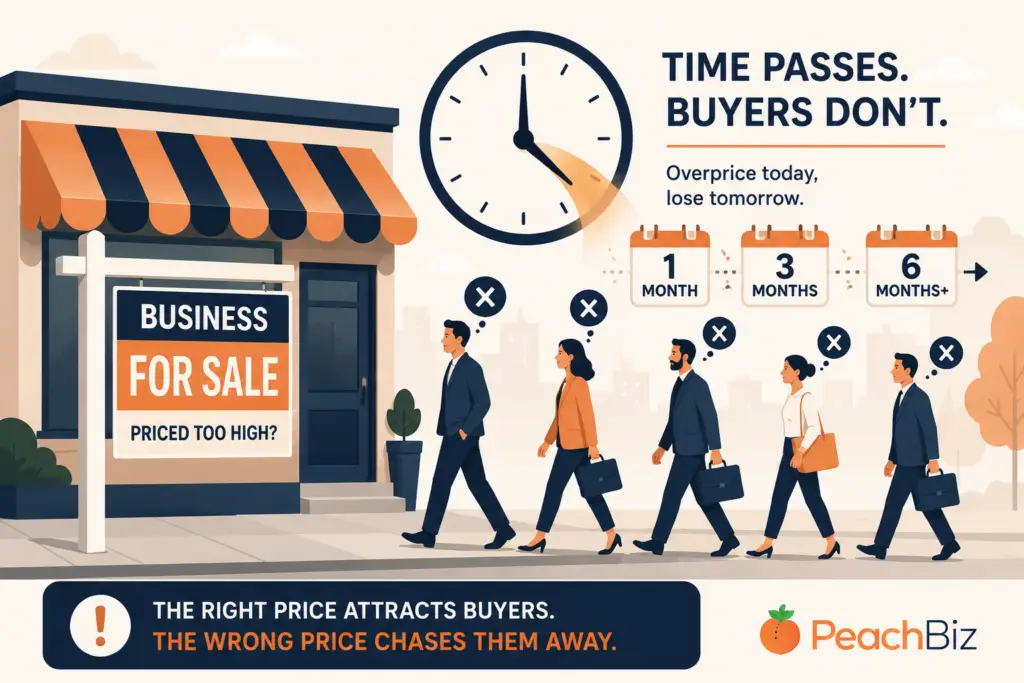
Overpricing a business doesn’t just mean it sells for less than you hoped. It triggers a cascade of consequences that are painful and expensive:
- Your best buyers walk away early. Qualified buyers who run the numbers immediately know when a price doesn’t pencil. They don’t negotiate — they just move on to the next listing. The buyers who stick around are often the ones who don’t know the market well enough to recognize an overpriced deal.
- Days on market become a red flag. A business that’s been listed for 9 months signals to buyers that something is wrong — even if the only thing wrong was the original price. By the time you reduce the price to where it should have been, the market has noticed the extended listing and buyer interest is lower than if you’d priced it right from day one.
- You tip off employees, customers, and competitors. The longer a business is on the market, the higher the probability that the wrong people find out. Key employees start updating their resumes. Long-term customers get nervous. Competitors use the uncertainty to their advantage.
- Your negotiating leverage erodes over time. A fresh listing with strong financials and a realistic price commands multiple offers and seller leverage. A stale listing with one interested party after 12 months puts the buyer in the driver’s seat.
The most successful exits — the ones where sellers walk away satisfied and buyers feel they got fair value — almost always start with a realistic, market-grounded asking price.
How to Close the Gap Before You Go to Market
The goal isn’t to lower your expectations. The goal is to either bring your asking price in line with market reality, or spend the time before your sale actually increasing your market value to meet your price expectations. Those are two very different strategies — and both are valid.
If your timeline is short (under 12 months): Get a professional opinion of value before you set your asking price. Work with a business broker or M&A advisor who has recent transaction experience in your industry. Use our Business Valuation Calculator to get a baseline before that conversation so you’re not walking in blind. Price to the market, not to your retirement plan.
If your timeline is longer (1–3 years): This is the better position to be in, and it’s where exit planning earns its value. If your current market value is $1.2M and your target is $2M, you have time to identify the levers that move value — recurring revenue, owner independence, customer diversification, margin improvement — and pull them. We walk through exactly how to do that in The 10 Factors Buyers Score Before They Make an Offer and How to Run an Exit Readiness Assessment on Your Client’s Business.
For CPAs and advisors: The gap conversation is one of the most valuable things you can have with a client who is approaching an exit. Most business owners have never had anyone run the actual math with them. Being the person who does — calmly, transparently, and with good data — builds extraordinary trust and positions you as the advisor who helps them actually succeed in the exit, not just file the taxes afterward.
A Note on Emotional Value
We want to be careful here, because this is real and it matters.
The emotional value of what you’ve built is not nothing. Twenty-two years of your life, your identity, your sacrifices, your team — these things are real and they deserve acknowledgment. The goal of this article isn’t to dismiss any of that.
But here’s the thing: a buyer can’t finance your emotional value. Their SBA lender won’t count it. Their equity partner won’t model it. And their own risk calculus won’t accommodate it.
The most successful sellers we see are the ones who find a way to hold both things at once: deep personal pride in what they built, and clear-eyed realism about what the market will pay for it. They’ve done the grieving of the gap privately, and they come to market ready to negotiate on facts.
That combination — emotional intelligence and financial clarity — is what makes an exit work.
Frequently Asked Questions
Why is my business worth less than I thought?
Usually it comes down to one of four things: your earnings haven’t been properly normalized, you’re applying a multiple to the wrong number, your business has risk factors (owner dependence, customer concentration, revenue trends) that compress the multiple, or you’re comparing to deals that aren’t truly comparable. Running a proper normalization using real transaction data almost always gives you a clearer — and more defensible — number.
Can I negotiate the price upward from the valuation?
Yes, but only with evidence. If you believe your business deserves a higher multiple, you need to be able to demonstrate why — documented recurring revenue, a strong management team, clean financials, a growing market. Negotiating upward from emotion doesn’t work with sophisticated buyers. Negotiating upward from evidence does.
Does my asking price affect how long it takes to sell?
Significantly. Overpriced businesses take longer to sell, attract lower-quality buyers, and often end up closing at a lower price than if they’d been priced correctly from the start. The research consistently shows that well-priced businesses sell faster, generate more competitive offers, and close at higher percentages of asking price.
Should I list high and negotiate down?
This is a common instinct — and in residential real estate, it sometimes works. In business sales, it generally doesn’t. Business buyers are almost always more financially sophisticated than residential buyers, and they run the numbers immediately. A price that doesn’t pencil gets ignored, not negotiated. You’re far better served by a well-supported asking price with clean documentation than by an inflated price with a willingness to come down.
How do I know if my asking price is realistic?
Start by calculating your normalized earnings — your SDE or EBITDA after proper add-backs. Then apply the industry multiple range from current transaction data. See where your business falls inside that range based on your quality factors. If your asking price is within that range, it’s defensible. If it’s significantly above it, you need to either close the gap with documented evidence or reset your expectations before going to market.
The Bottom Line
Your asking price is what you want. Your business value is what a qualified buyer will pay, using standardized methodology, under current market conditions. The gap between those two numbers is real, it’s common, and it’s one of the most important things to understand before you ever speak to a buyer.
The good news: the gap is closeable. Sometimes through better financial presentation. Sometimes through operational improvements. Sometimes through simply understanding the market and pricing realistically.
All of it starts with knowing the real number — not the number you hope for, but the number you can defend.
👉 Get your real baseline number with our free Business Valuation Calculator — built on real transaction data, no email required.
Related Reading
- What Is a Business Worth? The 4 Valuation Methods Explained
- EBITDA Multiples by Industry: What Buyers Are Actually Paying Right Now
- The 10 Factors Buyers Score Before They Make an Offer
- The 7 Value Drivers That Push Your Multiple Above the Midpoint
- How Deal Structure Affects the Real Price You Walk Away With
- Explore All Free PeachBiz Business Calculators