
How Deal Structure Affects the Real Price You Walk Away With

The number on the LOI is not what you walk away with.
This is one of the most important — and most consistently misunderstood — realities of selling a business. Sellers spend months focused on achieving a target enterprise value: $2M, $5M, $10M. They negotiate hard to reach that number. They celebrate when the LOI comes in at their target.
Then the deal closes and the actual proceeds land differently than expected. Sometimes significantly differently.
The gap between enterprise value and actual proceeds isn’t hidden or unfair — it’s deal structure. And deal structure is where buyers exercise the most sophisticated leverage in any transaction, because most sellers don’t fully understand what they’re agreeing to until they’re sitting at the closing table.
Understanding deal structure before you enter negotiations isn’t just useful — it’s the difference between an exit that meets your financial goals and one that falls short of them in ways you didn’t anticipate. This article covers the full landscape: what deal structure means, the four primary components, how each one affects your actual proceeds, and what to watch for when a buyer proposes terms that sound reasonable on the surface but aren’t.
What Deal Structure Actually Means
Deal structure refers to how the purchase price is paid — the form, the timing, the conditions, and the risk allocation between buyer and seller embedded in the transaction terms.
Enterprise value (the agreed purchase price) is the what. Deal structure is the how — and the how has enormous consequences for the seller.
Two deals at the same enterprise value can produce dramatically different outcomes for the seller depending on:
- How much is paid at closing vs. over time
- What conditions are attached to future payments
- Who bears the risk if the business underperforms after the sale
- How taxes are treated across the different payment components
- What the seller’s ongoing obligations are post-closing
The buyer’s goal in deal structure negotiations is to pay as little as possible at closing and shift as much risk as possible onto the seller through deferred payments tied to future performance. The seller’s goal is the opposite: maximize day-one cash, minimize contingent payments, and limit post-closing exposure.
Understanding that dynamic — and the specific tools buyers use to achieve their goal — is the foundation of negotiating deal structure effectively.
The Four Components of Deal Structure
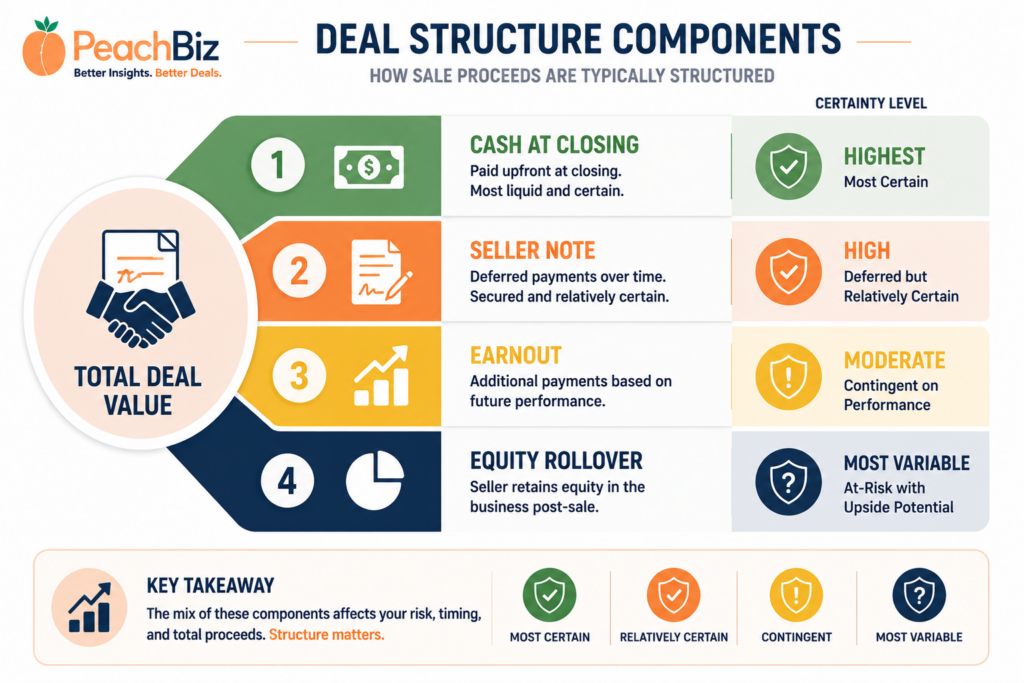
Most business sale transactions are built from some combination of four payment components. Understanding each one — and what it means for your actual proceeds — is essential before you evaluate any offer.
Component 1: Cash at Closing
Cash at closing is the only truly certain component of any deal structure. It’s the amount that transfers from the buyer’s account to yours on closing day — before any debt payoffs, working capital adjustments, transaction costs, or tax obligations, but after the enterprise value has been adjusted for those items.
For sellers, cash at closing is the number that matters most. It’s liquid, it’s immediate, and it’s not contingent on anything happening after the sale. Every other component of deal structure involves some combination of time delay, conditions, or uncertainty.
The seller’s goal: Maximize cash at closing as a percentage of total enterprise value. An all-cash deal — where 100% of the enterprise value is paid at closing — is the strongest possible outcome for a seller from a certainty standpoint.
The reality: All-cash deals are less common than sellers expect, particularly in small and mid-market transactions. Most buyers use some form of financing (SBA loans, conventional acquisition financing, equity partners), and financing structures often require or encourage some portion of the deal to be deferred. Even in all-cash transactions, working capital adjustments, escrow holdbacks, and debt payoffs reduce the day-one cash the seller actually receives.
What to watch for: Buyers who present a strong enterprise value but propose a low cash-at-closing percentage are shifting risk onto the seller. A $2M enterprise value with $800,000 cash at closing is a very different transaction than $2M with $1,600,000 at closing — even though the headline number is identical.
Component 2: Seller Notes (Seller Financing)
A seller note — also called seller financing — is a loan from the seller to the buyer that makes up a portion of the purchase price. Instead of receiving that portion at closing, the seller receives it in monthly payments over the note term, with interest.
Seller notes are extremely common in small business acquisitions. For SBA-financed deals, SBA lenders often require a seller note equal to 10% of the purchase price as a “standby note” — a condition that demonstrates seller confidence in the business’s continued performance.
Why buyers want seller notes:
- Reduces the amount of financing they need from a lender
- Demonstrates seller confidence in the business (a seller who is willing to finance part of the purchase price believes the business will continue to perform)
- Creates a more flexible deal structure, particularly for businesses that don’t qualify for full SBA financing
Why sellers should understand them carefully:
A seller note is not a guaranteed payment — it’s a loan to your buyer secured by the business you just sold. If the buyer can’t make the payments — because the business underperforms, because they’re a poor operator, or because external conditions change — your recourse is to take back a business you wanted to exit from. That’s the risk embedded in every seller note.
The terms that matter:
- Principal amount: What percentage of the enterprise value is financed through the seller note?
- Interest rate: Typically 5–8%. Lower rates reduce the total return on your deferred proceeds.
- Term: How long until the note is fully repaid? Typical range is 3–7 years.
- Subordination: In SBA-financed deals, the seller note is almost always subordinated to the SBA loan — meaning if the business defaults, the SBA lender gets paid before you do.
- Security: What collateral secures the seller note? In most transactions, it’s the business assets — which you’d take back if the buyer defaults.
The math on seller note returns:
A $200,000 seller note at 6% interest over 5 years generates approximately $231,000 in total payments — $200,000 in principal plus $31,000 in interest. Compared to receiving $200,000 at closing, the seller note represents a 5-year delay for $31,000 in additional proceeds — with the risk that the buyer defaults during that period.
Whether a seller note is acceptable depends on your financial situation, your confidence in the buyer, and your alternatives. For sellers who don’t need the full proceeds immediately, a well-secured seller note at a fair interest rate is manageable. For sellers who need the full proceeds to fund retirement, pay off personal debt, or make another investment, a large seller note creates real financial risk.
Component 3: Earnouts
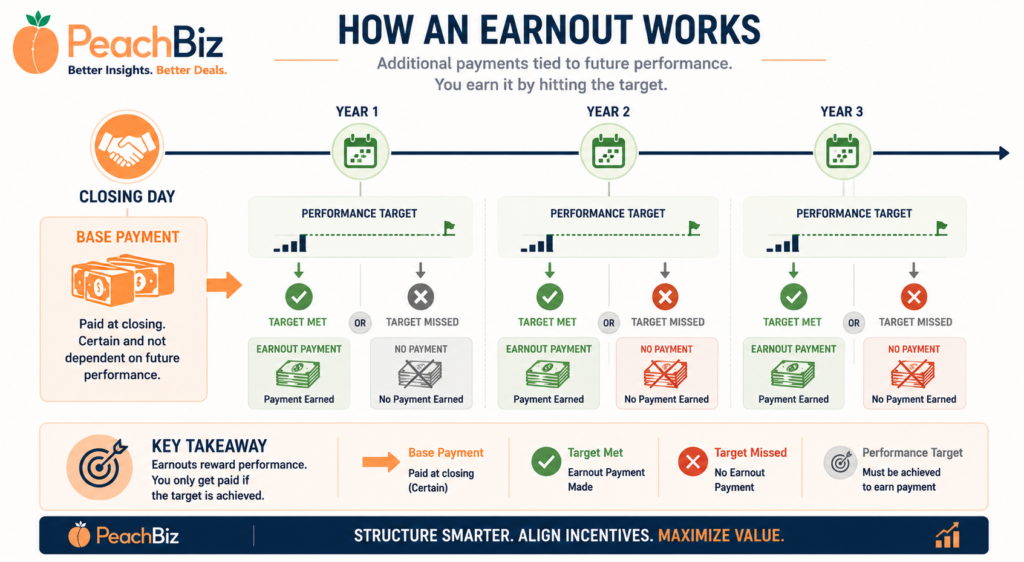
An earnout is a contingent payment — a portion of the purchase price that is paid to the seller only if the business meets specific performance targets after the sale. Earnouts are the most complex and often the most contentious component of deal structure in small and mid-market transactions.
Why buyers propose earnouts:
Earnouts are a tool for bridging valuation gaps — situations where the buyer and seller disagree on the business’s value. Buyers use earnouts when they’re uncertain whether the seller’s projected earnings will actually materialize under new ownership. The earnout says: “We’ll pay you the full price you’re asking — but only if the business actually performs at the level you’re claiming.”
Common triggers for earnout proposals:
- The business has been growing rapidly and the buyer questions whether that growth will continue
- There’s significant owner dependency that creates revenue transition risk
- The business recently landed a large new customer or contract that hasn’t yet been proven sustainable
- The seller is asking for a multiple above what the buyer believes the business’s historical performance justifies
The earnout’s fundamental problem for sellers:
Once you close the deal and hand over the keys, you no longer control the business. The buyer does. And the buyer now has an interest in hitting performance targets — but they also have many other decisions to make that affect those targets: hiring decisions, pricing decisions, customer relationship decisions, investment decisions.
If the business misses the earnout target — for any reason, including reasons entirely within the buyer’s control — you don’t get paid. And your recourse is legal action against a buyer who may have perfectly defensible explanations for every decision they made.
This is why experienced advisors consistently tell sellers: the best earnout is the one you negotiate out of the deal entirely. The second-best earnout is a short one (12 months), tied to a metric you can measure and verify independently (revenue, not profit), with strong protections against buyer actions that could artificially depress performance.
Earnout terms to negotiate carefully:
- Metric: Revenue earnouts are far preferable to EBITDA earnouts. Revenue is hard to manipulate; EBITDA can be affected by buyer decisions to increase expenses, accelerate investment, or change accounting methods.
- Duration: Shorter is better. A 12-month earnout is manageable. A 36-month earnout is a multi-year exposure to risk you no longer control.
- Measurement period: How is performance calculated — trailing 12 months from closing, calendar year, fiscal year? Small differences in measurement period can have large consequences.
- Anti-sandbagging provisions: Protection against the buyer deliberately underperforming the business to avoid hitting the earnout target.
- Acceleration triggers: If the buyer sells the business during the earnout period, the full earnout should become due immediately.
- Dispute resolution: A clear, efficient mechanism for resolving disagreements about earnout calculations before they become expensive litigation.
We cover earnouts in depth in Earnouts: When They Make Sense and When They’re a Red Flag.
Component 4: Equity Rollover
An equity rollover — sometimes called a rollover equity or management equity — is a structure where the seller accepts a portion of the purchase price not as cash but as an ownership stake in the acquiring entity. Instead of selling 100% of the business and walking away, the seller rolls a percentage of their equity into the new ownership structure.
Equity rollovers are most common in private equity transactions. PE firms often ask sellers to roll 10–30% of their equity into the new deal as a demonstration of confidence and to maintain seller engagement through a planned growth period before an eventual second exit.
Why PE buyers propose equity rollovers:
- Aligns the seller’s financial interest with post-acquisition performance
- Keeps experienced leadership motivated through the growth phase
- Reduces the PE firm’s required equity investment at closing
- Creates a potential “second bite of the apple” for the seller at the eventual PE exit
The upside case:
If the PE firm executes its growth plan successfully — through organic growth, add-on acquisitions, or multiple expansion — the seller’s rolled equity can be worth significantly more at the second exit than the cash equivalent would have been at the first. Some sellers who rolled 20% of their equity into a PE deal have received more from that 20% at the second exit than they received from the 80% at the first.
The downside case:
Your rolled equity is now in the hands of a PE firm that makes all the decisions about how the business operates, grows, and is eventually sold. If the PE firm’s growth thesis doesn’t work out — or if they sell the business at a lower multiple than expected, or if market conditions deteriorate — your rolled equity is worth less than the cash you turned down. It may be worth nothing.
Equity rollovers require very careful legal structuring — specifically around voting rights, anti-dilution provisions, exit rights, and what happens if the PE firm wants to sell before you do. Never agree to an equity rollover without experienced M&A legal counsel reviewing the terms.
Reading an Offer: What the Real Numbers Look Like
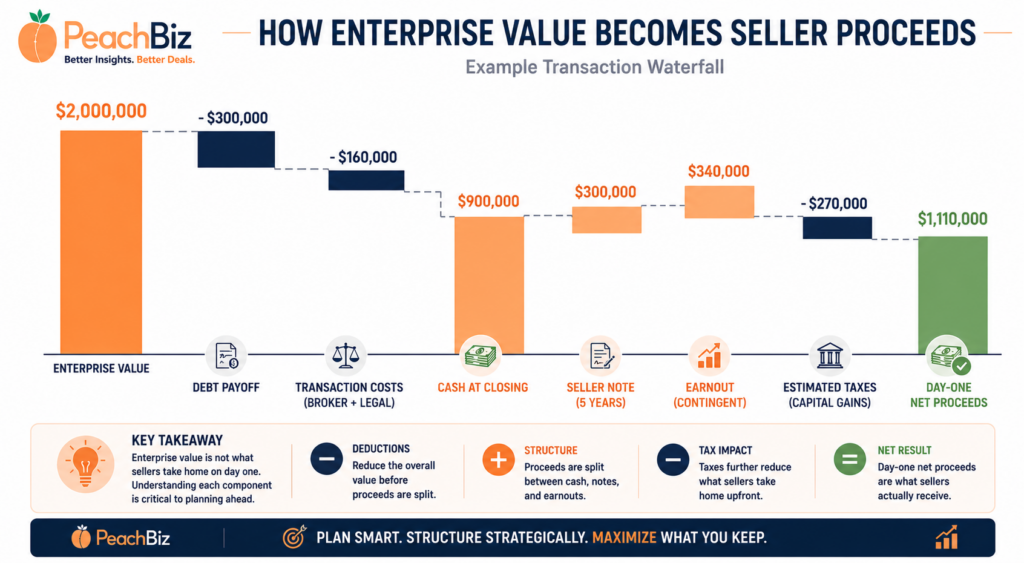
Let’s walk through a realistic deal structure scenario and calculate what a seller actually receives versus what the LOI headline suggests.
The scenario:
You receive an LOI for $2,000,000 enterprise value. Here’s what the deal structure actually looks like:
- Enterprise value: $2,000,000
- Outstanding SBA loan payoff: −$300,000
- Broker commission (8%): −$160,000
- Legal and closing costs: −$40,000
- Working capital adjustment (shortfall): −$60,000
- Cash at closing: $940,000
- Seller note (10%, 5 years, 6% interest): $200,000 received over 60 months
- Earnout (12-month revenue target): $460,000 contingent on hitting 90% of current year revenue in Year 1 post-closing
What you actually have on day one: $940,000 — before taxes.
What you might eventually receive: Up to $1,600,000 total — but $660,000 of that depends on the business performing after you’ve handed it over and on the buyer making their note payments.
This is the deal behind the $2,000,000 headline. A seller who evaluated this offer only at the enterprise value level would be significantly surprised by the day-one reality.
How to Evaluate and Negotiate Deal Structure
Armed with an understanding of each component, here’s how to approach deal structure evaluation and negotiation.
Step 1: Calculate your day-one net proceeds first.
Before you evaluate any other aspect of an offer, calculate what you actually receive on closing day after debt payoffs, transaction costs, working capital adjustments, and tax obligations. This is your real number — not the enterprise value. Compare it to your financial needs and goals. If day-one proceeds don’t meet your minimum requirements, the enterprise value is irrelevant.
Step 2: Stress-test the deferred components.
For every deferred component — seller note, earnout, equity rollover — ask: what’s the realistic worst-case scenario? What if the buyer misses note payments in Year 3? What if the earnout target is missed by 15%? What if the PE exit happens in a down market? Run the numbers on each scenario and make sure you can tolerate the worst case.
Step 3: Negotiate the structure, not just the price.
Most sellers focus their negotiating energy on enterprise value. Experienced sellers focus equally on structure. An increase in cash-at-closing percentage, a shorter earnout period, better earnout metric selection, or a higher seller note interest rate can be worth more in actual proceeds than a $100,000 increase in enterprise value.
Step 4: Involve your tax advisor before you accept any structure.
Deal structure has profound tax implications that vary significantly depending on how each component is treated. Asset sale vs. stock sale, installment sale treatment, earnout tax timing, equity rollover tax-free treatment under IRC Section 351 — these are decisions that can shift your after-tax proceeds by tens or hundreds of thousands of dollars. Your CPA needs to be involved in deal structure review before you sign, not after. We cover this in detail in Asset Sale vs. Stock Sale: The Tax Impact Nobody Talks About Early Enough.
Step 5: Use structure to your advantage as a seller.
Deal structure isn’t only about what buyers propose. Sellers can also use structure strategically. Offering seller financing can expand your buyer pool and justify a higher enterprise value. A well-structured earnout can bridge a valuation gap and allow you to capture upside from growth you believe is coming. An equity rollover in a PE deal can be worth accepting if the firm’s track record is strong and the deal economics are compelling.
We explore the strategic use of seller financing as a value lever in Seller Financing as a Value Lever: How It Can Increase Your Sale Price.
👉 Use our free Business Financing Calculator to model different deal structure scenarios and see exactly how changes in cash percentage, seller note terms, and earnout assumptions affect your actual proceeds.
👉 Get your enterprise value baseline with our free Business Valuation Calculator — so you’re negotiating deal structure from an informed position on both price and terms.
For Brokers and M&A Advisors: Guiding Sellers Through Structure
Deal structure is where broker expertise creates the most tangible value for sellers — and where the gap between an experienced advisor and an inexperienced one shows up most clearly in outcomes.
A few principles that make the difference:
Present structure and price together from the first offer. Sellers who see only the enterprise value in an initial offer summary will anchor on that number. Show the full structure — cash at closing, deferred components, contingency terms — from the first presentation so sellers evaluate the complete picture.
Translate structure into dollars and scenarios. “You have a $400,000 earnout” is abstract. “If the earnout target is missed by 10%, here’s what you actually receive — and here’s what you receive if you hit it in full” is concrete and actionable. Make the scenarios real.
Know the buyer’s motivation for each structural element. A buyer proposing a large earnout because of valuation disagreement is very different from one proposing it because of owner dependence risk. The mitigation strategy and the negotiating approach differ accordingly.
Model the tax impact at the structure level. Your seller’s after-tax proceeds from an all-cash asset sale, an installment sale with seller financing, and an equity rollover PE deal are completely different numbers. Help them understand those differences before they evaluate which offer is actually best.
Frequently Asked Questions
What is the most common deal structure for small business sales?
For Main Street transactions (under $2M enterprise value) using SBA financing, the most common structure is: 80–90% SBA loan funded at closing, 10% seller standby note, sometimes a small earnout tied to revenue or EBITDA for the first 12 months. For mid-market transactions without SBA financing, structures vary more widely — cash at closing percentages range from 60–90%, with seller notes and earnouts filling the remainder depending on the specific deal dynamics.
Can I negotiate to eliminate the earnout entirely?
Yes — and you should try. Earnouts are negotiating positions, not fixed requirements. The strongest argument for eliminating an earnout is a clean three-year financial history, low owner dependence, and a business where the buyer’s concerns about post-acquisition performance are demonstrably unfounded. If a buyer insists on an earnout, focus your negotiating energy on the metric (revenue over EBITDA), the duration (shorter), the target level (achievable), and the protections (anti-sandbagging, acceleration on buyer sale).
How much seller financing is typical?
For SBA-financed deals, the SBA standby note requirement is typically 10% of the purchase price. For non-SBA transactions, seller financing ranges from 10–30% depending on the deal dynamics — buyer’s available capital, lender requirements, and how much risk the seller is willing to accept. Seller notes above 30% of enterprise value are uncommon and typically signal either a weak business or a buyer with insufficient capital.
What happens if the buyer defaults on the seller note?
The seller note should be secured by the business assets and potentially by a personal guarantee from the buyer. If the buyer defaults, your recourse is to pursue the collateral — which typically means taking back the business (or what remains of it) and re-starting the sale process. This is why the creditworthiness of the buyer and the strength of the business are both important when evaluating seller note acceptability. A business that can sustain note payments even in a modest downturn is a safer candidate for seller financing than one operating on thin margins.
Is an equity rollover in a PE deal worth accepting?
It depends entirely on the PE firm’s track record, the deal economics, your financial situation, and how much you need the deferred capital. PE firms with strong track records of value creation and successful exits can make the equity rollover genuinely attractive — the “second bite of the apple” can be larger than the first. PE firms with weaker track records, or deals where the growth thesis is aggressive and uncertain, make the rollover a riskier proposition. Get independent legal and financial advice before agreeing to any equity rollover structure.
The Bottom Line
The enterprise value on your LOI is where the negotiation starts — not where it ends, and not what you actually receive. Deal structure is the mechanism through which that number gets translated into actual proceeds, and it’s where buyers exercise sophisticated leverage that most sellers aren’t prepared to counter.
Understanding the four components — cash at closing, seller notes, earnouts, and equity rollovers — gives you the foundation to evaluate any offer clearly and negotiate from an informed position. Know your day-one proceeds. Stress-test your deferred components. Understand the tax implications. And make sure the structure that closes is one you can live with in the worst case, not just the best.
The deals that work best for sellers are the ones where the seller understood the structure before they signed it — not after.
👉 Model your deal structure scenarios with our free Business Financing Calculator — built to show you exactly how different structure choices affect your actual proceeds.
Related Reading
- The Difference Between Enterprise Value and Equity Value (And Why It Matters at Closing)
- Earnouts: When They Make Sense and When They’re a Red Flag
- Seller Financing as a Value Lever: How It Can Increase Your Sale Price
- Asset Sale vs. Stock Sale: The Tax Impact Nobody Talks About Early Enough
- Why Your Asking Price and Your Business Value Are Two Different Numbers
- What Is a Business Worth? The 4 Valuation Methods Explained
- Explore All Free PeachBiz Business Calculators