
Asset Sale vs. Stock Sale: The Tax Impact Nobody Talks About Early Enough

Here is one of the most consequential decisions in your entire business sale — and most sellers don’t know it exists until their attorney brings it up two weeks before closing.
Asset sale or stock sale?
It sounds like a technical distinction that lawyers and accountants worry about. It isn’t. It’s a structural choice that determines how your sale proceeds are taxed — and the difference can easily be $100,000, $300,000, or more in after-tax proceeds on a mid-market transaction. The same enterprise value, the same buyer, the same closing date — and significantly different amounts landing in your bank account depending on which structure is used.
The reason this conversation happens too late isn’t that sellers are uninformed. It’s that nobody brings it up proactively until there’s a specific deal on the table. Buyers typically propose the structure they prefer — which is almost always the one better for them — and sellers accept it without understanding what they’ve agreed to.
This article gets you ahead of that conversation. By the time you finish it, you’ll understand exactly what asset and stock sales are, how each is taxed, why buyers and sellers almost always have opposite preferences, and what you can do — before you ever talk to a buyer — to position yourself for the best possible after-tax outcome.
The Basic Distinction
Before we get into tax implications, let’s establish exactly what we’re talking about.
Asset Sale
In an asset sale, the buyer purchases specific assets of your business — equipment, inventory, customer lists, intellectual property, contracts, the business name, goodwill — rather than the business entity itself. The legal entity (your LLC, S-Corp, or C-Corp) remains with you. The buyer takes ownership of what’s inside the entity, not the entity itself.
After closing, you’re left holding the shell of your business entity with the sale proceeds inside it. You then distribute those proceeds to yourself as the owner, triggering a second level of taxation in certain entity structures.
Stock Sale (or Membership Interest Sale)
In a stock sale, the buyer purchases your ownership interest in the business entity — your shares in the corporation or your membership interest in the LLC. The business entity itself transfers intact to the buyer, with all its assets, contracts, liabilities, history, and relationships inside it.
You receive the purchase price for selling your ownership stake, and the tax treatment of that gain is determined by how long you’ve held the interest and the nature of your business entity.
The practical difference:
In an asset sale, the buyer gets specific assets. In a stock sale, the buyer gets everything — including things they may not want, like undisclosed liabilities, pending litigation, or unfavorable contracts. That’s why asset sales are typically more favorable to buyers and stock sales are typically more favorable to sellers. The structure is never neutral.
Why Buyers Prefer Asset Sales
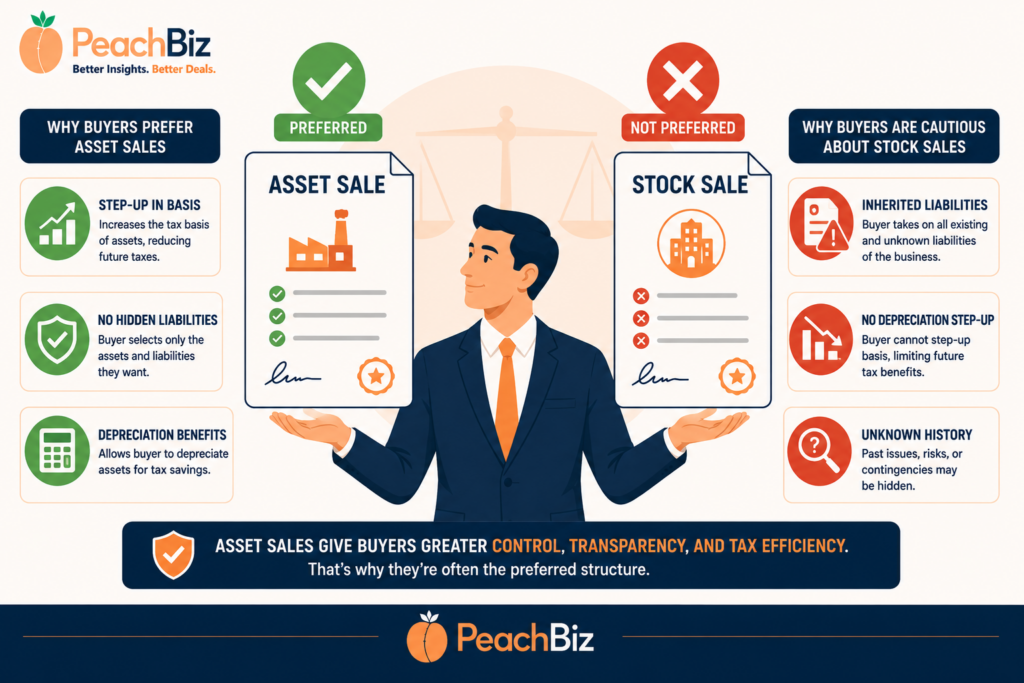
Buyers — in virtually every transaction involving a small or mid-market business — prefer asset sales. The reasons are substantial and directly financial.
Reason 1: Step-Up in Tax Basis
When a buyer purchases assets, they get to record those assets on their books at the purchase price — the “stepped-up” basis. This means they can depreciate the full purchase price of the acquired assets over their useful lives, generating significant tax deductions in the years following the acquisition.
In a stock sale, the buyer inherits the seller’s existing tax basis in the assets — often very low or near zero after years of depreciation. They get no step-up, no fresh depreciation, and significantly less tax benefit from the acquisition.
For a buyer acquiring a $2M business, the depreciation benefit from an asset sale step-up can be worth $400,000–$600,000 in present-value tax savings over the depreciation period. That’s a real, significant financial advantage.
Reason 2: No Inherited Liabilities
In an asset sale, buyers can choose which liabilities they assume and which they leave with the seller. They take the specific assets they want and negotiate whether to assume specific obligations. Any undisclosed liabilities, pending litigation, or historical compliance issues stay with the seller’s entity.
In a stock sale, buyers inherit the business entity with everything inside it — including things they don’t know about yet. Undisclosed tax liabilities, employee claims, regulatory violations, or contractual disputes from before the sale become the buyer’s problem. Buyers price this risk into their offers, and it’s one reason stock sale offers often come in lower than asset sale offers at the same enterprise value.
Reason 3: Selective Asset Acquisition
Asset sales allow buyers to exclude specific assets or liabilities they don’t want — real property in a separate entity, a specific legal claim, an unfavorable contract. This flexibility is valuable and unavailable in a stock sale where the entire entity transfers.
Why Sellers Prefer Stock Sales
The seller preference for stock sales comes down primarily to taxes — specifically, how the gain is characterized and at what rate it’s taxed.
The Capital Gains Advantage
In a stock sale, the seller’s gain is almost always treated as a long-term capital gain (assuming the ownership interest has been held for more than one year). Long-term capital gains rates are currently 0%, 15%, or 20% depending on the seller’s income level — significantly lower than ordinary income tax rates of up to 37%.
In an asset sale, different asset classes are taxed at different rates — and some at ordinary income rates, not capital gains rates. This is where the tax complexity — and the tax cost — of asset sales concentrates.
The Double Taxation Problem for C-Corps
For C-Corporation sellers, asset sales create a particularly painful tax situation: double taxation.
Here’s how it works:
- The corporation pays corporate income tax on the gain from the asset sale (currently 21% federal)
- The proceeds are then distributed to the shareholder (you), who pays personal income tax on the distribution — at capital gains rates if treated as a qualified dividend, or ordinary income rates in other scenarios
The result: corporate-level tax plus shareholder-level tax on the same proceeds. On a $2M asset sale by a C-Corp, this double taxation can consume 35–50% of the proceeds, depending on state taxes and how the gain is structured.
For S-Corporation, partnership, and LLC sellers, the double taxation problem doesn’t apply — gains pass through directly to the owner’s personal return. But the asset class taxation issue still creates complexity and potential ordinary income exposure.
The Asset Class Problem: Where Ordinary Income Taxes Enter
This is the most technically important — and most often overlooked — aspect of asset sale taxation.
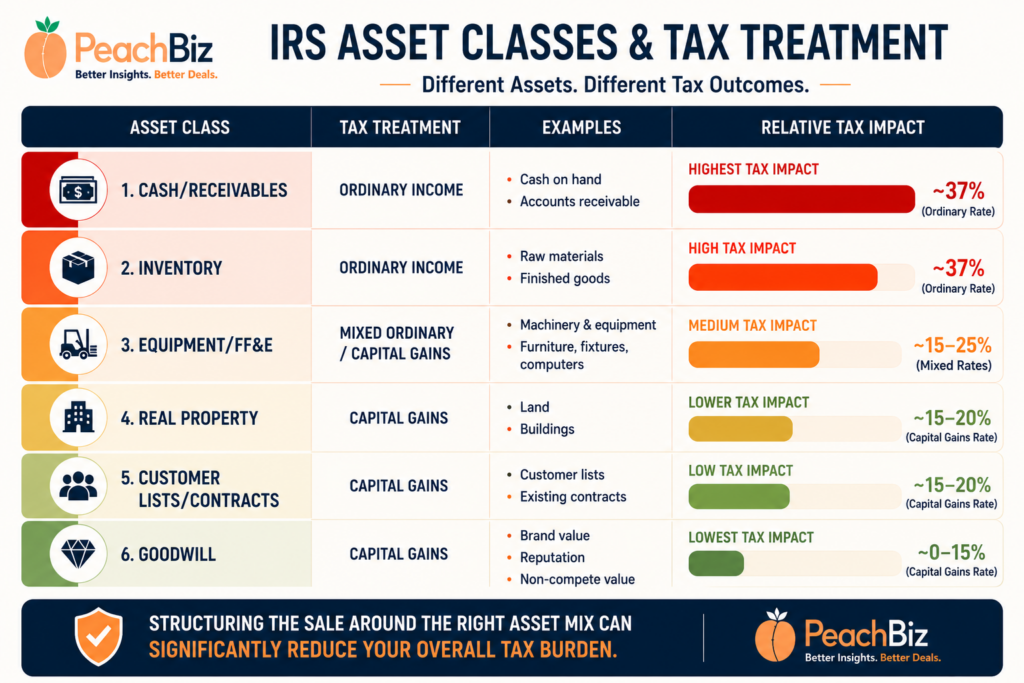
In an asset sale, the purchase price must be allocated across the different asset classes being sold. The IRS requires this allocation under IRC Section 1060, and both buyer and seller must report it consistently on Form 8594. The allocation matters enormously because different asset classes are taxed at different rates.
Asset Class I: Cash, Receivables, and Inventory
Taxed at ordinary income rates. If your business has significant cash, accounts receivable, or inventory being sold, those proceeds are ordinary income — taxed at up to 37% federal rather than the 20% capital gains rate.
Asset Class II: Certificates of Deposit, Government Securities
Taxed at ordinary income rates. Uncommon in most small business sales.
Asset Class III: Marked-to-Market Assets (Certain Securities)
Taxed at ordinary income rates. Rarely relevant in operating business sales.
Asset Class IV: Stock in Trade / Inventory
Taxed at ordinary income rates. Important for product businesses with significant inventory.
Asset Class V: All Other Assets (Equipment, Furniture, Fixtures)
This is where depreciation recapture enters the picture. Equipment that has been depreciated creates a recapture issue: when you sell it for more than its depreciated book value, the gain up to the original cost is recaptured as ordinary income under IRC Section 1245. Only gain above the original cost is capital gain.
Example: You bought equipment for $100,000, depreciated it to $20,000 book value, and are selling it for $80,000. The $60,000 gain ($80K sale price minus $20K book value) is ordinary income — depreciation recapture. Not capital gain.
Asset Class VI: Intangible Assets (Non-Goodwill)
Customer lists, non-compete agreements, proprietary processes, and similar intangibles are taxed at capital gains rates if held for more than a year.
Asset Class VII: Goodwill
Goodwill — the most significant asset in most service business sales — is taxed at long-term capital gains rates. This is the most favorable tax treatment in an asset sale, which is why sellers typically want as much of the purchase price allocated to goodwill as possible.
The allocation negotiation:
Buyers and sellers have opposite interests in how the purchase price is allocated across asset classes. Buyers want more allocated to depreciable assets (Classes V and VI) because they can depreciate them faster. Sellers want more allocated to goodwill (Class VII) because it’s taxed at capital gains rates.
This allocation is a negotiated element of the purchase agreement — and it’s one of the places where having an experienced CPA in the room significantly affects your after-tax outcome. A poorly negotiated allocation can shift tens or hundreds of thousands of dollars from capital gains treatment to ordinary income treatment, with no change to the headline enterprise value.
The Tax Math: A Side-by-Side Comparison
Let’s make this concrete with a comparison that illustrates what the structure choice actually costs or saves.
The scenario:
- S-Corporation selling a service business
- Enterprise value: $2,000,000
- Asset breakdown: $100,000 receivables, $150,000 equipment (book value $40,000), $1,750,000 goodwill and intangibles
- Seller’s tax basis in stock: $200,000
- Seller’s federal ordinary income tax rate: 37%
- Seller’s federal long-term capital gains rate: 20%
- State income tax: 5% (applied to both)
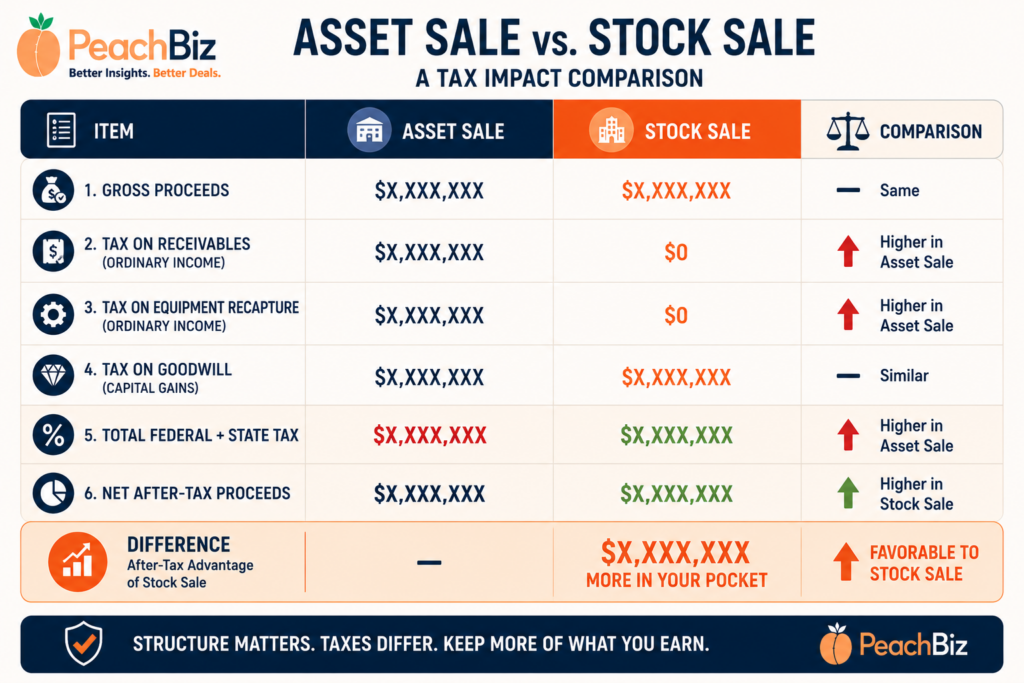
Asset Sale Tax Treatment:
| Asset | Amount | Tax Treatment | Federal + State Tax |
|---|---|---|---|
| Receivables | $100,000 | Ordinary income (42%) | $42,000 |
| Equipment gain above book ($150K − $40K) | $110,000 | Depreciation recapture — ordinary (42%) | $46,200 |
| Goodwill and intangibles | $1,790,000 | Long-term capital gain (25%) | $447,500 |
| Total tax | $535,700 | ||
| Net after-tax proceeds | $1,464,300 |
Stock Sale Tax Treatment:
| Amount | Tax Treatment | Federal + State Tax | |
|---|---|---|---|
| Total gain ($2,000,000 − $200,000 basis) | $1,800,000 | Long-term capital gain (25%) | $450,000 |
| Total tax | $450,000 | ||
| Net after-tax proceeds | $1,550,000 |
The difference: $85,700 more in after-tax proceeds from the stock sale — on the exact same enterprise value.
Note that this is a simplified illustration. Actual tax outcomes depend on numerous factors including state tax rates, alternative minimum tax considerations, the specific asset mix of the business, installment sale treatment, and the seller’s total income picture. Your CPA will build a full model for your specific situation — but the directional conclusion is consistent: stock sales almost always produce better after-tax outcomes for sellers, particularly for C-Corp sellers where the advantage can be dramatically larger.
Entity Type Matters: How Your Business Structure Affects the Tax Picture
The tax impact of asset vs. stock sale varies significantly depending on your business entity type.
C-Corporations — The Biggest Impact
C-Corp sellers face the most severe consequences from asset sales because of double taxation. The corporation pays 21% federal tax on the gain, then you pay personal tax on the distribution. Combined with state taxes, total effective tax rates on asset sale proceeds for C-Corp sellers can reach 50–60%.
For C-Corp sellers, the stock sale advantage is most dramatic — all gain passes through at the individual long-term capital gains rate with no corporate-level tax. This is often worth a significant price concession to achieve: accepting $1.8M in a stock sale can net more after taxes than $2.1M in an asset sale.
S-Corporations — Moderate Impact
S-Corp sellers don’t face double taxation — gains pass through to the individual’s personal return. But asset sales still create ordinary income exposure through depreciation recapture and receivables, while stock sales treat all gain as long-term capital gain. The advantage of a stock sale for S-Corp sellers is real but typically smaller than for C-Corp sellers.
LLCs and Partnerships — Nuanced
LLC and partnership asset sales are treated similarly to S-Corp asset sales for federal purposes — gains pass through to the members or partners. The stock sale equivalent for an LLC is a “membership interest sale,” which is treated as a capital asset sale at the individual level. The tax analysis is similar to S-Corps in most cases.
Sole Proprietors
Sole proprietors can only do asset sales — there are no shares or membership interests to transfer. The entire tax analysis for sole proprietors is about optimizing the asset allocation within an asset sale structure.
What to Do Before You Talk to a Buyer
The most important takeaway from this article is timing. The asset vs. stock sale decision needs to happen in your tax planning — before you list the business — not in LOI negotiations after a buyer has already proposed their preferred structure.
Here’s the pre-sale tax planning sequence we recommend:
Step 1: Understand your entity type and its tax implications.
Know whether you’re a C-Corp, S-Corp, LLC, or sole proprietor and how that affects your tax position in each sale structure. Your CPA should walk through this with you 12–24 months before your target sale date.
Step 2: Build a tax projection for both scenarios.
Have your CPA model the after-tax proceeds from both an asset sale and a stock sale at your target enterprise value. Use your specific asset mix, your tax basis in the business, and your expected income in the year of sale. This projection tells you exactly what each structure is worth to you in after-tax dollars.
Step 3: Consider entity conversion well in advance.
If you’re currently a C-Corp and a stock sale would significantly benefit you, there may be an opportunity to convert to an S-Corp well before the sale. However, there’s an important catch: S-Corp conversions are subject to a built-in gains (BIG) tax that applies if the business is sold within 5 years of the conversion. Conversion can still be worth it depending on the timeline and the magnitude of the tax difference — but it requires planning years, not months, in advance.
Step 4: Know your walk-away position on structure before the LOI.
When a buyer proposes an asset sale in their LOI — which is the default for most buyers — you need to know immediately what that structure costs you relative to a stock sale and whether you’re willing to accept it. If you haven’t done the tax planning, you can’t evaluate the proposal. If you have, you can either accept it with eyes open, negotiate for stock sale structure, or negotiate a price increase that compensates for the tax differential.
Step 5: Involve your M&A attorney and CPA in LOI review.
The asset/stock choice is typically established in the LOI — not in the purchase agreement. By the time the purchase agreement is drafted, the structure is usually already set. Make sure your CPA and attorney review the LOI before you sign it, with specific attention to the sale structure provision.
👉 Use our free Business Valuation Calculator to establish your enterprise value baseline — then work with your CPA to model the after-tax proceeds under each sale structure.
Negotiating the Structure
If a buyer proposes an asset sale and you prefer a stock sale, you have options beyond simply accepting what they propose.
Option 1: Propose a stock sale directly.
Counter with a stock sale at the same enterprise value. Buyers will often resist because of the step-up loss — their tax benefit from an asset sale has real value. But the resistance is negotiable, particularly if your business has clean historical records and limited undisclosed liability risk.
Option 2: Price the difference.
Calculate the tax differential between the two structures for the seller. Use that number as the basis for a price increase that compensates for the tax cost of an asset sale. “I’m willing to do an asset sale at $2.15M but need the stock sale price to be $2.0M to be indifferent after taxes” is a legitimate, well-reasoned negotiating position.
Option 3: Hybrid structures.
In some transactions, a hybrid approach allocates part of the purchase price as a stock sale and part as an asset sale to split the tax benefits between buyer and seller. These are complex to structure and require careful legal and tax guidance — but they exist and can be worth exploring when the parties have dramatically different preferences.
Option 4: 338(h)(10) Election for S-Corps
For S-Corporation sellers, there’s a specific tax mechanism — the Section 338(h)(10) election — that allows a transaction to be treated as a stock sale for legal purposes but as an asset sale for tax purposes. This gives the buyer their step-up in basis while allowing the seller the simplicity of transferring stock. The seller pays capital gains tax on the full gain (similar to a pure stock sale for an S-Corp), and the buyer gets their depreciation step-up. It’s a compromise structure that can bridge the gap — and it’s worth understanding and discussing with your advisors.
Frequently Asked Questions
Which is better for the seller: asset sale or stock sale?
Almost always stock sale, from a pure tax perspective. Stock sales generate cleaner capital gains treatment with fewer ordinary income exposures. The advantage is largest for C-Corp sellers (where asset sales create double taxation) and meaningful for S-Corp and LLC sellers (where asset sales create ordinary income through depreciation recapture and receivables). The specific dollar difference depends on your entity type, asset mix, tax basis, and state tax situation — which is why your CPA needs to model both scenarios for your specific circumstances.
Can I force a buyer to do a stock sale?
You can negotiate for it, but you can’t unilaterally require it. Most buyers prefer asset sales for legitimate tax and liability reasons. Your negotiating leverage depends on how competitive the buyer market is for your business — more buyers competing means more ability to insist on seller-preferred terms. The 338(h)(10) election for S-Corps is a commonly used compromise that addresses both parties’ core concerns.
What if I haven’t kept track of my tax basis in the business?
This is more common than it should be — and it creates real problems in tax planning for a business sale. Your tax basis in the business is the starting point for calculating your taxable gain. If you don’t know it, your CPA needs to reconstruct it from historical tax returns, capital contribution records, and prior distributions. This reconstruction is possible but time-consuming and potentially expensive — another reason why starting your tax planning 12–24 months before your target sale date is important.
Does the asset/stock structure affect the working capital adjustment?
Yes — the treatment of working capital items (receivables, payables, inventory) can differ between asset and stock sales. In an asset sale, the seller often retains receivables (collecting them after closing) and the buyer gets a “clean” working capital balance. In a stock sale, all working capital items transfer with the entity and are subject to the standard working capital peg adjustment. Your deal terms should be explicit about which working capital items transfer and how the closing adjustment is calculated regardless of structure.
What is goodwill and how is it taxed?
Goodwill represents the excess of the purchase price over the fair market value of the identifiable assets being sold — essentially the value of the business’s reputation, customer relationships, brand, and earning power above what the hard assets are worth. For sellers, goodwill gain in an asset sale is treated as long-term capital gain (the most favorable rate). For buyers, purchased goodwill must be amortized over 15 years under Section 197 — a slower tax benefit than depreciating physical equipment. This is one of the key tensions in asset allocation negotiations.
The Bottom Line
Asset sale or stock sale is not a technicality to be decided by whoever drafts the purchase agreement first. It’s a strategic decision with real, material consequences for your after-tax proceeds — consequences that can be significantly greater than many of the valuation factors sellers spend months focused on.
The sellers who get the best after-tax outcomes are the ones who understood this decision before they ever sat across the table from a buyer — who knew their tax position, had modeled both scenarios, understood the negotiating levers available to them, and were prepared to advocate for the structure that served their financial interests.
That preparation starts not at the LOI stage. It starts now — with your CPA, with a realistic model of both scenarios, and with a clear understanding of what each structure means for the number that actually matters: what you walk away with after the government takes its share.
👉 Start with your enterprise value baseline using our free Business Valuation Calculator, then take that number to your CPA for a full asset vs. stock sale tax comparison.
Related Reading
- How Deal Structure Affects the Real Price You Walk Away With
- The Difference Between Enterprise Value and Equity Value (And Why It Matters at Closing)
- Earnouts: When They Make Sense and When They’re a Red Flag
- Seller Financing as a Value Lever: How It Can Increase Your Sale Price
- Why Your Asking Price and Your Business Value Are Two Different Numbers
- What Is a Business Worth? The 4 Valuation Methods Explained
- Explore All Free PeachBiz Business Calculators