How to Build a Seller’s Discretionary Earnings (SDE) Statement That Holds Up Under Due Diligence
Your SDE statement is the most important financial document in your business sale. Not your tax return. Not your profit and loss statement. Not your balance sheet.
Your SDE statement.
It is the document that tells buyers, their lenders, and their advisors what your business actually earns — stripped of tax strategy, personal expenses, and accounting conventions that obscure the true economic output. It is the foundation of your valuation, the anchor of your asking price, and the first thing a buyer’s financial advisor will try to tear apart in due diligence.
And yet most sellers either don’t have one going into the sale process, have one that was thrown together quickly without proper documentation, or have one built on add-backs that a buyer’s advisor will challenge line by line.
This article fixes that. We’re going to walk you through exactly how to build an SDE statement from scratch — the right starting point, the right format, the right add-backs, the right documentation, and the right presentation — so that when a buyer’s advisor sits down with your financials, what they find confirms your number rather than contradicts it.
This is the document that either earns you your asking price or costs you it. Let’s build it right.
SDE vs. EBITDA: Which One Do You Need?
Before you build anything, you need to know which earnings metric applies to your business. Using the wrong one — or using both interchangeably without clarity — confuses buyers and signals that you don’t understand your own financial presentation.
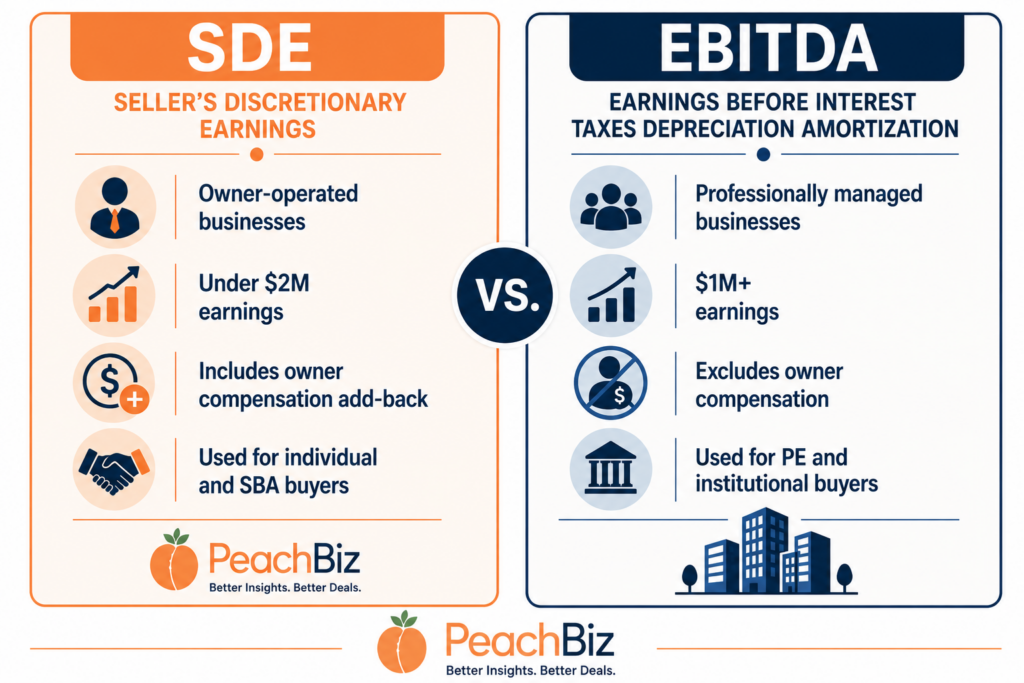
Use SDE when:
- Your business is owner-operated and you work in the business full time
- Your total annual earnings (before owner compensation) are under $2M
- Your likely buyer pool is individual operators, self-funded searchers, or SBA borrowers
- The business’s profitability is significantly tied to the owner’s personal involvement
Use EBITDA when:
- Your business has a professional management team that operates independently of you
- Your total annual earnings exceed $1M–$2M and you’re attracting institutional or PE buyers
- The business could be run by a hired CEO at a market-rate salary without significantly affecting profitability
The transition zone: Businesses in the $500K–$2M earnings range often present both metrics — SDE to show what an owner-operator would earn, and EBITDA (with a market-rate management cost netted out) to show institutional buyers the underlying operating profitability. Your broker will help you determine the right presentation for your specific buyer market.
For the purposes of this article, we’ll focus on building the SDE statement — the most common format for small to mid-size business sales.
The SDE Statement: Structure and Format
A properly built SDE statement follows a consistent, logical structure that moves from reported income to normalized earnings in a way that any financial professional can follow, verify, and confirm independently.
Here is the standard format:
[BUSINESS NAME] Seller’s Discretionary Earnings Recast For the Years Ended December 31, [Year -2], [Year -1], [Current Year]
| Line Item | Year -2 | Year -1 | Current Year | Notes |
|---|---|---|---|---|
| Net Income (Tax Return Basis) | $XXX,XXX | $XXX,XXX | $XXX,XXX | From Line 21/28 of tax return |
| Add: Owner’s Salary (W-2) | $XXX,XXX | $XXX,XXX | $XXX,XXX | Schedule W-2, Box 1 |
| Add: Owner’s Payroll Taxes (Employer Share) | $XX,XXX | $XX,XXX | $XX,XXX | 7.65% of owner salary |
| Add: Owner’s Health Insurance | $XX,XXX | $XX,XXX | $XX,XXX | Insurance invoices |
| Add: Owner’s Retirement Contributions | $XX,XXX | $XX,XXX | $XX,XXX | Tax return deduction |
| Add: Depreciation & Amortization | $XX,XXX | $XX,XXX | $XX,XXX | Tax return Schedule |
| Add: Interest Expense | $XX,XXX | $XX,XXX | $XX,XXX | P&L interest line |
| Add: Owner’s Vehicle Expense | $XX,XXX | $XX,XXX | $XX,XXX | Tax return + mileage log |
| Add: Personal Cell Phone | $X,XXX | $X,XXX | $X,XXX | Itemized phone bills |
| Add: [One-Time Expense — Description] | $XX,XXX | $— | $— | Invoice + explanation |
| Add: [Non-Recurring Item — Description] | $— | $XX,XXX | $— | Supporting documentation |
| Less: [Below-Market Owner Salary Adjustment] | $(XX,XXX) | $(XX,XXX) | $(XX,XXX) | Market salary data |
| Seller’s Discretionary Earnings (SDE) | $XXX,XXX | $XXX,XXX | $XXX,XXX | |
| Year-over-Year Change | — | X.X% | X.X% |
Three things to notice about this format:
Three years side by side. This is non-negotiable. A single year of SDE is nearly meaningless to a buyer — it could be an anomaly in either direction. Three years of SDE shows a trend, establishes credibility, and allows buyers to calculate a weighted average if they choose to.
A Notes column for every line. Every add-back references the specific document that supports it. This column is what separates a credible SDE statement from one that gets challenged line by line.
Adjustments go both directions. Some add-backs increase your SDE. Some adjustments — like a below-market owner salary that needs to be grossed up to market rate — decrease it. An honest SDE statement includes both, which is exactly what builds credibility.
Step-by-Step: Building Your SDE Statement
Now let’s walk through the actual construction process. This is the sequence we recommend — from gathering source documents through final presentation.
Step 1: Gather Your Source Documents
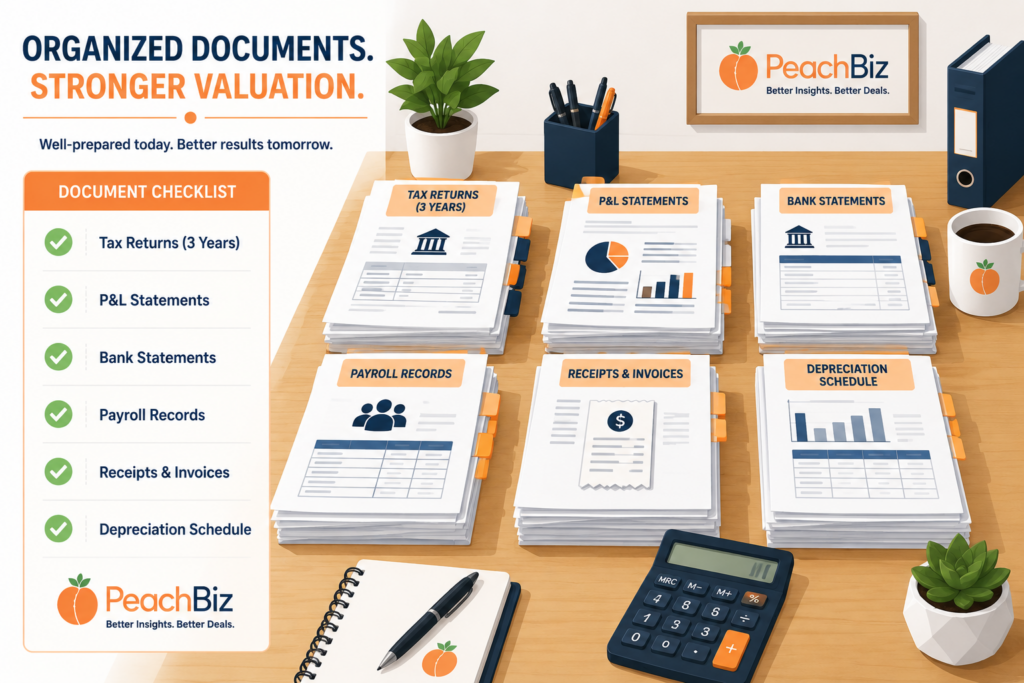
Before you write a single line of your SDE statement, gather every document you’ll need to support it. Missing documentation is the number one reason SDE statements get challenged in due diligence — you want everything in hand before you build, not scrambling to find it after a buyer asks.
Required documents:
- Federal business tax returns for the past three years (1065, 1120, 1120-S, or Schedule C depending on entity type)
- Monthly profit and loss statements for the past 36 months
- Business bank statements for the past 24–36 months
- Payroll records showing owner W-2 compensation for the past three years
- Depreciation schedule from the most recent tax return
- Business loan statements showing interest paid
- Health insurance invoices for owner coverage paid by the business
- Retirement plan contribution records
- Vehicle expense documentation (mileage logs, insurance, registration, fuel records)
- Invoices for any one-time or non-recurring expenses you plan to add back
- Documentation for any personal expenses run through the business
Organize before you build. Create a folder — physical or digital — with a subfolder for each year and each add-back category. Every document that supports a line on your SDE statement should be findable within 60 seconds. When a buyer’s advisor asks for backup on a specific add-back during due diligence, your response time and organization are themselves signals of how well-managed your business is.
Step 2: Start With the Tax Return, Not the P&L
This is one of the most important decisions in building your SDE statement — and the one most sellers get wrong.
Your SDE statement should start from the net income line on your federal tax return, not from your internal profit and loss statement.
Here’s why: your tax return is what buyers and their lenders will independently verify. The IRS-filed return is a fixed, auditable document that can’t be changed after the fact. When your SDE statement starts from the same number your buyer’s advisor sees when they pull your tax transcripts, the reconciliation is immediate and credible.
If you start from your internal P&L, there’s an immediate question: why is the starting point different from the tax return? Even if the difference is entirely legitimate (timing differences, accounting method differences), it creates an explanation burden that adds friction and invites scrutiny.
How to find the right starting line:
- Sole Proprietorships (Schedule C): Line 31 — Net Profit or Loss
- Partnerships (Form 1065): Line 22 — Net Income/Loss (ordinary business income)
- S-Corporations (Form 1120-S): Line 21 — Ordinary Business Income/Loss
- C-Corporations (Form 1120): Line 28 — Taxable Income (before tax)
Note these amounts for each of the three years. These are your starting points — one per year, one per column in your SDE statement.
Step 3: Add Back Owner’s Compensation — Carefully
Owner compensation is typically the largest add-back in any SDE calculation, and it requires the most care.
What to add back:
- Owner W-2 salary (confirmed against payroll records and W-2)
- Employer’s share of FICA on that salary (7.65% of W-2 wages up to the SS wage base)
- Health insurance premiums paid by the business for the owner
- Owner’s retirement plan contributions paid by the business
- Any other compensation to the owner that flows through the business (auto allowance, housing allowance, etc.)
The adjustment most sellers miss — replacement cost:
If your salary is significantly above what a professional manager would earn to do your job, buyers will net out a market-rate management cost from your add-back. This doesn’t mean you lose the add-back entirely — it means the net add-back is your salary minus the replacement cost.
Example:
Owner pays himself $250,000/year Market-rate General Manager for this business: $120,000/year Net owner compensation add-back: $130,000
If you pay yourself below market rate — which some owners do, particularly in the early years or when cash flow was constrained — buyers will add a replacement cost adjustment that actually reduces your SDE, because the true cost of running the business includes paying a manager at market rate.
This is one of the places where honesty matters most. Buyers will independently research replacement costs for your role using BLS data and industry salary surveys. If your add-back doesn’t account for replacement cost when it should, their recast will be lower than yours — and the difference becomes a negotiating point.
Step 4: Add Standard Non-Cash and Financing Add-Backs
These are the straightforward, universally accepted add-backs that require minimal documentation beyond the tax return:
Depreciation and Amortization: Pull the total depreciation and amortization from your tax return for each year. This is typically on Form 4562 (Depreciation and Amortization) and flows through to your Schedule C, 1065, or 1120-S. Add back the full amount for each year.
Interest Expense: Pull interest expense from your P&L or from Schedule C/1065/1120-S. Add it back for each year. Note: this is interest on business debt — not interest income received by the business, which stays in revenue.
Income Taxes (C-Corps only): If your business is a C-Corporation that pays income taxes at the entity level, add back the income tax expense line from your income statement. S-Corps and partnerships pass taxes through to owners personally, so there’s no entity-level tax add-back for these structures.
Step 5: Document and Add Personal and Mixed-Use Expenses
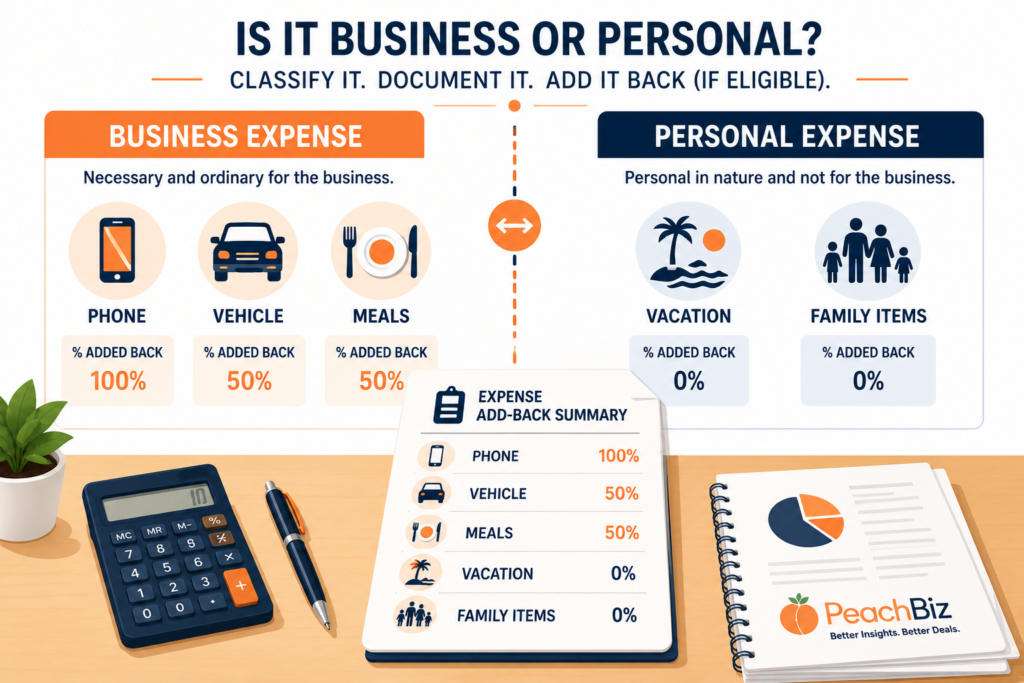
Personal and mixed-use expenses run through the business are legitimate add-backs — but they require specific documentation and conservative treatment to survive scrutiny.
Owner’s Vehicle: If the business owns or leases a vehicle used by the owner for personal and business purposes, the personal-use portion is an add-back. Document with:
- Annual vehicle expense total (depreciation, insurance, fuel, maintenance)
- Business use percentage (mileage log is ideal; IRS standard is a contemporaneous log)
- Personal-use add-back = total expense × personal use percentage
Conservative approach: If you don’t have a mileage log, use a reasonable documented estimate (50% personal is often defensible for a vehicle that serves dual purposes) rather than claiming 100% personal use.
Cell Phone: If the business pays for a cell phone used partially for personal calls, the personal-use portion is a legitimate add-back. Document with monthly bills and a reasonable personal-use percentage.
Home Office: If you’ve claimed a home office deduction on your taxes, note that this is typically already deducted from your net income — meaning the home office expense has already reduced your reported income. Whether to add it back depends on whether a new owner would actually incur this cost. If the buyer will operate from your current business location, the home office is a legitimate add-back.
Meals and Entertainment: Only the personal portion of meals and entertainment — not client meals with a genuine business purpose — is an add-back. Be conservative here. Buyers and their advisors are skeptical of large meals and entertainment add-backs, and the IRS documentation requirements for business meals (business purpose, attendees, business relationship) mean that undocumented meals are hard to defend as either business expenses or personal add-backs.
Step 6: Document One-Time and Non-Recurring Items
This is the most scrutinized section of any SDE statement. Every item here will be challenged, so documentation needs to be airtight.
For each one-time or non-recurring add-back, your documentation file should contain:
- The invoice or expense record showing the amount, date, and vendor
- A written explanation of why the expense is non-recurring — what specific event caused it and why it won’t happen again under new ownership
- Confirmation that the matter is resolved — particularly for legal expenses, regulatory fines, or dispute-related costs
Common legitimate one-time add-backs with required documentation:
| Add-Back Item | Required Documentation |
|---|---|
| Legal fees — resolved dispute | Law firm invoice + settlement or dismissal document |
| Equipment repair — extraordinary event | Repair invoice + explanation of cause (fire, flood, collision) |
| Lease negotiation costs | Professional fees invoice + copy of new lease |
| Moving or relocation costs | Invoices + explanation of one-time nature |
| COVID-related losses (2020–2021) | Revenue records + government documentation if applicable |
| Consulting fees — specific project | Invoice + project description + confirmation project is complete |
What you should not include here: Any expense that recurred in more than one of your three presentation years. Any expense that is part of normal business operation even if the amount varied. Any expense you’re “planning to eliminate” — a plan to eliminate is not the same as an expense being non-recurring.
Step 7: Calculate and Verify Your Three-Year SDE
With all add-backs documented and entered, calculate your SDE for each of the three years. Then do three verification checks before you show this document to anyone:
Verification Check 1: The bank statement test. Does your normalized SDE for each year roughly reconcile to what actually showed up in your bank accounts? If your SDE statement shows $400,000 in annual earnings but your bank statements show $150,000 in deposits above business expenses, someone will ask why. The reconciliation doesn’t have to be perfect — but a massive discrepancy is a red flag.
Verification Check 2: The trend test. Does your SDE trend make sense given what happened in your business over the three-year period? If SDE declined significantly in Year 2, does your statement explain why? If it jumped dramatically in Year 3, is there a documented reason? Unexplained trend breaks invite questions.
Verification Check 3: The reasonableness test. Does your SDE as a percentage of revenue make sense for your industry? If you’re showing 45% SDE margins in an industry where typical margins are 15–20%, expect that to be questioned. Have an answer ready that explains the variance — or recheck your add-backs for items that may not be as defensible as you think.
Step 8: Have Your CPA Review and Confirm
Before your SDE statement goes into any buyer presentation, your CPA should review it and be prepared to confirm its accuracy.
This doesn’t mean your CPA needs to formally certify the statement — that’s a different and more expensive engagement. It means your CPA has reviewed the add-backs, confirmed they reconcile to the tax returns, and would be willing to explain the methodology to a buyer’s advisor if asked.
A CPA-reviewed SDE statement carries significantly more credibility than a seller-prepared one. In a competitive offer situation, it can be the difference between a buyer proceeding with confidence and a buyer making a lowball offer that reflects their uncertainty about the financial presentation.
👉 Use our free Business Valuation Calculator to cross-check your SDE calculation against market multiples and see how your normalized earnings translate into a valuation range.
Common SDE Statement Mistakes That Cost Sellers Money
Starting from the P&L instead of the tax return. Creates an immediate reconciliation question. Always start from the tax return.
Missing the owner’s payroll tax add-back. The employer’s share of FICA on the owner’s salary is a legitimate add-back that’s frequently overlooked. At $150,000 in owner salary, that’s $11,475 left on the table.
Not including three years. A single year of SDE is nearly worthless for valuation purposes. Three years is the minimum — and each year needs the same level of documentation.
Leaving out the Notes column. An SDE statement without source references for each add-back invites every line to be challenged. The Notes column is not optional.
Ignoring the replacement cost adjustment. If you’re adding back a salary significantly above market rate without netting a replacement cost, sophisticated buyers will do it for you — and their version will be lower than yours.
Not reconciling to bank statements. If the SDE can’t be tied to actual cash flows in and out of the business, buyers and lenders will discount it. The reconciliation to bank statements is a credibility check you should run before they do.
Presenting add-backs without CPA involvement. An unreviewed, seller-prepared SDE statement carries the lowest possible credibility. CPA involvement changes the conversation.
For Brokers and CPAs: Building the SDE Statement as a Team
The best SDE statements are built collaboratively — with the seller providing the business knowledge, the CPA providing the financial accuracy and tax context, and the broker providing the market perspective on which add-backs buyers in this industry will accept.
Here’s how we recommend structuring that collaboration:
The seller’s role: Identify every expense that has a personal or one-time component. Provide documentation for vehicle use, phone, home office, and any one-time items. Explain the business context for anything unusual in the financials.
The CPA’s role: Build the formal reconciliation from tax returns to normalized earnings. Confirm that every add-back is consistent with what’s on the tax return. Flag any items that create tax implications in the sale structure.
The broker’s role: Review the draft SDE statement through a buyer’s eyes. Identify which add-backs will be challenged. Ensure the format and presentation are consistent with what buyers and lenders in this market expect. Set realistic expectations with the seller about which items are defensible and which aren’t.
When these three roles work together before the CIM is prepared, the SDE statement that goes to buyers is clean, comprehensive, and credible — which means faster offers, fewer challenges, and a smoother path to closing.
Frequently Asked Questions
What is the difference between SDE and net profit?
Net profit is what your tax return shows after all expenses — including your salary and personal expenses — are deducted. SDE adds back the owner’s compensation and personal expenses to show what the business truly earns as an economic engine, independent of how the owner has structured their personal compensation. For most small businesses, SDE is significantly higher than reported net profit.
How do I calculate SDE if I’m a sole proprietor with no W-2 salary?
Sole proprietors typically don’t pay themselves a formal W-2 salary — they draw from the business’s profits. In this case, the “owner compensation add-back” is the owner’s draws plus any guaranteed payments, confirmed against bank records. The rest of the SDE calculation works the same way as for an incorporated business.
Should I include officer life insurance as an add-back?
If the business pays premiums on a life insurance policy owned by the business with the business as beneficiary, and the policy is specifically tied to the current owner’s life, it’s a legitimate add-back — because the new owner may choose not to continue the policy. Document with the policy and premium invoices. If the policy has significant cash value, how that’s treated in the transaction should be discussed with your broker and CPA.
How do I handle a year where earnings were unusually low or high?
Document the specific cause of the anomaly clearly in your SDE statement. If earnings were unusually low due to a specific event (a major customer lost, a temporary operational disruption, COVID), explain it and consider whether a normalized adjustment is appropriate and defensible. If earnings were unusually high due to a non-recurring event (a one-time large contract, an insurance settlement), that revenue should be normalized out. Buyers will calculate a weighted average of your three years — anomalies in either direction that aren’t explained and normalized will affect that average.
What if my tax returns understate my actual revenue?
If you have unreported income, you cannot include it in your SDE statement. Attempting to add back unreported cash sales or undisclosed revenue creates significant legal exposure for you and is a deal-killer with any serious buyer or SBA lender. The solution is to work with your CPA to normalize your reported financials over time before going to market — not to represent income that isn’t on your tax return.
The Bottom Line
Your SDE statement is the foundation of everything in your business sale — your valuation, your asking price, your credibility with buyers and lenders. Built correctly, it’s a powerful document that earns you the price your business deserves. Built incorrectly, it’s a liability that undermines every conversation it enters.
The standard isn’t complicated: start from your tax return, document every add-back, run both directions, include three years, have your CPA review it. Build it to a standard that a buyer’s advisor would independently confirm — not to a standard that requires defending.
Do that, and your SDE statement becomes an asset rather than an obstacle.
👉 Cross-check your SDE against current market multiples with our free Business Valuation Calculator — built on real transaction data and designed to produce a number you can defend.
Related Reading
- The EBITDA Add-Backs Buyers Accept vs. The Ones That Blow Up Deals
- 3 Years of Financials: What Buyers Read, What They Ignore, and What Scares Them
- Why Clean Books Are Worth More Than a Higher Multiple
- What Is a Business Worth? The 4 Valuation Methods Explained
- EBITDA Multiples by Industry: What Buyers Are Actually Paying Right Now
- Red Flags That Kill Deals Before the LOI: A Pre-Sale Checklist
- Explore All Free PeachBiz Business Calculators