
The EBITDA Add-Backs Buyers Accept vs. The Ones That Blow Up Deals
Add-backs are one of the most powerful tools in a business seller’s arsenal — and one of the most abused.
Done right, a properly documented add-back schedule can legitimately increase your normalized earnings by 20, 30, sometimes 50 percent above what your tax return shows. That translates directly into a higher valuation and more money in your pocket at closing.
Done wrong — with add-backs that are aggressive, poorly documented, or simply indefensible — you don’t just lose the add-back. You lose credibility. And in a business sale, lost credibility is the fastest path to a dead deal or a dramatically reduced offer.
Here’s what most sellers don’t understand: buyers and their advisors have seen every add-back in the book. They know exactly which ones are legitimate normalizations and which ones are attempts to inflate earnings. When they encounter the aggressive ones, they don’t just reject that specific add-back — they start questioning everything else in your financial presentation. The math gets scrutinized more carefully. The due diligence gets more intensive. The offer gets lower.
This article gives you the complete picture. We’ll cover what add-backs are, how they work in the valuation calculation, which ones buyers and SBA lenders accept without question, which ones require strong documentation to survive scrutiny, and which ones will damage your credibility and potentially blow up your deal.
What Add-Backs Are and How They Work
An add-back is an adjustment made to your reported net income to arrive at a normalized earnings figure that more accurately reflects the true economic output of your business — independent of how you’ve structured your taxes, your compensation, or your personal expenses.
The concept exists because small business owners — entirely legitimately — run their businesses in ways that minimize taxable income. They pay themselves market-rate or above-market salaries. They run personal expenses through the business. They take accelerated depreciation. They make one-time investments that won’t recur. The result is a tax return that often shows very little net income — which, while great for your April 15 bill, dramatically understates what the business is actually worth to a buyer.
Add-backs reverse those adjustments to show what the business truly earns. The result — SDE (Seller’s Discretionary Earnings) for smaller businesses or adjusted EBITDA for larger ones — is the foundation of your valuation.
The basic formula:
Net Income (from tax return or P&L)
- Owner’s Compensation (salary, payroll taxes, benefits)
- Depreciation and Amortization
- Interest Expense
- Income Taxes (if applicable)
- One-Time / Non-Recurring Expenses
- Personal Expenses Run Through the Business
- Non-Cash Expenses = Adjusted SDE or EBITDA
Each line in that formula is a category of add-backs. Some are universally accepted. Some require documentation. Some are red flags. Let’s go through them.
The Add-Backs Buyers Accept Without Question
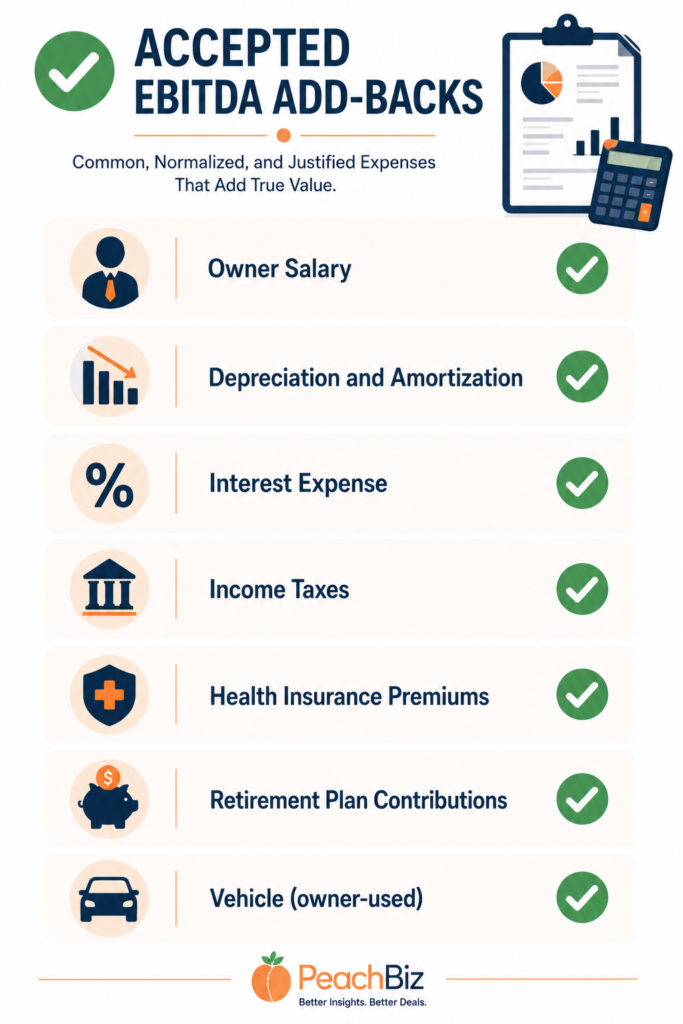
These are the standard, universally recognized add-backs that every experienced buyer, M&A advisor, and SBA lender expects to see and will accept as legitimate normalizations without significant scrutiny — provided they are clearly documented.
Owner’s Compensation — Salary and Payroll Taxes
This is the largest and most fundamental add-back in any SDE calculation. The owner’s W-2 salary, plus the employer’s share of FICA taxes on that salary, is added back because a buyer will replace you with either themselves (in which case the salary goes to them, not the business) or a hired manager (in which case the replacement cost is separately evaluated).
Documentation required: W-2s, payroll records, or officer compensation line on the tax return. Straightforward.
Depreciation and Amortization
Depreciation and amortization are non-cash accounting entries — they reduce reported income without any actual cash leaving the business in that period. Adding them back shows the actual cash-generating capacity of the business independent of accounting schedules.
Documentation required: Depreciation schedule from the tax return. Universally accepted.
Interest Expense
Interest expense reflects how the current owner has chosen to finance the business — not an inherent cost of operating it. A buyer may use different financing with different interest costs, so removing interest normalizes for capital structure differences.
Documentation required: Interest expense line on the P&L or Schedule C. Standard.
Income Taxes (for C-Corps)
If your business is a C-Corporation that pays income taxes at the entity level, those taxes are added back. S-Corps and LLCs pass taxes through to the owner’s personal return, so this add-back typically applies only to C-Corp transactions.
Documentation required: Tax return and P&L. Standard.
Owner’s Health Insurance Premiums
Owner health insurance premiums paid by the business are a form of owner compensation. They’re added back as part of the owner’s total compensation package.
Documentation required: Insurance invoices or the deduction on the business tax return. Standard.
Owner’s Retirement Plan Contributions
SEP-IRA, SIMPLE IRA, Solo 401(k), or defined benefit plan contributions made by the business on behalf of the owner are owner compensation in another form. They’re added back.
Documentation required: Tax return deductions or plan contribution records. Standard.
Owner’s Vehicle Expense (Owner-Used Vehicle)
If the business owns or leases a vehicle used primarily by the owner for personal and business use, the business portion of that expense is a legitimate add-back representing owner compensation in kind.
Documentation required: Vehicle expense on the tax return, business use percentage, and — ideally — a mileage log or documentation of how the business use percentage was calculated.
The Add-Backs That Require Strong Documentation
These are legitimate add-backs that experienced buyers will accept — but only with clear, specific, verifiable documentation. Present them without that documentation and they become negotiating points at best, credibility problems at worst.
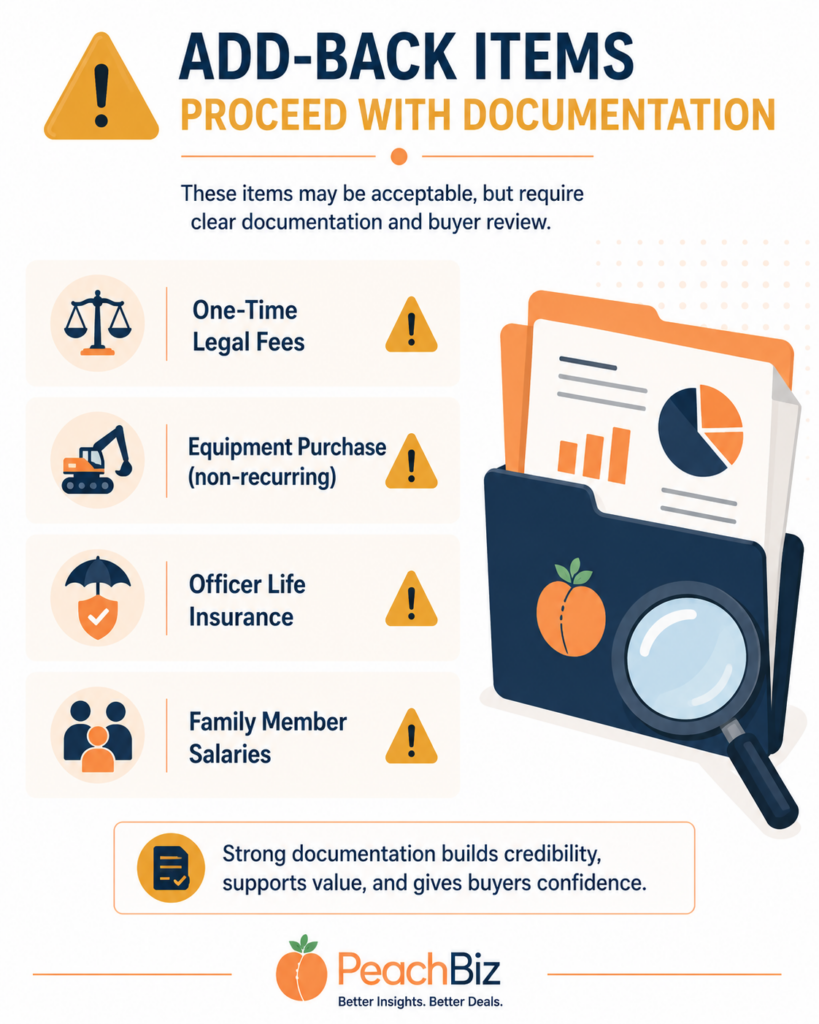
One-Time Legal or Professional Fees
Legal fees related to a one-time dispute, a lawsuit settlement, a lease negotiation, or another non-recurring event are legitimate add-backs because they won’t recur for the new owner.
Documentation required: Invoice from the law firm or professional, description of the specific matter, and confirmation that the matter has been resolved. Buyers will ask: is this truly resolved and truly non-recurring?
One-Time Equipment Purchases or Repairs
A major equipment purchase or repair that won’t recur in the normal course of business can be added back. The key word is one-time — equipment replacement that happens every few years as part of normal maintenance is not a legitimate add-back.
Documentation required: Invoice for the purchase or repair, explanation of why it’s non-recurring, and evidence that it doesn’t represent deferred maintenance that will need to happen again soon.
Pandemic-Related Revenue or Expense Anomalies
For businesses still carrying 2020–2021 anomalies in their three-year average, adjustments for pandemic-related impacts — PPP loan forgiveness income, EIDL grants, revenue disruptions — are legitimate normalizations.
Documentation required: Specific line items from the financials with clear explanation of the COVID-related nature, and ideally supporting documentation from government programs. Buyers will verify these independently.
Rent Above or Below Market
If you own the building your business operates in and charge the business below-market rent — or if a related party charges above-market rent — an adjustment to market rate is appropriate. This normalizes the occupancy cost for a buyer who will be paying market rent.
Documentation required: Comparable lease rates in your market (ideally from a commercial real estate broker), your current lease terms, and a clear explanation of the relationship between the property owner and the business.
Officer Life Insurance (Business-Owned)
If the business pays premiums on a life insurance policy owned by the business with the business as beneficiary, that’s a legitimate add-back as a non-recurring business expense that may not continue under new ownership.
Documentation required: Policy documentation showing the business as owner and beneficiary, premium invoices. If the policy has a cash value component, buyers will also want to understand how that’s treated in the transaction.
Above-Market Family Member Salaries
If a family member is on the payroll at a salary above what their role would command in the open market, the above-market portion is a legitimate add-back. The key distinction: the market-rate salary stays in the cost structure (because the new owner needs someone doing that job), and only the excess is added back.
Documentation required: Job description for the family member’s role, market salary data for comparable positions (BLS data, salary surveys), current compensation details. This one gets scrutinized carefully — be precise and conservative.
The Add-Backs That Blow Up Deals
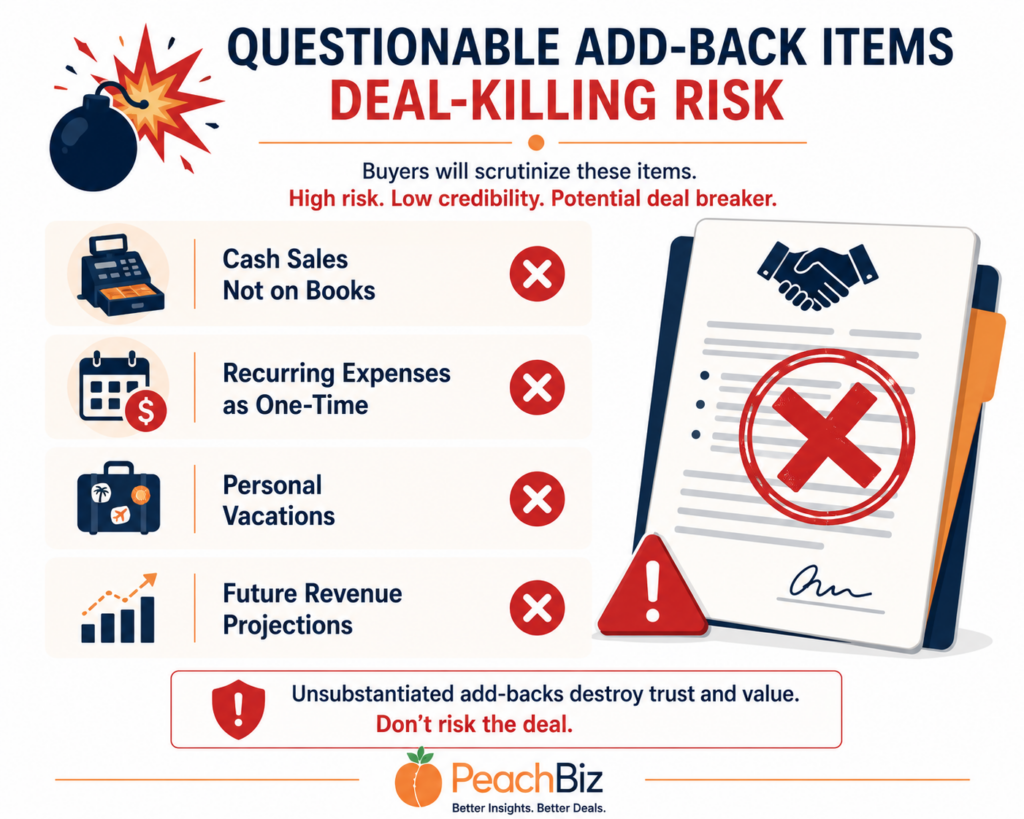
These are the add-backs that experienced buyers immediately recognize as red flags. When they appear in a seller’s financial presentation, they don’t just get rejected — they cause buyers and their advisors to question the integrity of the entire financial package. Deals die here.
Unreported Cash Income
“We actually do $200K more in revenue, but we take it in cash and don’t report it” is the fastest way to end a business sale conversation. Buyers cannot finance unreported income. SBA lenders will not count it. And the buyer’s advisor will immediately wonder what else in the financials isn’t accurate.
Beyond the deal implications, sellers who represent unreported income in their financial package are creating significant legal exposure for themselves. This is not a strategy — it’s a liability.
What to do instead: If your business has historically operated with significant cash transactions, the path forward is working with your CPA to normalize the reported financials over time, not trying to add back what was never on the books.
Recurring Expenses Labeled as One-Time
Every business has recurring costs that the owner wishes would go away — the annual software subscription, the quarterly equipment service contract, the yearly insurance renewal. Presenting these as “one-time” add-backs because they happened to be particularly high in one year, or because you’ve decided to try to eliminate them, is a credibility-destroying move.
Experienced buyers and their advisors will request two to three years of detailed expense records and will identify recurring items immediately. When they find them mislabeled, they reprice — and they start applying much higher scrutiny to everything else you’ve presented.
What to do instead: Only add back expenses that are genuinely, verifiably non-recurring. If an expense has appeared in any of the last three years, it’s almost certainly recurring.
Personal Vacations and Lifestyle Expenses Disguised as Business Travel
A family vacation to Disney World expensed as a “sales conference.” A ski trip labeled as a “team building retreat.” A personal meal tab coded as “client entertainment.”
These aren’t add-backs — they’re personal expenses that were run through the business. Legitimate personal-expense add-backs exist (owner meals, home office, personal phone) but they need to be genuinely business-connected and reasonably documented. Presenting an obvious personal vacation as a business expense add-back tells a buyer exactly the kind of financial management they’re inheriting.
What to do instead: Personal expenses that are legitimately mixed with business use (vehicle, phone, meals with a business component) can be added back with appropriate documentation. Pure personal expenses that were disguised as business costs are not add-backs — they’re disclosures.
Excess Owner Compensation Without Market Comparison
An owner who pays themselves $500,000 a year from a business that generates $800,000 in SDE can add back the full $500,000 — but must then subtract a market-rate replacement cost for their role. The add-back is not the full salary; it’s the salary minus what a replacement manager would cost.
Sellers who add back the full owner compensation without netting out the replacement cost are overstating their SDE. Buyers know this and will adjust — but the correction, discovered in due diligence, creates friction and erodes trust.
What to do instead: Present owner compensation add-backs net of realistic market-rate replacement cost. Use salary data (BLS, industry surveys, job postings) to document the replacement cost assumption.
Projected or Future Revenue
“We’re about to land a major contract that will add $300,000 in revenue” is not an add-back. It’s a projection. Buyers price businesses on demonstrated, documented historical performance — not on what the seller believes is about to happen.
Sellers sometimes try to include projected revenue or pipeline deals in their earnings presentation, effectively asking buyers to pay today for revenue that hasn’t materialized. Experienced buyers reject this immediately, and it raises questions about whether the seller’s financial judgment is sound.
What to do instead: If you have significant pipeline opportunities, present them as growth opportunities for the buyer — not as current earnings. They can factor into the buyer’s underwriting and potentially support a higher price, but they don’t belong in the SDE or EBITDA calculation.
One-Time Revenue Treated as Recurring
The inverse of the recurring-expense problem: a one-time revenue event — a large non-recurring project, a liquidation sale, a government contract that won’t be renewed — included in the earnings base without disclosure or adjustment.
What to do instead: Identify any significant one-time revenue in your three-year history and normalize it out of your recurring earnings base. Buyers will find it anyway. Normalizing it yourself, with a clear explanation, shows financial sophistication and builds trust.
How to Build an Add-Back Schedule That Survives Scrutiny
The goal isn’t to maximize your add-back total. The goal is to present a normalized earnings figure that is accurate, defensible, and consistent with what a buyer’s advisor will calculate independently when they review your books.
Here’s how to build an add-back schedule that does that:
Step 1: Start with your tax return, not your P&L. Your tax return is what buyers and their lenders will verify first. Build your add-back schedule starting from the net income line on your tax return, so the path from reported income to normalized SDE/EBITDA is traceable and auditable.
Step 2: Document every add-back with a source. Every line in your add-back schedule should have a corresponding document: a W-2, a payroll record, a tax return line item, an invoice, a lease agreement. If you can’t point to a document, reconsider whether the add-back belongs on the schedule.
Step 3: Present three years, not one. A single year of normalized earnings is less credible than three years of consistently normalized financials showing a stable or growing earnings trend. Build your add-back schedule for each of the past three years, using the same methodology consistently.
Step 4: Have your CPA review it before buyers do. Your CPA’s involvement — ideally a CPA with business transaction experience — adds credibility to your add-back schedule. If your CPA can confirm that the schedule is consistent with your tax returns and reflects legitimate normalizations, buyers’ advisors are more likely to accept it without aggressive challenge.
Step 5: Be conservative, not aggressive. When in doubt, leave it out. An add-back that’s borderline — that you know a buyer’s advisor will challenge — is almost always worth more in credibility than in dollars. A seller who presents a conservative, fully documented add-back schedule is far more credible than one who presents an aggressive schedule that gets challenged line by line in due diligence.
👉 Our free Business Valuation Calculator walks through the normalization process step by step — helping you understand which add-backs apply to your situation and how they affect your valuation.
👉 Once you have your normalized earnings, use our EBITDA Growth Calculator to see how improving your actual operating performance — not just your add-backs — moves your valuation.
For Brokers and M&A Advisors: Managing the Add-Back Conversation
The add-back schedule is one of the most important documents you’ll help a seller build — and one of the most common sources of friction in a transaction.
A few principles that make the difference:
Set expectations early. In your first financial review with a seller, walk through the legitimate add-backs and the questionable ones. Sellers who understand the buyer’s perspective before they build their financial presentation are far less likely to include add-backs that will cause problems later.
Build the schedule before the CIM. The add-back schedule should be finalized and reviewed by the seller’s CPA before it appears in the Confidential Information Memorandum. Changes to the add-back schedule after the CIM has been distributed — which happens when buyers challenge add-backs and sellers suddenly “remember” additional items — destroy credibility.
Anticipate the buyer’s recast. When you review a seller’s add-back schedule, do your own buyer’s-eye recast first. What will a buyer’s advisor challenge? What will they reject? Where will they add back expenses you haven’t included? Running this exercise before the buyer does prepares you to manage the conversation rather than react to it.
Document everything. An add-back without documentation is an invitation to negotiate. Build the documentation file at the same time as the schedule — don’t wait for buyers to ask for it.
Frequently Asked Questions
What is the difference between an add-back and a normalization?
These terms are often used interchangeably, but technically an add-back increases earnings (adding back the owner’s salary, for example) while a normalization can go in either direction — adding back expenses that are above normal or deducting revenue that was below normal. In practice, most sellers refer to the entire recast process as “add-backs” even when some adjustments reduce the earnings figure.
How many add-backs is too many?
There’s no fixed number, but the ratio of add-backs to reported net income matters. A business showing $50,000 in net income with $400,000 in add-backs will face much heavier scrutiny than one showing $300,000 in net income with $150,000 in add-backs — even if both arrive at the same SDE. Large add-back-to-income ratios signal that the business has been heavily managed for tax minimization, which buyers understand but scrutinize carefully.
Can I add back expenses that occurred in prior years?
Add-backs are typically calculated for the current year and the two prior years — the standard three-year financial presentation window. You cannot retroactively add back expenses from five years ago. However, if a significant one-time expense occurred within the three-year window, it’s appropriate to add it back in the year it occurred.
What happens if a buyer challenges one of my add-backs?
If you have solid documentation, you defend it. Provide the supporting documents, explain the basis for the add-back, and let the documentation do the work. If the buyer’s advisor still rejects it after seeing the documentation, it may become a negotiating point — a small reduction in price to resolve a disputed item is often better than losing the deal over it. If you don’t have documentation, the add-back will almost certainly be rejected, and you should consider whether it was a legitimate add-back in the first place.
Do SBA lenders use the same add-back rules as buyers?
SBA lenders apply their own underwriting standards to the add-back schedule, which are sometimes more conservative than what a buyer might accept in a non-SBA deal. SBA lenders typically require that the business demonstrate sufficient debt service coverage from documented, verified earnings — which means add-backs need to be supportable from the tax return or bank statements. Projected earnings, unreported income, and aggressive add-backs are particularly problematic in SBA-financed transactions.
The Bottom Line
Add-backs are a legitimate and important part of presenting your business’s true earning power to buyers. Used correctly, they can meaningfully increase your valuation and your sale proceeds. Used incorrectly, they can undermine your credibility, trigger aggressive due diligence, and turn an interested buyer into a skeptical one — or no buyer at all.
The standard is simple: every add-back should be real, documented, and something a reasonable buyer’s advisor would independently calculate if they recasted your financials themselves. If it meets that standard, it belongs on your schedule. If it doesn’t, it doesn’t.
Build your add-back schedule to that standard — conservatively, thoroughly, and with your CPA’s involvement — and you’ll have a financial presentation that buyers and lenders can trust.
👉 Start building your normalized earnings picture with our free Business Valuation Calculator — designed to walk you through the add-back process accurately and produce a valuation you can defend.
Related Reading
- What Is a Business Worth? The 4 Valuation Methods Explained
- How to Build a Seller’s Discretionary Earnings (SDE) Statement That Holds Up Under Due Diligence
- 3 Years of Financials: What Buyers Read, What They Ignore, and What Scares Them
- Why Clean Books Are Worth More Than a Higher Multiple
- Why Your Asking Price and Your Business Value Are Two Different Numbers
- EBITDA Multiples by Industry: What Buyers Are Actually Paying Right Now
- Explore All Free PeachBiz Business Calculators