
Red Flags That Kill Deals Before the LOI: A Pre-Sale Checklist

Here’s something most sellers don’t realize until it’s too late: the majority of business deals that fall apart don’t die on the closing table. They don’t even make it to due diligence.
They die in the first 30 days — sometimes the first 30 minutes — when a buyer or their advisor sees something in your initial presentation, your financials, or your first conversation that triggers a quiet, internal “no.”
You never get a rejection letter. The buyer just stops returning calls. The LOI never comes. And you’re left wondering what happened.
What happened is a red flag. Or more commonly, several of them.
Red flags in business sales are the warning signals that tell an experienced buyer — before they’ve committed to anything — that this deal carries more risk than the price reflects, more complexity than they want to manage, or more uncertainty than their lender will accept. When buyers see enough of them, they move on. Quietly, quickly, and without explanation.
The good news is that most red flags are fixable. The bad news is that you have to find them yourself — before a buyer does — because once they find them, you’ve lost control of the narrative.
This article is your pre-sale checklist. Work through it honestly before you go to market and you’ll know exactly what you’re walking into and what you need to address.
Why Red Flags Kill Deals Before the LOI
Understanding why buyers react so strongly to red flags — even early ones — helps you understand what you’re really managing when you prepare for a sale.
Buyers who are evaluating multiple opportunities at once are running a triage process. They have limited time, limited capital, and in many cases limited capacity to take on deals with significant complexity or risk. When they see a red flag early, the mental math is simple: why spend 90 days in due diligence on a risky deal when there are cleaner opportunities in the pipeline?
For individual buyers using SBA financing, the math is even more stark. SBA lenders have specific requirements around business financial performance, owner transition risk, and deal structure. A business with red flags that affect SBA eligibility isn’t just harder to buy — it may be impossible to finance through conventional channels, which eliminates the largest pool of qualified buyers for most small businesses.
For private equity buyers, red flags trigger a different response: they don’t walk away, they reprice. The offer comes in lower, with more seller risk baked in through earnouts or seller notes, and with more aggressive representations and warranties. The red flag doesn’t kill the deal — it just means you pay for it.
Either way, finding and addressing red flags before you go to market is one of the highest-return activities a seller can do in the months leading up to a sale.
The Pre-Sale Red Flag Checklist
We’ve organized the most common deal-killing red flags into six categories. Work through each one honestly. For every red flag you find, we’ve included what a buyer sees when they encounter it and what you can do to address it.
Category 1: Financial Red Flags
☐ Revenue or earnings declining for two or more consecutive years
What buyers see: A business in structural decline, not a temporary dip. Their first question is whether the trend is reversible — and if they can’t answer that confidently from the information provided, they move on.
What to do: If the decline is explainable and reversible, document the cause and the recovery clearly. Two years of decline followed by a demonstrated rebound is a very different story than three years of uninterrupted erosion. If the decline is ongoing, price accordingly or fix the trend before going to market.
☐ Significant year-to-year earnings volatility without explanation
What buyers see: Unpredictable cash flows, which means unpredictable debt service, which means their lender gets nervous. Variance is acceptable when it’s explained — seasonal patterns, one-time events, a lost contract that was replaced. Unexplained variance suggests poor financial controls or management.
What to do: For every year where earnings varied significantly, prepare a written explanation that ties to specific, verifiable events. Build this into your financial presentation from day one — don’t make buyers ask.
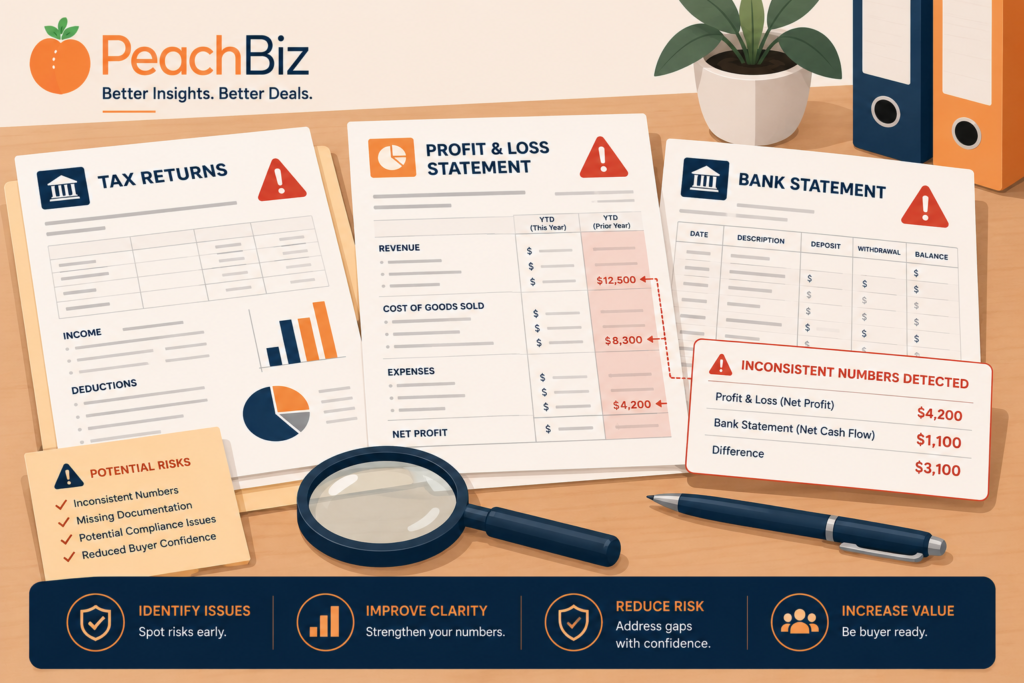
☐ Tax returns that don’t reconcile to P&L statements
What buyers see: Either aggressive tax strategy (which is fine) or financial mismanagement (which isn’t). The problem is they can’t tell which from the outside, and that uncertainty is enough to kill interest.
What to do: Prepare a clear reconciliation document that bridges your tax returns to your management P&Ls, with explanations for every significant difference. Have your CPA involved in this — their credibility adds to yours.
☐ Declining gross margins over the past three years
What buyers see: Pricing pressure, cost creep, or competitive erosion — all of which will continue after they take over. Shrinking margins on flat or growing revenue is one of the most concerning financial patterns buyers encounter.
What to do: Identify the specific drivers of margin compression. If it’s addressable — pricing strategy, vendor renegotiation, product mix shift — demonstrate that you’ve begun addressing it. If it’s structural, buyers need to understand that before they commit.
☐ Large, unexplained cash transactions or irregular banking patterns
What buyers see: Potential unreported income (which creates tax liability), potential cash diversion, or financial controls issues. Any of these create problems for financing and for the buyer’s own legal exposure post-acquisition.
What to do: If your business has historically operated with significant cash transactions, work with your CPA well in advance of a sale to document and normalize the financial picture. This is a multi-year cleanup, not a 30-day fix.
☐ Accounts receivable aging over 90 days represents more than 20% of total AR
What buyers see: Potential collection problems that will require working capital to resolve — and a working capital adjustment that will reduce their net proceeds or require them to fund a shortfall.
What to do: Aggressively collect aging receivables in the 12 months before a sale. Write off uncollectable accounts rather than carrying them — a clean AR aging report is worth more than inflated paper assets.
Category 2: Legal and Compliance Red Flags
☐ Pending or recent litigation
What buyers see: Contingent liability of unknown size, potential distraction during transition, and a signal that the business may have governance or relationship problems that generated the dispute.
What to do: Resolve pending litigation before going to market where possible. If resolution isn’t possible on your timeline, work with your attorney to quantify the range of outcomes and prepare a clear, honest disclosure. Buyers can price in known, bounded risks — they can’t price in open-ended unknowns.
☐ Payroll tax delinquency or IRS issues
What buyers see: An immediate, quantifiable liability that must be resolved at or before closing — and a signal about financial management practices.
What to do: Resolve any tax delinquencies before going to market. There are no workarounds here — most SBA lenders require a tax transcript showing no outstanding federal tax liabilities, and most sophisticated buyers won’t sign an LOI with unresolved IRS issues on the table.
☐ Worker misclassification (1099 vs. W-2)
What buyers see: Significant contingent liability — back payroll taxes, penalties, and potential employment law claims if the IRS or state labor board reclassifies your contractors as employees.
What to do: Have an employment attorney review your independent contractor relationships before going to market. If misclassification exists, the options are to reclassify proactively, disclose and quantify the risk, or resolve it through a voluntary disclosure program. This issue discovered in due diligence almost always either kills the deal or creates a significant escrow holdback.
☐ Licenses or permits that are non-transferable or expired
What buyers see: Operational continuity risk — if a key license doesn’t transfer to a new owner, the business may not be able to operate legally after closing.
What to do: Audit every license and permit your business holds. Identify which are personal to you versus transferable to a business entity. For non-transferable licenses, understand the re-application process and timeline so you can help buyers plan for it. For expired permits, renew them before going to market.
☐ Lease that is non-assignable or expires within 12 months
What buyers see: Either a landlord relationship that needs to be navigated before closing — with no guarantee of success — or a location that may not be viable post-acquisition.
What to do: Review your lease for assignment provisions before going to market. If the lease is non-assignable without landlord consent, begin that conversation early — ideally before you’ve signed an LOI. If the lease is expiring, open renewal discussions with your landlord and try to secure at least a 3–5 year extension before marketing the business.
Category 3: Customer and Revenue Red Flags
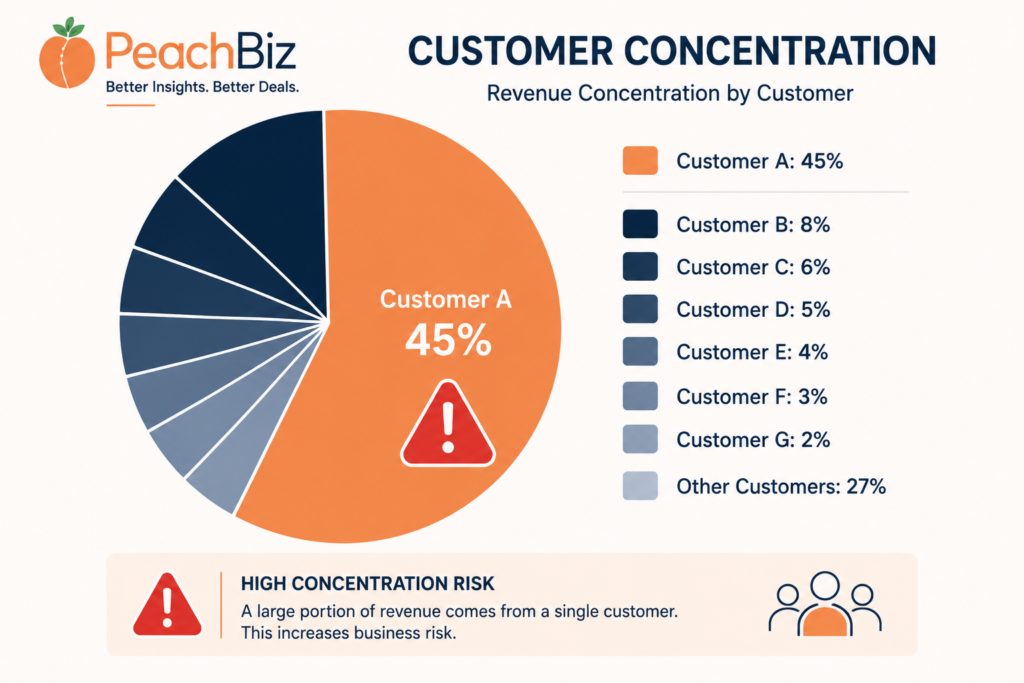
☐ Single customer represents more than 20% of revenue
What buyers see: Concentration risk that may not be financeable through SBA (which has specific concentration thresholds) and that creates existential revenue risk if that customer leaves post-acquisition.
What to do: Begin customer diversification immediately. Even moving a dominant customer from 35% to 22% over 18 months materially changes the risk profile. Where diversification isn’t possible on your timeline, prepare documentation showing the depth and security of the relationship — long-term contracts, personal introductions, demonstrated loyalty history.
☐ No written contracts with major customers
What buyers see: Revenue that exists only on a handshake — and that a new owner may not be able to retain because there’s no contractual obligation binding the customer to continue.
What to do: Convert your most important customer relationships to written agreements before going to market. Even simple annual service agreements or master service agreements create contractual continuity that buyers — and their lenders — can rely on.
☐ Revenue heavily dependent on a single product or service line
What buyers see: Concentration risk at the product level — if that product loses market relevance, faces a competitor, or encounters a supply disruption, the entire business is at risk.
What to do: Document the resilience of your product or service — market trends, competitive position, supplier relationships. If you have adjacent revenue streams that could be developed, highlight them as growth opportunities for the buyer.
☐ Declining customer retention rate
What buyers see: A business that’s losing its existing base faster than it’s replacing it — which means the revenue you’re showing today won’t be the revenue the buyer sees six months after closing.
What to do: Calculate and document your customer retention rate for the past three years. If it’s declining, identify why and what you’ve done about it. If it’s stable or improving, this becomes a selling point — document it clearly and include it in your financial presentation.
Category 4: Operational Red Flags
☐ No documented processes or standard operating procedures
What buyers see: A business that can’t be operated without the current owner — which means high transition risk, high training costs, and significant uncertainty about whether the business will perform at its current level after the handoff.
What to do: Begin documenting your core processes immediately. Focus on the highest-impact areas first: customer acquisition, service delivery, hiring and onboarding, financial management. Even basic documentation is dramatically better than none.
☐ Key employee who is likely to leave at or after the sale
What buyers see: Human capital risk — a departure of a critical employee during or immediately after transition can be as damaging to business performance as the owner leaving.
What to do: Identify your key employees and assess their likelihood of staying through a transition. Consider stay bonuses funded from sale proceeds (negotiated in the purchase agreement) that incentivize key employees to remain for 12–24 months post-close. In some cases, early, confidential conversations with key employees may be appropriate — coordinated carefully with your broker.
☐ Deferred maintenance or significant capital expenditure requirements
What buyers see: Hidden costs that will hit them immediately after closing — reducing their effective return on investment and creating cash flow pressure during the transition period when they can least afford it.
What to do: Either address deferred maintenance before going to market or disclose it transparently and price accordingly. Buyers who discover deferred capex in due diligence will demand a dollar-for-dollar reduction in price — or walk. Buyers who knew about it from the start have already factored it into their offer.
☐ Outdated technology or systems that require immediate replacement
What buyers see: Capital requirements and operational disruption in their first year of ownership — on top of the learning curve of running a new business.
What to do: Assess your technology stack honestly. If core systems are past end-of-life or are clearly inadequate, either upgrade before the sale or disclose the cost and timeline of replacement. Document what you have, what it does, and what a replacement would realistically cost.
Category 5: Owner and Transition Red Flags
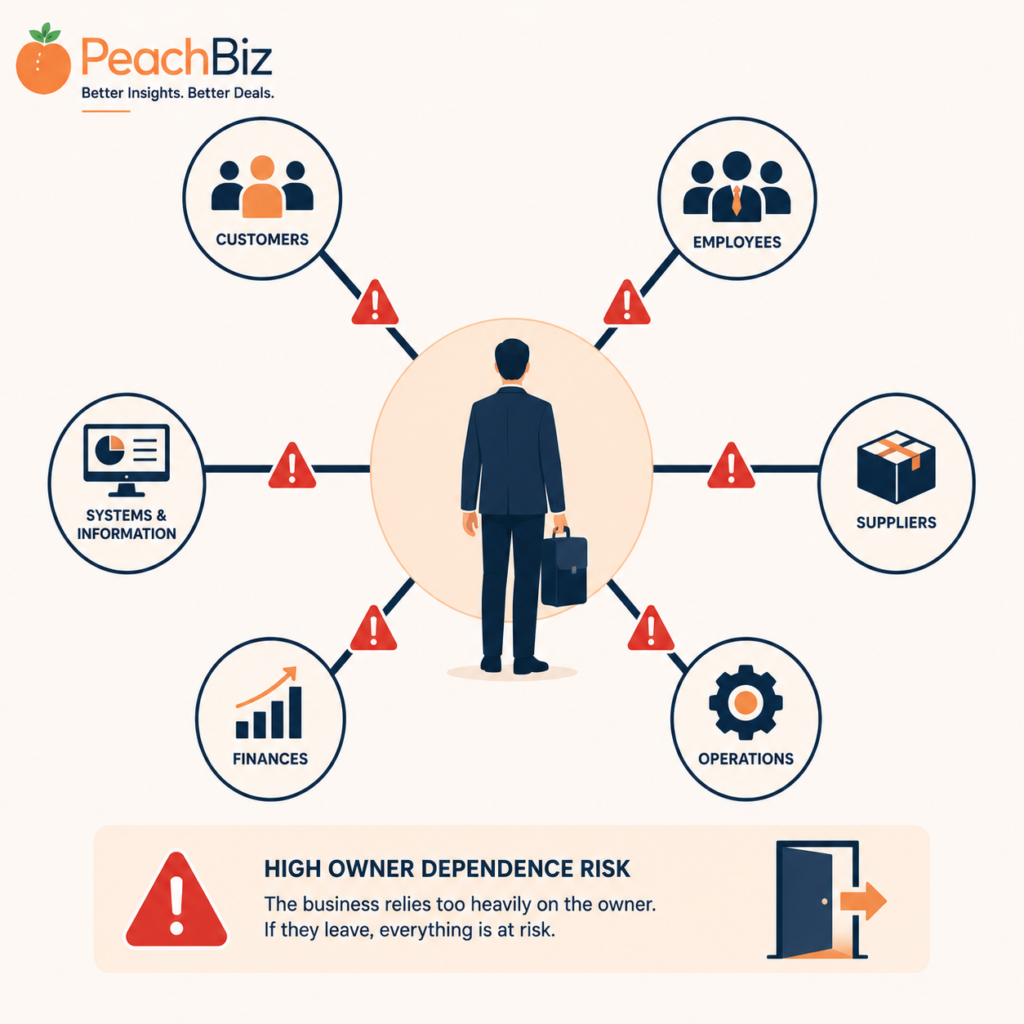
☐ Owner is the primary or sole salesperson
What buyers see: Revenue that may leave with the seller — because customers buy from the person, not the business. This is the single most common owner-dependence red flag buyers encounter.
What to do: Begin transitioning sales relationships to other team members or to a documented sales process before going to market. Even 12 months of demonstrated sales activity by someone other than the owner changes the conversation significantly.
☐ Owner holds all key customer and vendor relationships personally
What buyers see: Relationship risk — the possibility that critical counterparties will not transfer their loyalty to a new owner, particularly if those relationships were built on personal trust over many years.
What to do: Begin introducing key customers and vendors to other members of your team. Document the relationships — length of relationship, key contacts, communication preferences, special arrangements. Make a new owner’s relationship-building easier by laying the groundwork before you leave.
☐ Owner unwilling or unable to provide a reasonable transition period
What buyers see: A difficult handoff — and for SBA loans in particular, most lenders require a minimum transition period (typically 30–90 days) during which the seller remains available to support the new owner.
What to do: Plan for a transition period of 60–180 days depending on the complexity of your business. Build this into your mental model of the sale timeline early so it doesn’t become a negotiating obstacle at the LOI stage.
☐ Owner has unrealistic price expectations relative to market
What buyers see: A difficult counterparty who will be resistant to negotiation, who may pull back from the deal at any point, and whose emotional attachment to the business may create friction throughout the process.
What to do: Get a realistic market-based valuation before you go to market. Understand the gap between your hope price and your market price — and either close it through operational improvements or adjust your expectations before you start talking to buyers. We cover this in depth in Why Your Asking Price and Your Business Value Are Two Different Numbers.
Category 6: Market and Industry Red Flags
☐ Business operates in a declining or disrupted industry
What buyers see: A headwind they’ll be fighting from day one — and a question about whether the business model has a viable long-term future.
What to do: Be honest about your industry’s trajectory. If you’re in a challenged sector, the answer isn’t to hide it — it’s to articulate clearly why your business is positioned to navigate the disruption better than competitors, and why the buyer’s specific plan for the business is viable despite the industry headwinds.
☐ Single-source supplier with no backup
What buyers see: Supply chain concentration risk — if that supplier raises prices, changes terms, or goes out of business, the buyer has no alternative and potentially no business.
What to do: Qualify at least one alternative supplier before going to market, even if you don’t use them regularly. Document the alternatives. Show buyers that you’ve thought about this risk and have a contingency.
☐ Business model heavily dependent on a platform, algorithm, or third-party channel
What buyers see: Existential platform risk — a policy change, algorithm update, or platform decision could eliminate a significant portion of revenue overnight, with no recourse.
What to do: Diversify your channel mix before going to market. If you’re a marketplace seller with 80% of revenue from one platform, even moving to 60% with 40% spread across other channels and direct improves the risk profile meaningfully. Document your diversification efforts and the timeline.
Your Pre-Sale Action Plan
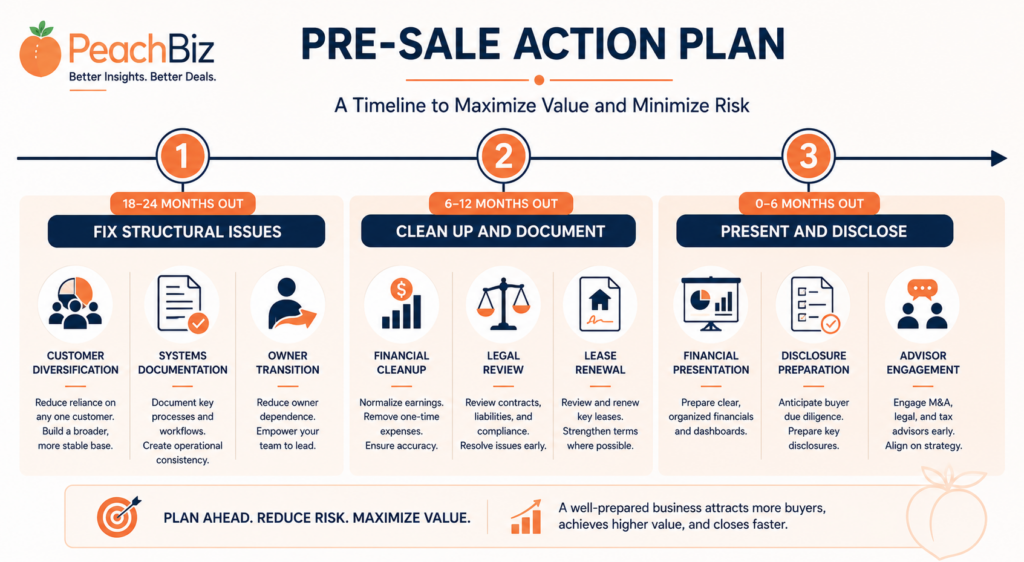
Working through this checklist is step one. What you do with the findings is what matters.
Here’s how to prioritize:
Fix before you go to market (18+ months out): Structural issues — customer concentration, owner dependence, revenue decline, worker misclassification — require the most time and the most sustained effort. These aren’t quick fixes. If you find them with 18 months to your target sale date, start immediately.
Clean up and document (6–12 months out): Financial documentation, legal review, lease renewal, systems documentation — these are intensive but time-bounded. A focused 90-day effort with the right professionals can resolve most of these.
Disclose and price (0–6 months out): If you’re too close to your sale date to fix a red flag, the only remaining options are proactive disclosure and appropriate pricing. A buyer who discovers a red flag themselves will react much more negatively than one who was told about it upfront. Control the narrative.
For every red flag you find, ask three questions: Can I fix it? How long will it take? What is it worth in dollars to fix? The answers determine your priority order and your timeline.
👉 Not sure where to start? Use our free Business Valuation Calculator to get a baseline value estimate and understand what your current profile looks like to a buyer.
👉 Use our Margin Health Check to identify financial red flags in your profitability profile before a buyer does.
Frequently Asked Questions
What is the most common reason business deals fall through?
The most common deal-killers — based on broker and M&A advisor experience — are unrealistic seller price expectations, financial documentation problems, and owner dependence discovered during due diligence. Of these, unrealistic pricing is the most common reason deals never get to LOI; financial and owner-dependence issues are the most common reasons deals fail after LOI.
When is it too late to fix a red flag?
It’s never too late to either fix or disclose. Even at the LOI stage, a proactively disclosed red flag with a clear explanation is manageable. What kills deals is a red flag discovered by the buyer’s team during due diligence that the seller knew about and didn’t disclose — that’s not just a deal issue, it can become a legal one.
Do I have to disclose red flags to buyers?
You have legal obligations that vary by state and deal structure — your attorney is the right resource for the specifics. Beyond the legal question, the practical answer is yes: material issues that affect the business’s value, operations, or risk profile should be disclosed. Sophisticated buyers will find them anyway, and discovery in due diligence is always worse than upfront disclosure.
How many red flags can a business have and still sell?
There’s no fixed number — it depends on the severity, the category, and whether they’re addressable in the deal structure. A business with three minor red flags that are fully disclosed and priced in can absolutely sell. A business with one catastrophic red flag — an unassignable lease on a retail location, for example — may not be sellable at all without resolving it first.
Should I hire someone to help me identify red flags before going to market?
Yes — a pre-sale advisory process with a business broker, exit planner, or M&A advisor is exactly the right investment for this. Their job is to see your business the way a buyer sees it, which is something you cannot do objectively as the owner. See How to Run an Exit Readiness Assessment on Your Client’s Business for a detailed look at what that process involves.
The Bottom Line
Red flags don’t announce themselves. They sit quietly in your business — in your customer list, your lease agreement, your tax returns, your org chart — until a buyer’s advisor finds them and uses them against you in price negotiations or simply walks away without explanation.
The checklist in this article is your opportunity to find them first. To fix what can be fixed. To disclose what can’t. To price what needs to be priced. And to go to market as a seller who has done the work — because buyers can tell the difference, and they pay for it.
The businesses that sell well, sell fast, and sell without drama are almost always the businesses where the seller did this work before the buyer ever called.
👉 Start your pre-sale assessment with our free Business Valuation Calculator — and know your number before a buyer tries to tell you what it is.
Related Reading
- The 10 Factors Buyers Score Before They Make an Offer
- How to Run an Exit Readiness Assessment on Your Client’s Business
- Why Your Asking Price and Your Business Value Are Two Different Numbers
- What “Deal-Ready” Actually Looks Like — And How Long It Takes to Get There
- Owner Dependency: The Single Biggest Value Killer in Small Business Sales
- How Customer Concentration Tanks a Valuation (And How to Fix It Before You Sell)
- Why Clean Books Are Worth More Than a Higher Multiple
- Explore All Free PeachBiz Business Calculators