
The Difference Between Enterprise Value and Equity Value (And Why It Matters at Closing)

Picture this: you’ve spent six months in a sale process. You’ve signed the LOI. The buyer agreed to a $3.2M purchase price. You’ve been mentally spending that money — paying off the mortgage, funding retirement, maybe buying that piece of land you’ve had your eye on.
Then the closing statement arrives.
The wire transfer hits your account for $2.1M.
What happened to the other $1.1M?
This scenario — painful, preventable, and more common than it should be — almost always traces back to one misunderstanding: the difference between enterprise value and equity value. Most sellers think of these as the same number. They are not. And the gap between them is exactly what shows up on that closing statement.
Understanding this distinction before you go to market isn’t just helpful — it’s essential. Let’s walk through it clearly.
What Is Enterprise Value?
Enterprise value (EV) is the total value of your business as an operating entity — the price a buyer is paying to acquire the entire business, including its debt obligations and regardless of how much cash it happens to be holding on closing day.
Think of it as the sticker price on the car before trade-ins, incentives, and financing adjustments. It’s the agreed-upon value of the business itself.
When a buyer says “we’re offering $3.2M for your business,” they almost always mean $3.2M in enterprise value. That number gets announced in the LOI, discussed in negotiations, and referenced in the purchase agreement. It’s the headline number.
But it is not — in most cases — the number that hits your bank account.
What Is Equity Value?
Equity value is what you, the seller, actually walk away with. It’s what’s left after the enterprise value has been adjusted for the financial obligations and assets that transfer — or don’t transfer — as part of the deal.
The formula is straightforward:
Equity Value = Enterprise Value − Debt + Excess Cash ± Working Capital Adjustment
Each of those components deserves a closer look, because each one is a place where significant money moves — and where sellers who don’t understand the mechanics get surprised.
The Three Adjustments That Turn Enterprise Value Into Equity Value
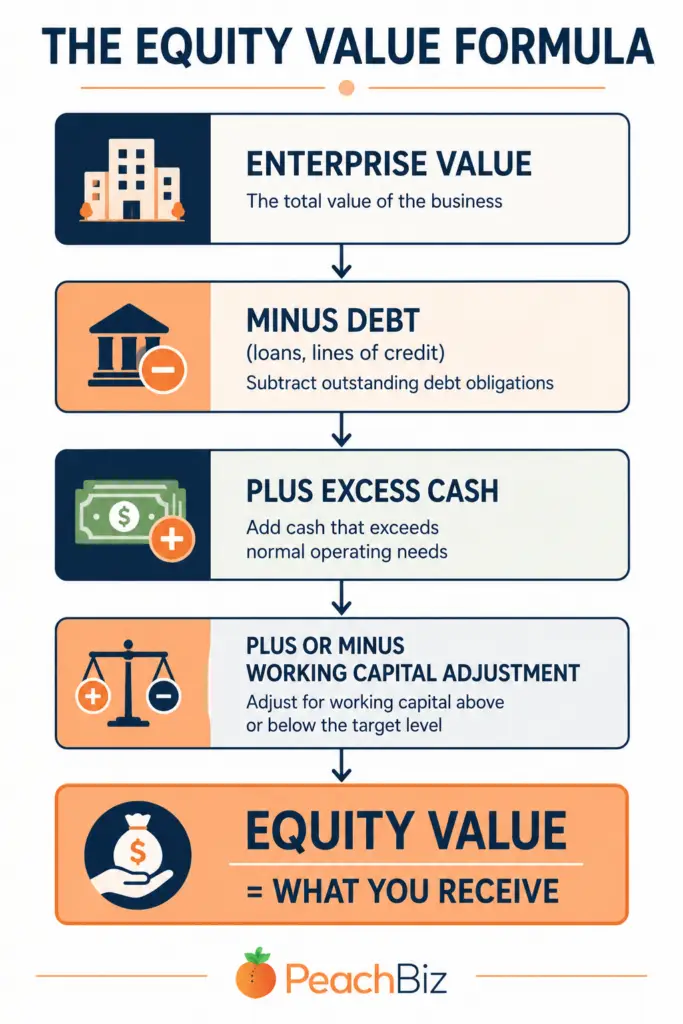
Adjustment 1: Debt — The Most Common Surprise
When a buyer acquires your business, they’re typically acquiring it free and clear of debt. That means any outstanding loans, lines of credit, equipment financing, or other interest-bearing obligations on your balance sheet get paid off at closing — and that payoff comes out of the purchase price before you see a dollar.
Here’s how it works in practice:
Enterprise Value: $3,200,000 Outstanding SBA Loan: −$680,000 Equipment Financing Balance: −$95,000 Line of Credit Balance: −$125,000 Subtotal after debt payoff: $2,300,000
That $900,000 in debt didn’t disappear — it got paid at closing from the purchase proceeds. You didn’t lose it; your lenders received it. But from your perspective, that’s $900,000 that never touched your bank account.
This is the most common source of the gap between the number sellers expect and the number they receive. Sellers who’ve been carrying debt for years sometimes stop thinking of it as “real money going somewhere at closing” — but it absolutely is.
What to do about it: Know your total debt load before you go to market. Work with your broker or M&A advisor to present the deal clearly on both an enterprise value and equity value basis. And factor your debt payoff into your retirement math long before you sign an LOI.
Adjustment 2: Excess Cash — The One That Works in Your Favor
Most M&A transactions are structured on a “cash-free, debt-free” basis. This means the buyer takes the business without any of the cash on the balance sheet at closing — and without any of the debt. The cash stays with you.
If your business is holding $150,000 in the bank on closing day, that cash is typically yours to keep on top of the enterprise value. In some deal structures, it’s explicitly added to your proceeds; in others, it’s simply retained by you before the transfer.
This is the one adjustment that generally works in your favor — but it’s also the one sellers most often forget to account for when they’re mentally running the numbers.
What to watch for: Not all cash is “excess cash.” Some of it may be classified as working capital — money needed to run the business operations — rather than free cash you can keep. Your deal documents will specify how cash is treated, and it’s worth reviewing this closely with your advisor.
Adjustment 3: Working Capital — The Most Negotiated Variable
This is the adjustment that generates the most complexity, the most negotiation, and the most post-closing disputes in business sales. Understanding it clearly before you reach the LOI stage will save you time, money, and significant frustration.
What is working capital?
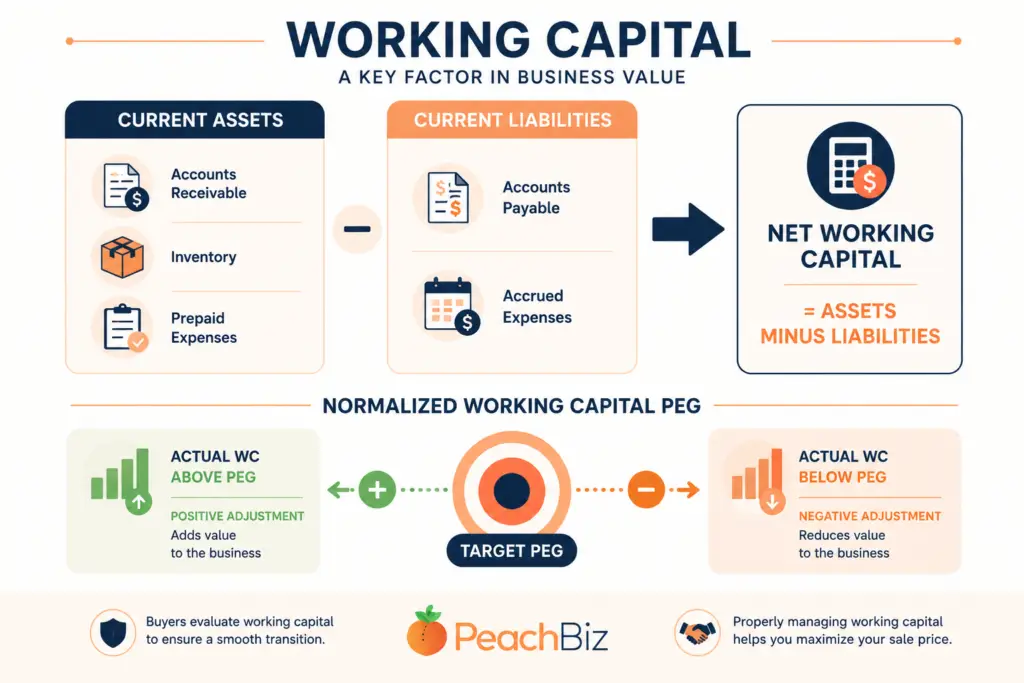
Working capital is the difference between your current assets (accounts receivable, inventory, prepaid expenses) and your current liabilities (accounts payable, accrued expenses). It’s the financial fuel that keeps your business running day-to-day — the money needed to pay suppliers, fulfill orders, and cover payroll before customer payments come in.
In most business sale agreements, the buyer and seller agree on a working capital target — sometimes called a “peg” — that represents the normal, expected level of working capital needed to operate the business. This peg is calculated based on historical averages, typically trailing 12 months.
Here’s where the adjustment happens:
- If the actual working capital at closing is above the peg, you receive the excess as additional proceeds.
- If the actual working capital at closing is below the peg, the shortfall is deducted from your proceeds.
In practice, this means you can gain or lose hundreds of thousands of dollars based on the state of your receivables, payables, and inventory on a specific day — closing day.
A real-world example:
Agreed working capital peg: $400,000 Actual working capital at closing: $310,000 Working capital shortfall: −$90,000 This $90,000 is deducted from your closing proceeds.
Sellers sometimes try to accelerate cash collection or delay vendor payments in the weeks before closing to boost working capital — a practice buyers are very aware of and specifically guard against in deal documents. The better approach is to run your business normally through closing and understand where your working capital naturally settles.
Why this matters for your planning:
The working capital peg negotiation happens during the LOI and purchase agreement phase — before closing, not at it. This is the time to push back, ask questions, and make sure the target reflects actual business operations rather than an artificially inflated benchmark a buyer might be trying to set.
Your broker or M&A advisor should model the working capital adjustment as part of your deal economics — not leave it as a surprise on the closing statement.
Putting It All Together: A Full Example
Let’s walk through a complete example that shows exactly how enterprise value becomes equity value on a real closing statement.
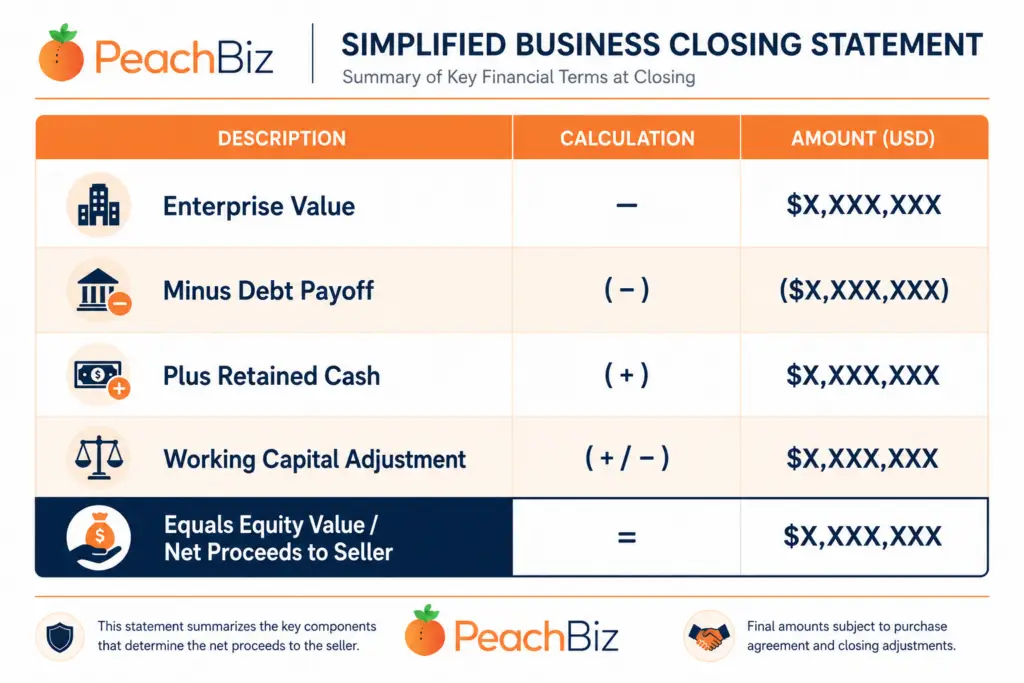
The deal:
- Agreed enterprise value: $3,200,000
- Outstanding business debt (SBA loan + equipment): −$775,000
- Retained cash (cash-free, debt-free structure): +$140,000
- Working capital adjustment (shortfall vs. peg): −$65,000
Equity value / net proceeds to seller: $2,500,000
That’s still a meaningful outcome — but it’s $700,000 less than the $3.2M headline number. A seller who didn’t understand these adjustments going in would feel blindsided. A seller who modeled them from the start planned for $2.5M and structured their retirement accordingly.
The math didn’t change. The expectations did.
Other Closing Adjustments Sellers Often Miss
Beyond the three primary adjustments, there are several other items that commonly appear on closing statements and affect your final proceeds:
Transaction costs. Broker commissions (typically 8–12% for Main Street deals, 3–6% for mid-market), legal fees, accounting fees, and representation & warranty insurance premiums all come out of proceeds at closing. These are known costs — factor them in early.
Seller notes. If part of your deal is structured as a seller note (you finance a portion of the purchase price for the buyer), that amount doesn’t arrive at closing. It comes in monthly payments over the note term — with interest, but over time, not as a lump sum.
Escrow / holdback amounts. Many deals include a portion of proceeds held in escrow for 12–24 months to cover any indemnification claims from the buyer. Typically 5–15% of enterprise value. You’ll receive it eventually — assuming no claims are filed — but not on closing day.
Tax obligations. The structure of your sale (asset sale vs. stock sale, installment sale treatment, capital gains vs. ordinary income) dramatically affects what you keep after taxes. This is a conversation to have with your CPA well before closing — not after. We cover this in depth in Asset Sale vs. Stock Sale: The Tax Impact Nobody Talks About Early Enough.
What This Means If You’re a Business Broker or Advisor
If you work with sellers, this is one of the most valuable conversations you can have early in the relationship — before the LOI, before the listing, ideally before the client has a number cemented in their head.
Walking a client through the enterprise-to-equity waterfall during initial discovery accomplishes several things:
- It sets realistic expectations before emotions get attached to a headline number
- It gives you credibility as an advisor who understands deal mechanics, not just brokerage
- It reduces the friction and renegotiation that happens when closing statements surprise unprepared sellers
- It positions you as a partner in their financial planning, not just their transaction
The sellers who feel best about their exits are almost never the ones who got the highest headline price. They’re the ones who understood what they were going to walk away with — and planned accordingly.
For CPAs specifically: your clients are often forming their sale price expectations in conversations with you before they ever talk to a broker. Being the advisor who explains the enterprise-to-equity adjustment clearly — with the tax implications layered in — makes you an indispensable part of the exit team.
Frequently Asked Questions
Is the purchase price the same as enterprise value?
In most M&A transactions, yes — the stated purchase price is enterprise value. But always confirm this in the LOI, because some deals are quoted on an equity value basis (particularly in stock sales). Know which number you’re looking at before you start spending it mentally.
Do all business sales include working capital adjustments?
Most deals above $500K in enterprise value include a working capital mechanism of some kind. Smaller Main Street transactions sometimes don’t — particularly asset sales of simple businesses. Your broker or attorney will tell you whether it’s included, but you should ask explicitly if it’s not mentioned.
What’s a typical seller note percentage?
It varies significantly by deal size and buyer type. SBA loans often require a seller note of 10% of the purchase price as a standby note. Private buyer deals without SBA financing might involve a seller note of 10–30% depending on how the buyer is financing the acquisition. Seller notes typically carry 5–8% interest rates.
How do I reduce the gap between enterprise value and what I receive?
Pay down debt before going to market where it makes financial sense to do so. Understand your working capital baseline so you’re not surprised by a shortfall adjustment. Negotiate transaction costs into your planning from day one. And structure your tax strategy in advance with your CPA — tax planning is one of the highest-ROI things you can do before a sale.
What happens to accounts receivable at closing?
It depends on the deal structure. In many asset sales, the seller retains accounts receivable — meaning you continue collecting invoices that were outstanding at closing. In stock sales and some asset sales, receivables transfer to the buyer. This should be explicitly negotiated and documented in your purchase agreement.
The Bottom Line
Enterprise value is what the buyer is paying for your business. Equity value is what you actually receive. The difference between those two numbers — paid to your lenders, retained as cash, adjusted for working capital — can easily run into six or seven figures.
None of this is hidden or unfair. It’s standard deal mechanics. But it only works in your favor when you understand it before you go to market, not after the closing statement lands in your inbox.
Model the full waterfall. Know your real number. Plan accordingly.
👉 Start with your enterprise value baseline using our free Business Valuation Calculator, then work with your advisor to model the full equity value picture.
👉 Curious how your deal structure choices affect what you walk away with? Explore our Business Financing Calculator to run different scenarios.
Related Reading
- What Is a Business Worth? The 4 Valuation Methods Explained
- Why Your Asking Price and Your Business Value Are Two Different Numbers
- How Deal Structure Affects the Real Price You Walk Away With
- Asset Sale vs. Stock Sale: The Tax Impact Nobody Talks About Early Enough
- Seller Financing as a Value Lever: How It Can Increase Your Sale Price
- Explore All Free PeachBiz Business Calculators