
Building an Exit Planning Practice: The Referral Engine Between Advisors
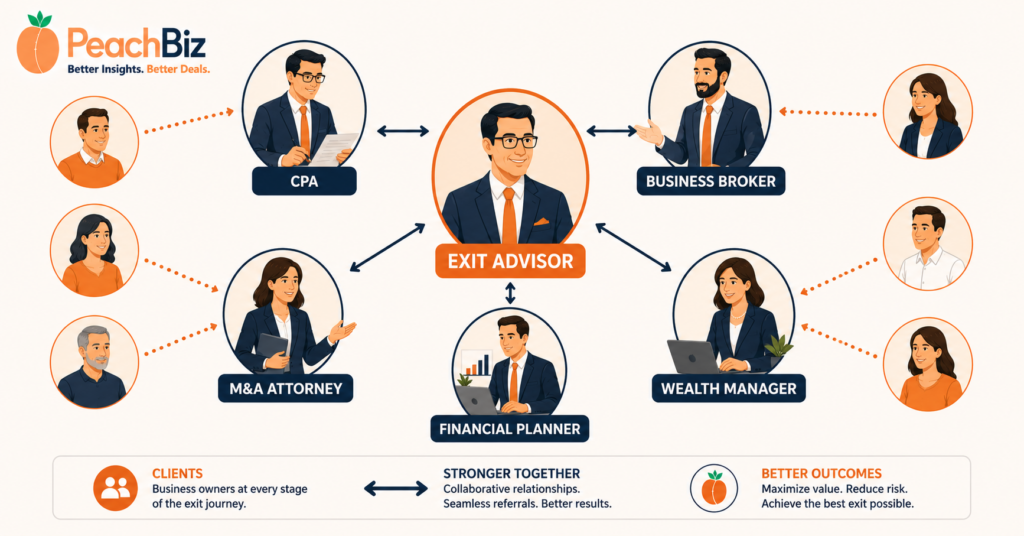
The most successful exit planning advisors — the ones who have built sustainable practices with consistent deal flow and genuinely satisfied clients — share one characteristic that has nothing to do with technical expertise.
They don’t work alone.
They’ve built what we call a referral engine: a structured, intentional network of complementary professionals who refer clients to each other consistently, collaborate effectively on shared engagements, and collectively serve business owners through the full arc of an exit — from initial planning through post-closing wealth management.
This isn’t networking in the conventional sense — attending events, collecting business cards, making occasional referrals when someone happens to ask. It’s something more deliberate and more valuable: a curated set of relationships with specific professionals whose practices complement yours, where referrals flow regularly in both directions, where you’ve built enough mutual trust to collaborate openly on shared clients, and where the whole network produces better outcomes than any single advisor could deliver alone.
This article is a practical guide to building that engine — from identifying the right partners, to structuring the relationships, to maintaining them over time, to making the network a genuine competitive advantage for your practice.
Why the Referral Engine Is the Business Model
Before we get into mechanics, let’s establish why the referral engine matters so much specifically in exit planning.
Exit planning clients are not abundant. The universe of business owners who are actively planning an exit — with enough runway to make advisory work meaningful, with the financial sophistication to value that work, and with the budget to pay for it — is a relatively small slice of the overall business owner population. You can’t reach them through cold outreach efficiently. You can’t advertise to them cost-effectively. And you can’t serve them well without a team.
The advisors who access this client population most consistently do it through trusted professional relationships — CPAs who refer clients planning exits, business brokers who identify clients who need pre-sale preparation, financial planners who see a large liquidity event approaching on a client’s horizon, attorneys who handle estate planning for business owners who’ve started thinking about succession.
Each of those professionals has ongoing relationships with exactly the clients you want to serve. And each of them has a need that you can meet — either by receiving referrals for services you provide, or by giving referrals that make their client relationships stronger.
The referral engine is the mechanism that makes those relationships systematic rather than occasional — predictable rather than random — and mutually valuable rather than one-directional.
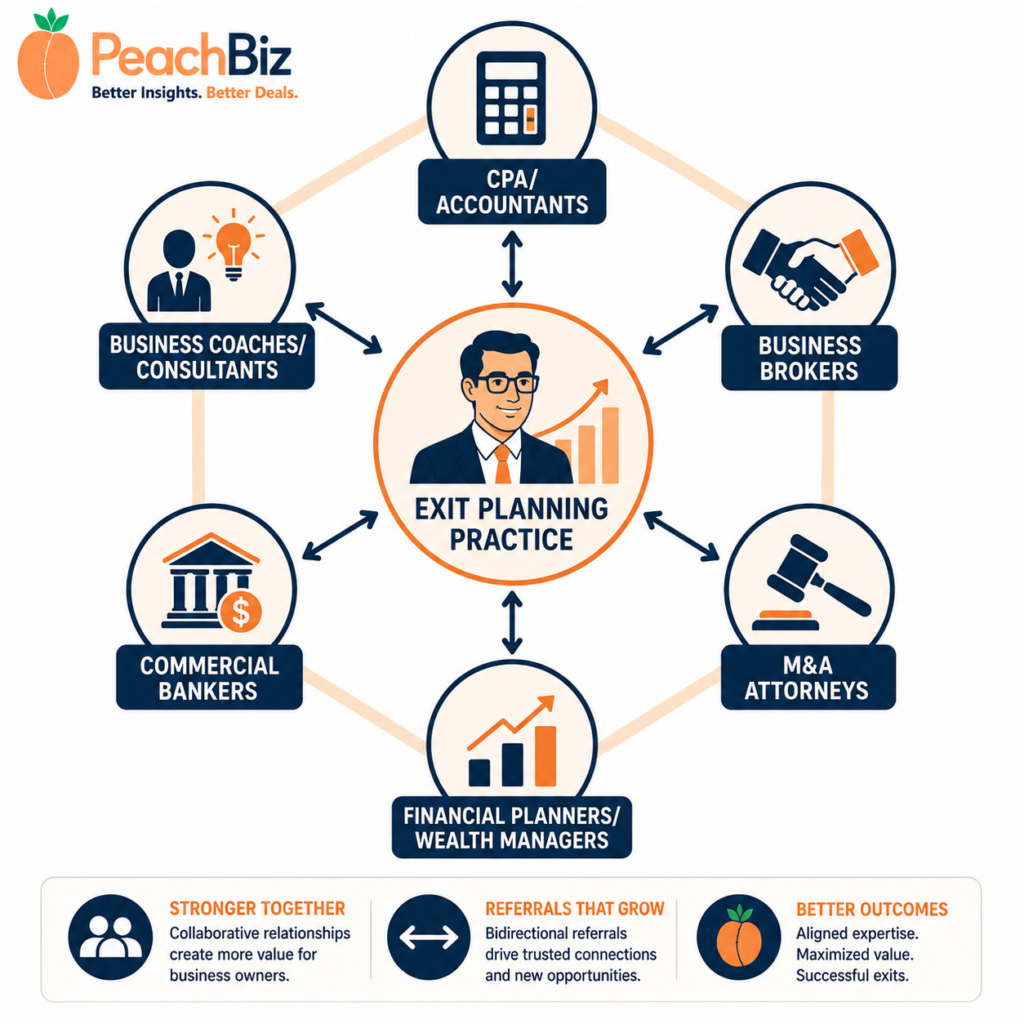
The Six Professional Communities That Feed an Exit Planning Practice
Not all professional relationships are equally valuable as referral sources. Here are the six communities that most consistently generate well-qualified exit planning clients — and what each community needs from you in return.
Community 1: CPAs and Accounting Firms
Why they’re your best referral source: CPAs have ongoing, trusted relationships with business owners. They know about exit intentions before almost anyone else — because they see the financials, they prepare the tax returns, and they’re often the first call when a client has a major financial decision to make. A CPA who understands what you do and trusts your work will refer exit planning clients consistently for years.
What they need from you: CPAs need to know that referring a client to you won’t jeopardize their relationship. They need to trust that you’ll keep them central to the engagement — not sideline them once you’re hired. They also genuinely value education about exit planning concepts they weren’t trained in: SDE normalization, deal structure tax implications, purchase price allocation, installment sale treatment. When you make a CPA smarter about transactions, you become someone they want to refer.
How to build the relationship: Lunch-and-learns for CPA firms on exit planning topics (especially tax-adjacent ones) are one of the highest-ROI business development activities available to exit planners. One presentation to a firm of 10 CPAs can generate referrals for years. Offer to co-present with the CPA on business owner workshops. Make yourself available as a resource for CPA questions on exit planning matters — not as a paid engagement, but as a professional courtesy that builds trust over time.
Community 2: Business Brokers
Why they’re a valuable referral source: Business brokers regularly encounter business owners who need exit planning work before they’re ready to list — clients with unrealistic price expectations, messy financials, significant owner dependence, or insufficient runway to close in their target timeline. A broker who can refer those clients to an exit planner, rather than declining to work with them, provides value to the client and maintains the relationship for when the business is actually market-ready.
What they need from you: Brokers need confidence that you’re not trying to take their client. They need to know that when the business is ready to sell, the referral comes back to them rather than to a competing broker. They also genuinely benefit from receiving clients who’ve done exit planning work — because those clients are more prepared, have more realistic expectations, and close more successfully.
How to build the relationship: Be explicit from the beginning about the referral reciprocity: when a client is ready to go to market, you refer to your broker partners rather than allowing the client to shop the listing. That commitment — made clearly and honored consistently — is the foundation of a sustainable broker relationship. Equally important: communicate about your mutual clients regularly, with appropriate privacy protocols.
Community 3: M&A Attorneys
Why they’re a valuable referral source: M&A attorneys handle the transaction legal work for business sales and often maintain long-term relationships with business owner clients around corporate governance, estate planning, and business contracts. When an attorney’s client mentions they’re thinking about selling, the referral to an exit planner is natural if the relationship exists.
What they need from you: Attorneys need to know you won’t overstep into their domain — that you’re not giving legal advice or representing yourself as a legal resource. They also value advisors who understand the legal mechanics of transactions well enough to prepare clients effectively for the legal due diligence process.
How to build the relationship: Join business law sections of your local bar association as an associate member. Attend events. Offer to present on exit planning topics — attorneys who do estate planning for business owners are particularly receptive. When you refer clients to attorneys, follow up to make sure the referral was well-received. Referrals that work generate reciprocal referrals.
Community 4: Financial Planners and Wealth Managers
Why they’re a valuable referral source: Financial planners and wealth managers often work with business owners on retirement planning and personal financial goals — conversations that naturally surface exit intentions. A wealth manager who sees that a client’s retirement timeline requires a business sale in the next 3–5 years has a natural reason to refer that client to an exit planner to begin the preparation work.
What they need from you: Wealth managers need to know that you understand their role in the post-sale picture — that you’re not trying to manage the investment of sale proceeds, and that you’ll refer the client back to them (or to their recommended advisor) for post-closing wealth management. They also genuinely value understanding more about the exit process, because the timing and structure of a business sale affects their clients’ retirement planning significantly.
How to build the relationship: Co-present with financial planners on business owner retirement topics. The “how to fund your retirement from a business exit” workshop, delivered jointly by an exit planner and a financial planner, is one of the most compelling business owner education events available — and it benefits both practice development efforts simultaneously.
Community 5: Commercial Bankers
Why they’re a valuable referral source: Commercial bankers have deep relationships with business owner clients through lending, cash management, and treasury services. They often know about ownership transitions before anyone else — because the business owner needs to refinance, secure working capital for a transition, or discuss the banking implications of a sale. SBA lenders in particular are connected to the business acquisition market and often know buyers who are looking for businesses to acquire.
What they need from you: Bankers need to know you can help their clients successfully navigate the financial aspects of an exit — making the banking transition smoother and the client relationship stronger through the process. They also value being part of a professional network that generates business owner introductions.
How to build the relationship: Introduce yourself to SBA lenders, commercial banking relationship managers, and business banking teams at your regional banks. Offer to present at their business owner client events. When you have clients who need SBA financing referrals, referring to bankers you know and trust creates the reciprocity that generates inbound referrals over time.
Community 6: Business Coaches and Consultants
Why they’re a valuable referral source: Business coaches and operational consultants work with business owners on performance improvement — and often discover in those engagements that the owner has an exit on the horizon. A business coach who understands exit planning can add enormous value to their clients by identifying when the improvement work they’re doing has exit implications and referring to an exit planner at the right moment.
What they need from you: Business coaches need clarity about how exit planning complements rather than competes with their work. The framing is natural: the coach improves business performance; the exit planner helps convert that improved performance into maximum sale value. Both serve the same goal.
How to build the relationship: Business coaching communities — EOS implementers, Vistage chairs, business performance coaches — are underappreciated referral sources for exit planners. Join peer groups where these professionals participate. Present on exit planning topics at their events. The “how to build a business that’s worth selling” framing resonates naturally with business coaches because it aligns with the performance improvement work they’re already doing.
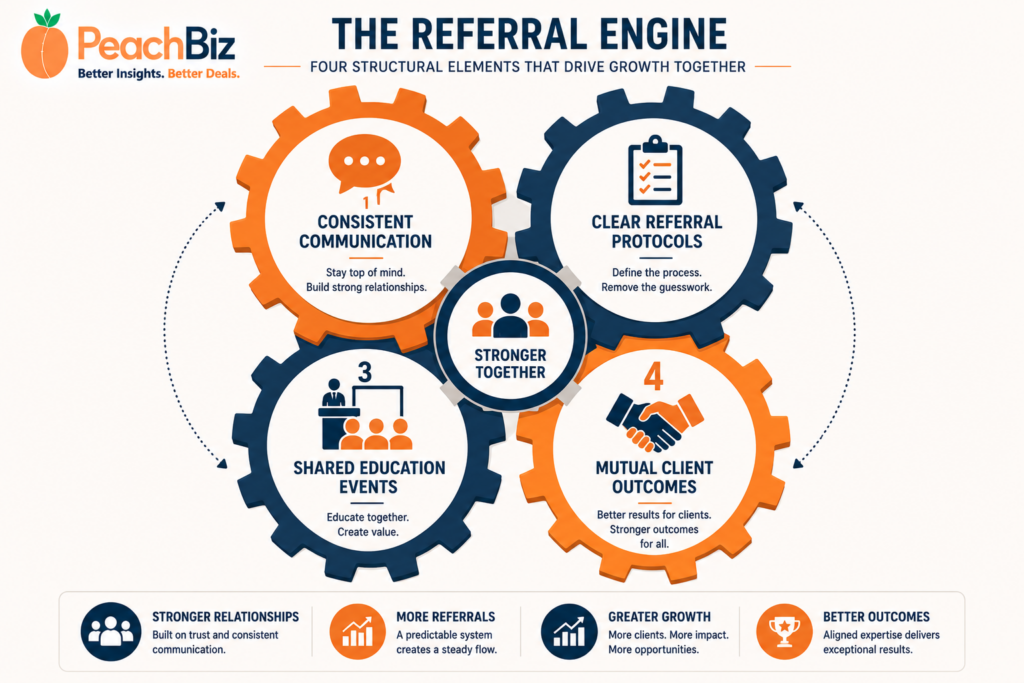
Building the Engine: The Four Structural Elements
Understanding who belongs in your referral network is necessary but not sufficient. The referral engine only works if it has structural elements that make referrals flow predictably rather than occasionally.
Element 1: Consistent, Proactive Communication
The referral relationships that generate the most consistent volume are the ones with the most consistent communication — not sporadic check-ins when you have something to offer, but regular touchpoints that keep you present in your partners’ minds when a relevant client situation arises.
Practically, this means:
- Monthly or quarterly check-ins with your top 5–10 referral partners (a brief call or coffee, not a formal meeting)
- A regular email or newsletter that provides exit planning content useful to your professional partners — not a sales pitch, but genuine intelligence they can use in their own practices
- Immediate follow-up when you receive a referral — acknowledging it, communicating about the outcome, and closing the loop with the referring partner
- Proactive referrals in the other direction — the most powerful way to reinforce a referral relationship is to make a referral yourself
The follow-up discipline: Most referral relationships atrophy because the recipient doesn’t follow up adequately. If a CPA refers a client to you and never hears how it went, the CPA doesn’t know whether the referral was a good use of their client relationship. A simple update — “I met with your client last week, here’s what we’re working on together, thank you for the introduction” — is the minimum that keeps a referral relationship alive.
Element 2: Clear Referral Protocols
Ambiguity about how referrals work — who should contact whom, what information transfers with the referral, what the client has been told, whether compensation is involved — is the friction that slows referral relationships down. Clear, explicit protocols remove that friction.
For each referral relationship, establish:
The referral trigger: What specific client situation should prompt a referral to you? “Any client who mentions selling within five years” is more actionable than “clients who might benefit from exit planning.”
The introduction process: Does the referring partner make a warm introduction by email or phone? Does the client reach out directly? Does the referring partner brief you before the introduction?
The information transfer: What does the referring partner share with you about the client (with the client’s consent)? Business type, size range, timeline, and any specific concerns that prompted the referral help you prepare for the first conversation.
Compensation: Most professional referral relationships in this space are non-compensated — the reciprocal referral flow is the compensation. However, some relationships involve formal referral fees, particularly when one party is consistently generating more referrals than the other. If compensation is involved, ensure it complies with applicable professional regulations in your jurisdiction.
The feedback loop: How and when do you report back to the referring partner? What information do they need to know the referral was handled well?
Element 3: Shared Education Events
One of the most effective ways to simultaneously build referral relationships and generate new clients is the joint educational event — a workshop, seminar, or roundtable that brings together business owner prospects and the professional advisors who serve them.
The most effective formats:
The Business Owner Workshop: A 90-minute educational event for business owners on exit planning topics — “What’s Your Business Worth and What Would It Take to Sell It?” — co-hosted by an exit planner and a CPA or financial planner. Each co-host brings their own clients and prospects. The educational content builds credibility. The Q&A generates conversations that convert to engagements.
The Advisor Roundtable: A breakfast or lunch roundtable for professional advisors — CPAs, brokers, attorneys, financial planners — focused on a specific exit planning topic. This is a practice development event for the advisors, not a client-facing event. The benefit is deepening your relationships with referral partners and positioning yourself as an educational resource within the professional community.
The Industry-Specific Workshop: A workshop targeted at business owners in a specific industry — “Exit Planning for HVAC Business Owners” or “Selling Your Professional Services Firm” — co-hosted with a broker who specializes in that industry. Industry specificity dramatically improves attendance and conversion rates because the content feels immediately relevant.
Frequency and format: The advisors with the strongest referral networks host two to four events per year — enough to maintain presence and generate new relationships without creating an unsustainable event calendar.
Element 4: Mutual Client Outcomes as Social Proof
The strongest argument for your referral network is a track record of excellent client outcomes. When the clients you’ve served together — the business owner whose exit was significantly better because the exit planner and broker worked together seamlessly — talk about their experience to other business owners, that social proof is more valuable than any marketing you could do.
Build case studies (with client permission and appropriate anonymization) of successful cross-disciplinary engagements. Share them with your referral partners. Use them in your business owner workshops. Publish them in your newsletter.
The advisor who can say “here’s a business owner we helped together, here’s what we did, here’s the outcome” is far more compelling to both referral partners and prospective clients than the advisor who talks about their process in the abstract.
The Reciprocity Principle: Giving Before You Get
The referral engine runs on reciprocity — but the most common mistake advisors make is waiting for reciprocity to show up before they give it.
The advisors who build the strongest referral networks are the ones who give proactively — who refer clients to partners before those partners have referred clients back, who share useful information without expecting immediate return, who make introductions because it’s the right thing for the client rather than because they expect something back.
This approach feels counterintuitive in a practice development context where every activity is mentally evaluated for ROI. But the ROI on proactive generosity in professional referral networks is both real and substantial — it’s just delayed and indirect.
Here’s the practical version of the reciprocity principle:
Make two referrals before you expect one. When you enter a new referral relationship, make two referrals to that partner before you’ve received any from them. This establishes your seriousness about the relationship and creates a genuine sense of reciprocal obligation — not a transactional one, but the natural human desire to return a favor.
Make introductions that don’t directly benefit you. If a CPA you’re building a relationship with would benefit from meeting a specific financial planner you know — and that introduction has nothing to do with a shared client — make it anyway. Being the connector in your professional network increases your value to every member of it.
Share intelligence freely. If you encounter research, a market development, or a professional insight that would be useful to a referral partner, share it without attaching any strings. A brief “thought this would be useful for your practice” email builds more relationship capital than a formal meeting.
Measuring Your Referral Engine
A referral engine you can’t measure is one you can’t improve. Track these metrics to understand how your network is performing and where to invest:
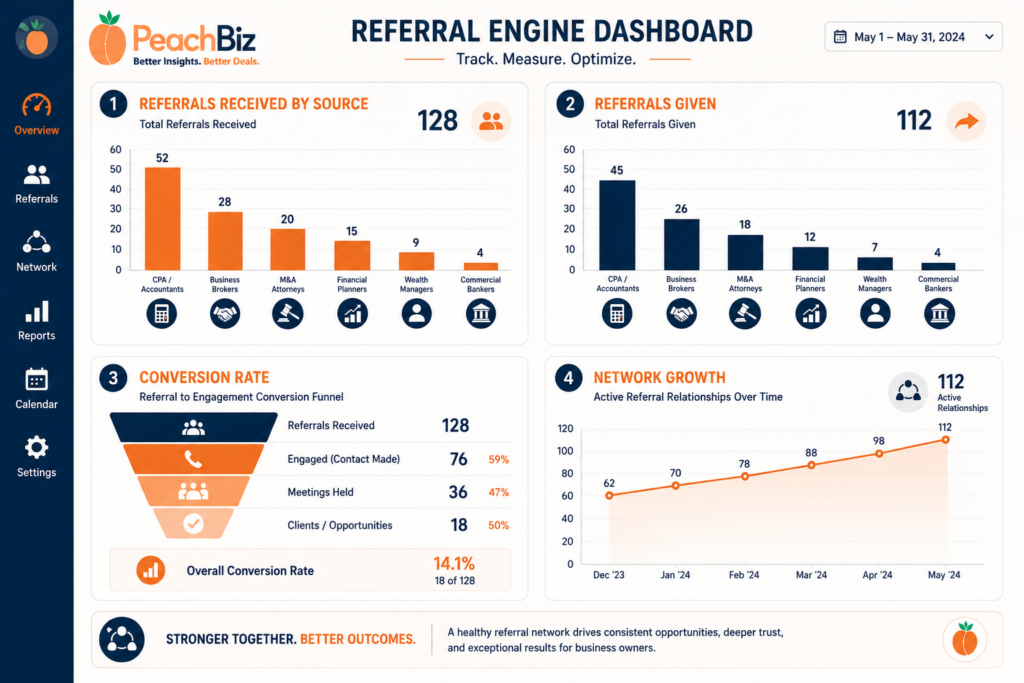
Referrals received by source: Which professional communities and specific individuals are generating the most referrals? This tells you where to invest more relationship-building time and where relationships need more attention.
Referrals given: Are you generating as much referral volume as you’re receiving from each relationship? Imbalanced referral flows eventually atrophy — the partner who’s giving more will deprioritize the relationship. Track your outbound referrals and make sure the reciprocity is real.
Conversion rate by source: What percentage of referrals from each source convert to engagements? High referral volume with low conversion often signals a mismatch between what the referring partner thinks you do and what you actually do — a clarity problem to solve through better partner education.
Relationship depth: For your top 10 referral partners, how often are you in contact? What’s the quality of the relationship — surface acquaintance or genuine trusted colleague? Relationship depth is a leading indicator of referral volume.
Client outcomes from referred engagements: How have the clients who came through your referral network fared? Excellent outcomes generate more referrals. Poor outcomes dry them up. Track and understand the connection.
Building the Engine Over Time: A Realistic Timeline
The referral engine doesn’t generate results immediately. Here’s a realistic timeline for what to expect:
Months 1–6: Foundation Building
Identify your target referral partner communities and specific individuals. Make initial outreach and begin building relationships. Host your first joint educational event. Make your first outbound referrals. Set up tracking systems.
Results: You’re building relationships, not yet receiving significant referral volume. This is normal and necessary.
Months 6–18: Relationship Deepening
Regular communication cadence with your top 10–15 partners is established. You’ve made referrals in both directions. You’ve worked together on at least a few shared clients. You’ve hosted 2–3 educational events. Partners are beginning to think of you when relevant client situations arise.
Results: Referral volume begins to appear — irregular but real. Some relationships are proving more productive than others; invest more in the productive ones.
Months 18–36: Engine Activation
Your network is established and active. Referrals flow regularly from multiple sources. You’ve built a track record of excellent outcomes on shared clients that your partners know about and can cite. Your educational events have an established audience.
Results: Referral volume is consistent and meaningful. New partners are entering the network through introductions from existing partners. The engine is largely self-sustaining.
Year 3 and Beyond: Optimization
The engine runs. Your investment shifts from building to maintaining — deepening the most productive relationships, pruning the unproductive ones, and selectively adding new partners who complement existing gaps.
Results: Consistent, high-quality referral flow from a trusted professional network that serves your mutual clients better together than any of you could alone.
Frequently Asked Questions
How many referral partners do I need?
Quality matters far more than quantity. Five deeply engaged referral partners — professionals who know you well, trust your work, and think of you consistently when relevant situations arise — will generate more value than fifty superficial connections who occasionally make a cold introduction. Target 10–20 relationships at various depths, with a core group of 5–8 who are your most active collaborators.
Should referral relationships be formalized with written agreements?
For most professional referral relationships, a formal written agreement isn’t necessary and can feel transactional in a way that actually impedes relationship building. The exception is when compensation is involved — any referral fee arrangement should be in writing and compliant with professional regulations. For non-compensated relationships, a shared understanding of how referrals work is more valuable than a formal agreement.
How do I handle a situation where a referral partner refers a client who isn’t a good fit?
Handle it honestly and promptly. Tell the referring partner directly — “Thank you for the introduction. After speaking with them, I think this client needs X, which is outside my specific focus — I’d recommend [alternative].” This kind of honest feedback makes you a more reliable referral partner over time, not a less reliable one. Partners who know you’ll be honest about fit trust you more, not less.
What if a referral partner makes promises to a client that don’t reflect what you actually do?
This is a clarity problem — the referring partner doesn’t understand your practice well enough to position you accurately. Address it directly with the partner (not in front of the client) and use it as an opportunity to clarify your positioning. A brief written description of your typical engagement, your ideal client profile, and what you specifically do and don’t do is a useful tool to share with referral partners — it reduces misrepresentation and improves referral quality.
How do I get started if I have no existing referral relationships?
Start with the professionals you already know — your own CPA, your attorney, financial advisors you’ve worked with personally. These warm connections are easier to develop into referral relationships than cold outreach to strangers. Also consider joining professional organizations where your target referral communities participate: local chapters of the Exit Planning Institute, IBBA (International Business Brokers Association), your state CPA society, and similar organizations are all places where the right professional relationships start.
The Bottom Line
The advisors who build the most successful exit planning practices aren’t necessarily the most technically sophisticated or the most experienced. They’re the ones who’ve built the most effective networks — the referral engines that consistently deliver well-qualified clients and enable the collaborative, team-based service that produces genuinely excellent client outcomes.
Building that engine takes time. It requires genuine investment in relationships — giving before you get, communicating consistently, following through on every referral, making introductions that don’t directly benefit you. It requires clarity about what you do, who you serve, and what you need from your professional partners to collaborate effectively.
But the advisors who’ve built it will tell you the same thing: there is no more efficient business development strategy, no more satisfying professional life, and no better way to serve clients than through a network of trusted colleagues who share your commitment to helping business owners exit well.
Start building yours today. One relationship at a time.
👉 Explore the tools your clients and referral partners will be using throughout the exit planning process — from our free Business Valuation Calculator to our comprehensive suite of Business Calculators built for business owners, brokers, and advisors.
Related Reading
- What CPAs Need to Know Before Their Client Decides to Sell
- How Exit Planners and Business Brokers Can Work Together (Without Stepping on Each Other)
- How to Run an Exit Readiness Assessment on Your Client’s Business
- The 10 Factors Buyers Score Before They Make an Offer
- What “Deal-Ready” Actually Looks Like — And How Long It Takes to Get There
- EBITDA Multiples by Industry: What Buyers Are Actually Paying Right Now
- Explore All Free PeachBiz Business Calculators