
Earnouts: When They Make Sense and When They’re a Red Flag

Few deal structure components generate more seller anxiety — or more post-closing disputes — than the earnout.
And for good reason. An earnout asks you to accept a fundamental bargain: we’ll pay you the full price you’re asking, but only if the business continues to perform at the level you’re claiming after you’ve handed it over to us. It’s a promise of payment that comes with conditions. And the conditions are measured after you’ve already given up control.
When earnouts work well, they’re a genuine bridge — a mechanism that allows a deal to close at a price the seller believes in, while giving the buyer confidence they’re not overpaying for performance that won’t materialize. Some sellers walk away from earnouts having collected every dollar they were promised, feeling the structure was fair.
When earnouts go badly — and they go badly more often than sellers expect — they become one of the most painful experiences in a business sale. The buyer makes decisions that affect performance. The earnout target is missed. The disputes begin. And the seller who thought they sold their business for $2.5M ends up having received $1.8M — and spent $40,000 in legal fees arguing about the rest.
Understanding when earnouts make legitimate sense, when they’re a red flag, and how to protect yourself when you have to accept one is some of the most valuable knowledge you can bring to a deal negotiation.
What an Earnout Actually Is
An earnout is a contractual provision in a business sale that makes a portion of the purchase price contingent on the acquired business achieving specific performance targets after closing. The seller receives a “base payment” at closing — typically a lower amount than the full agreed value — and earns additional payments if and when the business hits defined milestones.
A simplified example:
Enterprise value agreed: $2,000,000 Cash at closing: $1,400,000 Earnout: $600,000, payable if the business generates $800,000+ in revenue in the 12 months following closing
If the business hits $800,000 in Year 1 revenue, the seller receives the additional $600,000. If it generates $700,000, the seller receives nothing additional — or a prorated amount depending on the earnout structure. If it generates $850,000, the seller still receives $600,000 — earnouts typically have a cap.
The earnout doesn’t change the enterprise value the buyer and seller agreed on. It changes when and whether the seller receives the full amount.
When Earnouts Actually Make Sense
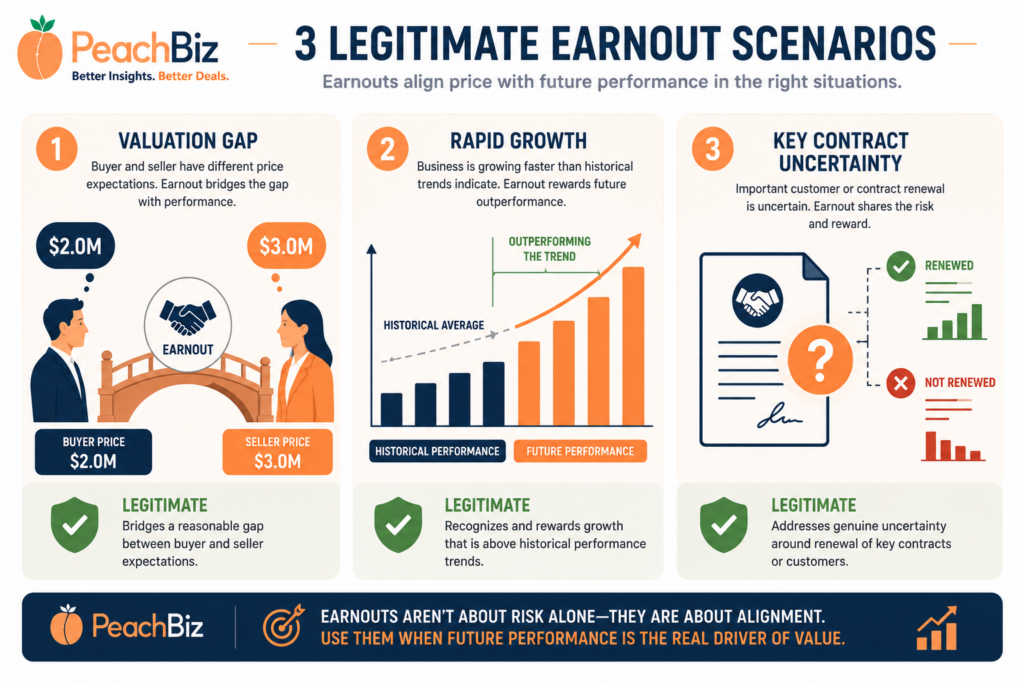
Not every earnout proposal is a red flag. There are legitimate scenarios where an earnout structure is actually a reasonable solution for both parties. Understanding them helps you distinguish between a buyer who is proposing an earnout in good faith and one who is using it as a negotiating tool to shift risk onto you.
Scenario 1: A Genuine Valuation Gap
The most legitimate use of an earnout is bridging a genuine, good-faith valuation disagreement. The seller believes the business is worth $2.5M based on its recent performance trajectory. The buyer believes it’s worth $2.0M based on historical averages. Neither is necessarily wrong — they’re applying different frameworks to the same data.
An earnout can bridge this gap: the buyer pays $2.0M at closing, and if the business performs at the level the seller is projecting, an additional $500,000 becomes payable. The seller gets the full value they believe in. The buyer gets downside protection against overpaying for projected performance that doesn’t materialize.
This is the earnout in its cleanest, most legitimate form — a valuation mechanism rather than a risk-shifting tool.
Scenario 2: Recent Rapid Growth That May or May Not Continue
If your business has grown 40% in the past 12 months — significantly faster than its historical average — a buyer has a legitimate question: is this growth sustainable, or is it a one-time spike that will normalize?
If the buyer values the business on trailing-twelve-month performance at the peak of the growth curve, they’re accepting the risk that the growth doesn’t continue and they’ve overpaid. An earnout that pays the full value only if the growth is sustained is a reasonable risk-sharing mechanism in this scenario.
For sellers who genuinely believe their recent growth is sustainable — because they’ve landed multi-year contracts, because they’ve made operational improvements that permanently elevated performance, because the market shift driving the growth is structural rather than temporary — an earnout can actually be to your advantage: it allows you to capture full value for performance you believe will continue.
Scenario 3: Pending Contracts or Key Events
If a major contract renewal, regulatory approval, or strategic partnership is pending at the time of sale — one that would significantly affect the business’s value — an earnout tied to that specific event can be a clean, limited bridge.
“We’ll pay $1.8M at closing and an additional $400,000 if the XYZ contract renews for three years” is a specific, time-bounded earnout with a clear binary trigger. It’s different from a broad performance earnout that exposes the seller to general business risk for 24 months.
Scenario 4: High Owner Dependency That Creates Genuine Transition Risk
If the seller acknowledges that their business has meaningful owner dependency — that key customer relationships are personal, that the operation requires significant owner judgment — an earnout tied to post-closing revenue retention can be a legitimate mechanism for sharing the transition risk between buyer and seller.
In this scenario, the earnout is essentially insurance for both parties: the seller who is confident in the transition gets paid in full if their confidence is justified. The buyer who is worried about transition risk gets protection against a scenario they can’t fully underwrite.
The key is that the seller enters this earnout with clear eyes — knowing what the risk is and believing they can manage it through active transition support.
When Earnouts Are a Red Flag
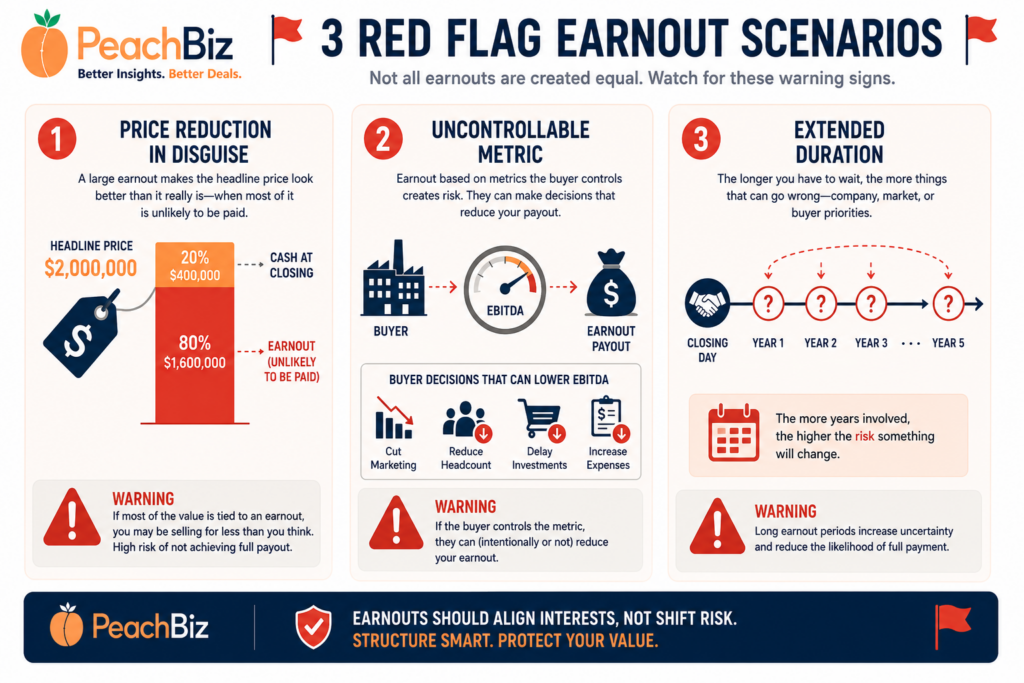
Just as important as knowing when earnouts are legitimate is knowing when they’re being used as a negotiating tool that primarily benefits the buyer at the seller’s expense.
Red Flag 1: The Earnout That’s Really a Price Reduction
The most common earnout red flag is the “soft offer” — a buyer who proposes a headline enterprise value that seems attractive but structures the deal so that a large percentage of that value is in an earnout tied to targets that are genuinely difficult to achieve.
If a buyer proposes $2.5M enterprise value with $800,000 in cash at closing, $400,000 seller note, and $1,300,000 in earnout tied to 25% revenue growth over two years — the real offer is $1,200,000 in relatively certain proceeds, with $1,300,000 contingent on growth the buyer may not be positioned to achieve or motivated to pursue.
The earnout in this scenario isn’t bridging a valuation gap — it’s reducing the buyer’s effective price by making a large portion of the value contingent on something that may not happen.
How to identify it: Calculate the base payment (cash + seller note) as a percentage of the enterprise value. If the earnout represents more than 20–25% of the total, ask hard questions about why such a large portion is contingent. If the earnout targets require performance significantly above the business’s historical trajectory, the buyer is essentially asking you to accept risk for upside you haven’t yet created.
Red Flag 2: An EBITDA-Based Earnout Metric
EBITDA earnouts are dangerous for sellers because EBITDA is entirely within the buyer’s control to influence after closing. A buyer who wants to avoid paying an earnout can increase expenses, accelerate investment, change accounting methods, or shift costs between periods in ways that legitimately reduce EBITDA without harming the underlying business.
None of that requires bad faith. A buyer who hires two additional employees in Month 6 because they believe it’s the right investment for long-term growth is making a perfectly defensible business decision — and also reducing the EBITDA that determines your earnout payment.
The alternative: Revenue-based earnouts are significantly seller-friendly by comparison. Revenue is harder to manipulate, directly observable, and less affected by buyer operational decisions. When you have to accept an earnout, push hard for revenue as the metric.
Red Flag 3: Duration Over 24 Months
Every month of earnout period is another month during which the buyer controls the business, makes decisions that affect your earnout, and has potential to create circumstances — intentional or otherwise — that result in the earnout not being paid.
Earnout periods of 12 months are manageable. Twenty-four months is at the outer edge of acceptable. Anything longer than 24 months should be challenged — because you’re accepting a multi-year exposure to risk in a business you no longer own or control.
If a buyer is proposing a 36-month or longer earnout, ask specifically why they need that duration and what specific uncertainty they’re trying to hedge against. The answer will tell you a great deal about whether the earnout is a legitimate bridge or an attempt to significantly defer and reduce the purchase price.
Red Flag 4: Vague or Manipulable Measurement Provisions
Earnout provisions that don’t specify exactly how the metric will be calculated — which accounting standards, which customers are included, how intercompany allocations are handled, what happens with acquisitions the buyer makes during the earnout period — are red flags regardless of the headline terms.
Vague measurement provisions don’t just create legal risk. They create disputes. And disputes in earnout periods are expensive, slow, and damaging to the seller’s relationship with the buyer during a period when you still need them to cooperate on your earnout payments.
Every earnout should specify:
- Exact metric definition (revenue means X, calculated as Y, excluding Z)
- Accounting standards to be applied (GAAP, cash basis, as previously reported)
- Reporting requirements (when and how the buyer reports earnout metrics)
- Audit rights (your right to independently verify the reported numbers)
- Dispute resolution mechanism
Red Flag 5: No Protection Against Buyer Actions That Affect Performance
If the earnout has no provisions protecting the seller against buyer decisions that could depress performance — pricing changes, customer relationship decisions, cost increases, changes to the sales team — the seller is fully exposed to actions that are outside their control but directly affect their payment.
This isn’t hypothetical. Post-closing, buyers regularly make operational decisions that are entirely reasonable from a business perspective but that reduce short-term revenue or EBITDA. Without earnout protection provisions, those decisions reduce the seller’s earnout without any recourse.
Essential protective provisions:
- Negative covenants: Restrictions on specific buyer actions during the earnout period that would materially reduce the earnout metric (e.g., restrictions on raising prices above X%, restrictions on terminating key sales staff without replacement, restrictions on discontinuing specific product lines)
- Anti-sandbagging protections: Prohibitions on deliberate actions to depress performance metrics
- Acceleration on sale: If the buyer sells the business during the earnout period, the full remaining earnout becomes immediately due
- Change of control protections: If the buyer is acquired or merges, the earnout obligations survive and transfer
The Earnout Negotiation Playbook
If you’re facing an earnout proposal and can’t negotiate it out entirely, here’s how to protect yourself as effectively as possible.
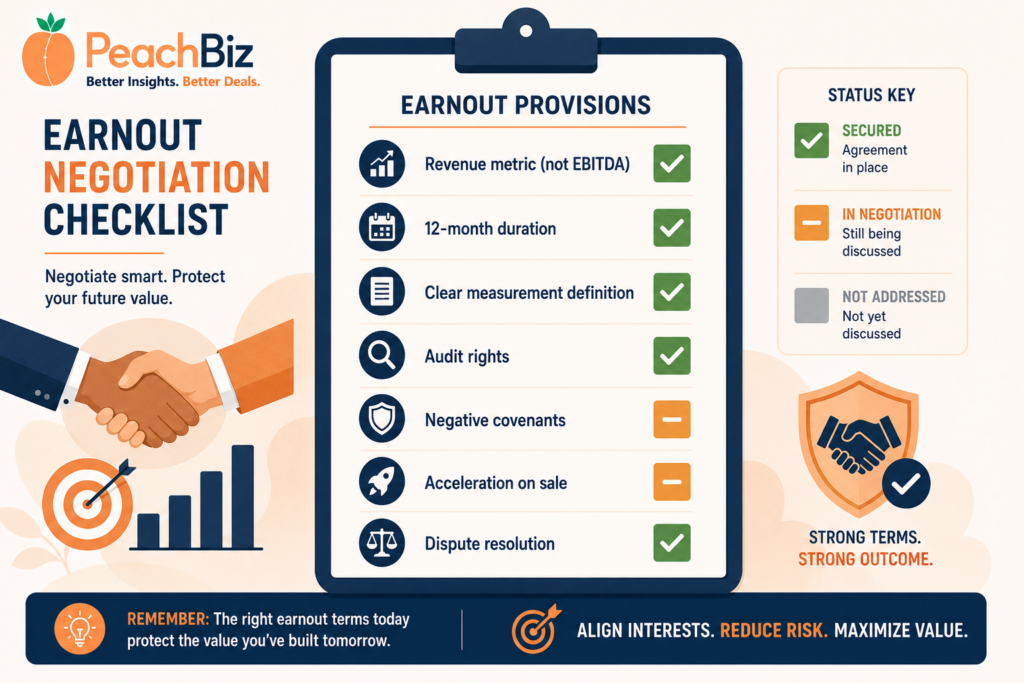
Negotiate the metric first.
Before you discuss duration, targets, or protection provisions — negotiate the metric. Revenue is the most seller-friendly earnout metric. Gross profit is a reasonable middle ground. EBITDA or net income are buyer-favorable and should be resisted. If the buyer insists on an earnings-based metric, push for strong negative covenants that limit their ability to increase expenses during the earnout period.
Push for the shortest possible duration.
Twelve months is the target. Twenty-four months is the maximum you should accept without significant additional compensation for the extended exposure. For every month of earnout duration beyond 12, push for either a reduction in the earnout amount or an increase in cash at closing.
Set targets at or below current performance.
Earnout targets should be based on what the business has historically demonstrated — not on what the buyer hopes or what the seller is projecting. A target at 100% of trailing 12-month revenue requires the business to maintain current performance. A target at 90% of trailing revenue gives both parties a small buffer. A target at 125% of trailing revenue requires growth that the buyer, not the seller, is responsible for generating.
Get your audit rights in writing.
You have the right to independently verify the earnout calculation — but only if that right is explicitly included in the purchase agreement. Without it, you’re relying on the buyer’s reported numbers with no ability to confirm their accuracy. Audit rights should include access to relevant financial records, the right to engage an independent accountant, and a defined timeline for exercising the right.
Negotiate a floor.
Some earnout structures include a minimum payment that the seller receives regardless of performance — for example, “the seller will receive a minimum of $150,000 of the earnout regardless of performance, with the remaining $250,000 contingent on hitting the target.” A floor provides partial protection against the worst-case scenario.
Include a dispute resolution mechanism.
Specify in the purchase agreement how earnout disputes will be resolved — ideally through a neutral third-party accountant or arbitrator rather than litigation. Litigation is expensive, slow, and uncertain. A pre-agreed dispute mechanism reduces the risk and cost of disagreements about earnout calculations.
The Tax Dimension of Earnouts
Earnouts have tax implications that are often overlooked until after the deal closes — which can significantly affect the seller’s after-tax proceeds from the deferred payments.
The basic principle: earnout payments are generally taxed when received, not when agreed to. This means:
- If the earnout is paid in Year 1 post-closing, it’s taxed as income in Year 1
- If the earnout spans multiple years, the tax liability is spread across those years
- The characterization of the earnout payment (ordinary income vs. capital gain) depends on the deal structure and what the earnout is tied to
The installment sale rules under IRC Section 453 govern how earnouts are taxed in most transactions. The rules are complex and situation-specific — which is why your CPA needs to model the tax implications of any earnout structure before you agree to it.
A few specific issues worth flagging for your tax advisor:
- Open transaction treatment vs. closed transaction treatment for uncertain earnout amounts
- The interaction between earnout payments and the allocation of purchase price across asset classes
- State tax implications of earnout payments received in a different tax year than the closing
We cover the broader tax implications of deal structure in Asset Sale vs. Stock Sale: The Tax Impact Nobody Talks About Early Enough.
Alternatives to Earnouts
Before accepting an earnout, explore whether there are alternative structures that achieve the same risk-balancing objective with less seller exposure.
Seller note with performance adjustment: Instead of a contingent earnout payment, a seller note with a provision that adjusts the principal balance based on Year 1 performance gives the buyer downside protection while giving the seller a more certain payment structure and predictable returns.
Escrow holdback: A portion of the purchase price held in escrow for 12 months and released based on representations and warranties — not performance targets — is a limited, time-bounded risk-sharing mechanism that doesn’t expose the seller to operational performance risk.
Reduced price with no earnout: Sometimes the cleanest solution is to accept a lower certain price rather than a higher contingent one. The math depends on your confidence in the earnout targets being hit and your need for certainty in your proceeds. A $1.8M certain sale can be worth more than a $2.3M deal with $500,000 in earnout that has a 50% probability of being paid.
Extended transition with consulting agreement: If the buyer’s earnout concern is transition risk — “we’re not sure we can maintain the business without you” — a longer transition period or paid consulting agreement may address the underlying concern without requiring a contingent payment structure.
👉 Use our free Business Financing Calculator to model different earnout scenarios side by side — including the probability-weighted value of earnout payments versus certain alternatives.
Frequently Asked Questions
How common are earnouts in small business sales?
Earnouts appear in roughly 20–30% of small and mid-market business transactions, according to broker surveys. They’re more common in certain situations — high-growth businesses, businesses with significant owner dependence, transactions where the buyer and seller have a meaningful valuation gap — and less common in stable, well-documented businesses where the buyer has high confidence in the financial presentation.
Can I walk away from a deal because of an earnout?
Yes — and sometimes you should. If a buyer’s earnout proposal represents an unacceptable shift of risk onto the seller, or if the earnout terms are structured in a way that makes payment unlikely, declining the offer or counter-proposing a different structure is entirely reasonable. The best earnout is the one negotiated out of the deal entirely.
What happens if I disagree with the buyer’s earnout calculation?
This is why dispute resolution provisions matter. Without them, disagreements about earnout calculations often become expensive litigation. With a well-drafted dispute resolution clause — specifying that disputes go to a neutral accountant or arbitrator rather than to court — the resolution process is faster, cheaper, and more predictable.
Do earnouts get paid if the business is sold during the earnout period?
Only if the purchase agreement includes an acceleration provision. Without explicit acceleration language, a buyer who sells the business during the earnout period may be able to structure that sale in ways that leave your earnout unpaid or disputed. Acceleration on sale — the full remaining earnout becomes immediately due if the business changes hands — is a non-negotiable provision in any earnout you accept.
Is the earnout payment taxed as ordinary income or capital gain?
It depends on the deal structure and what the earnout is tied to. In most asset sale transactions where the earnout is tied to business performance, the payments are treated as additional sale proceeds and taxed at capital gains rates. However, if the earnout is structured as compensation for post-closing services — for example, tied to the seller’s continued employment — it may be characterized as ordinary income. Your CPA should model the tax treatment before you agree to any earnout structure.
The Bottom Line
Earnouts are neither inherently good nor inherently bad. They’re a tool — one that can bridge legitimate valuation gaps and allow deals to close that otherwise wouldn’t, or one that can shift risk inappropriately onto a seller who doesn’t fully understand what they’re agreeing to.
The difference between a reasonable earnout and a damaging one isn’t always visible in the headline terms. It’s in the metric, the duration, the targets, the protective provisions, and the dispute resolution mechanism. It’s in understanding whether the earnout is bridging a genuine valuation disagreement or reducing the buyer’s effective price through conditions that are unlikely to be met.
Go into any earnout negotiation knowing the difference. Push for revenue metrics, short durations, achievable targets, strong protections, and clear dispute resolution. And if you can negotiate the earnout out entirely — take that deal.
👉 Model your earnout scenarios and compare them to clean deal alternatives with our free Business Financing Calculator.
Related Reading
- How Deal Structure Affects the Real Price You Walk Away With
- Seller Financing as a Value Lever: How It Can Increase Your Sale Price
- Asset Sale vs. Stock Sale: The Tax Impact Nobody Talks About Early Enough
- The Difference Between Enterprise Value and Equity Value (And Why It Matters at Closing)
- Red Flags That Kill Deals Before the LOI: A Pre-Sale Checklist
- Why Your Asking Price and Your Business Value Are Two Different Numbers
- Explore All Free PeachBiz Business Calculators