
What “Deal-Ready” Actually Looks Like — And How Long It Takes to Get There

“Deal-ready” is one of those phrases that gets used constantly in business sales conversations — by brokers, by exit planners, by M&A advisors — without anyone taking the time to define what it actually means.
So let’s define it.
A deal-ready business is one where a qualified buyer can understand what they’re buying, verify that it is what you say it is, finance the acquisition through conventional channels, and operate it successfully after you leave — without discovering anything that makes them wish they hadn’t.
That’s it. Not perfect. Not flawless. Not without any risk. Deal-ready means clear, documented, verifiable, and transferable. It means a buyer can do their job — evaluate, finance, and close — without running into walls that send them back to the negotiating table or push them to walk away entirely.
What surprises most sellers is how specific “deal-ready” actually is — and how far in advance the work needs to start. In this article we’re going to show you exactly what deal-ready looks like across every dimension of your business, give you honest timelines for each area, and help you build a realistic roadmap from where you are today to where you need to be on the day you go to market.
The Deal-Ready Benchmark: What Buyers Actually Need to See
Before we get to timelines and action plans, let’s establish the standard. Here is what a deal-ready business looks like — the specific benchmarks that experienced buyers, their lenders, and their advisors expect to find when they evaluate a well-prepared business for sale.
These aren’t aspirational ideals. They’re the practical minimum for commanding a market-rate price, attracting qualified buyers, and closing without renegotiation.
Financial Benchmark: Three Clean Years
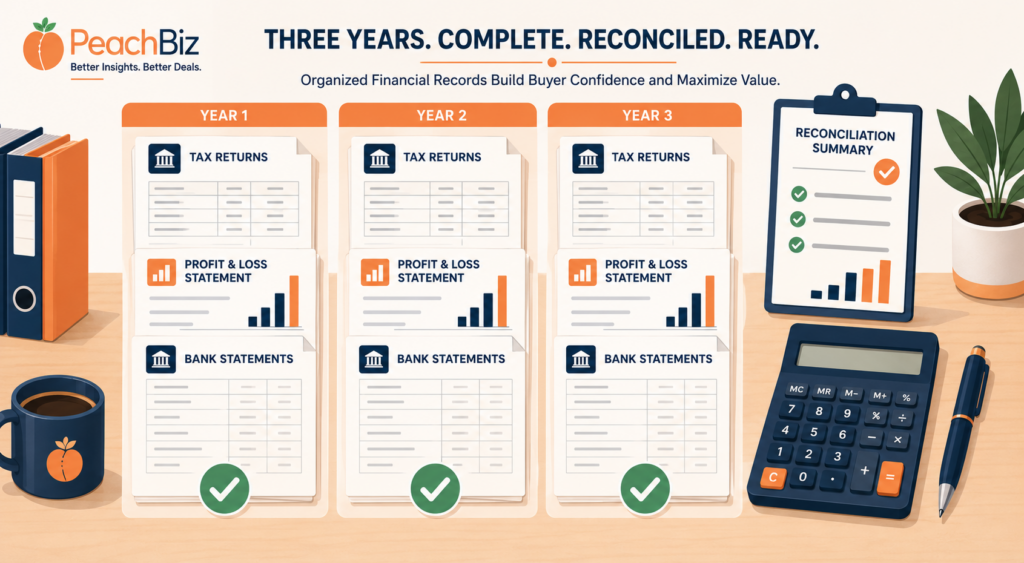
A deal-ready business has three consecutive years of financial records that are clean, consistent, and reconcilable. Specifically:
- Tax returns for the past three years that reconcile to your P&L statements with documented explanations for any differences
- Monthly profit and loss statements for the past 24–36 months showing revenue, cost of goods, gross margin, and operating expenses clearly categorized
- A current balance sheet that accurately reflects assets, liabilities, and equity
- Bank statements for the past 24 months that support the financial figures
- A normalized earnings analysis — a clear, documented recast of your SDE or EBITDA with every add-back explained and supported
The normalized earnings document is particularly important. It’s the financial foundation of your valuation, and a buyer’s advisor will scrutinize every line. Add-backs need to be defensible — not creative accounting, but legitimate normalizations that a reasonable buyer would accept.
The standard: No unexplained variance greater than 10% between any two comparable periods. Every material add-back supported by documentation. Financial statements that a CPA could review and confirm within 30 days.
Operations Benchmark: The Bus Test
The bus test is simple: if you got hit by a bus tomorrow, could your business continue operating at its current level for 90 days?
A deal-ready business passes the bus test. That means:
- A general manager or operations lead who handles day-to-day decisions without needing the owner’s input
- Written SOPs covering the core operational processes — customer acquisition, service delivery, hiring and onboarding, financial management, vendor management
- A CRM or customer database that captures the customer relationships — contact information, history, preferences, contracts — in a system, not in the owner’s head or phone
- Documented vendor relationships — key contacts, pricing agreements, lead times, alternatives
- Cross-trained staff so that no single employee departure creates an operational crisis
The bus test isn’t about having a Fortune 500 operations manual. It’s about whether the business can function — and continue to serve customers at the same level — without the owner in the building every day.
The standard: The owner should be able to take a 30-day vacation without a business crisis. If that’s not possible today, it needs to be possible before you go to market.
Customer Benchmark: No Single Point of Failure
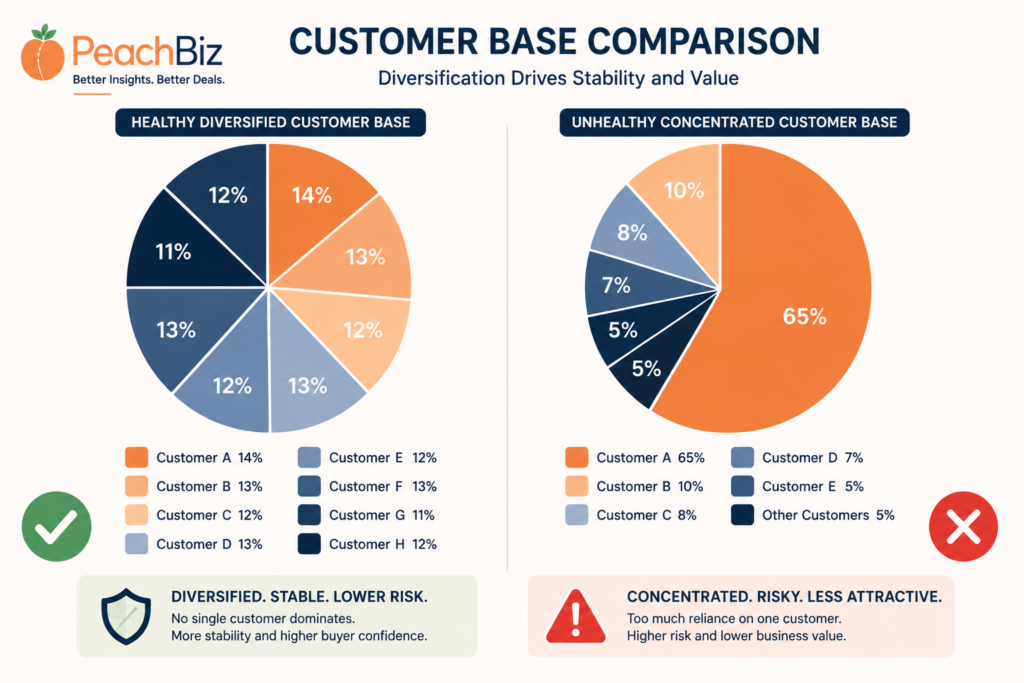
A deal-ready business has a customer base that survives the ownership transition without significant attrition. That requires:
- No single customer representing more than 15–20% of revenue — the threshold at which most SBA lenders start requiring additional underwriting and buyers start building risk premiums into their offers
- Written agreements with key customers — contracts, service agreements, or master service agreements that create contractual continuity beyond the personal relationship with the current owner
- Documented customer relationships — key contacts, tenure, purchasing history, and relationship context captured in a system accessible to a new owner
- A demonstrated retention track record — three years of customer retention data showing that your customer base is stable, not churning
If you have key customers whose business would be at risk in a transition, a deal-ready business has a plan for that — whether it’s early customer introductions to a management team, multi-year contract extensions signed before the sale, or transition provisions built into the purchase agreement.
The standard: No customer should represent more than 20% of revenue. The top 5 customers combined should not represent more than 50% of revenue. Every major customer relationship should be documented and at least partially system-based rather than purely personal.
Legal Benchmark: Nothing That Surprises a Buyer’s Attorney
A deal-ready business has no legal landmines waiting to be discovered in due diligence. Specifically:
- No pending litigation — or fully disclosed, quantified, and appropriately reserved pending matters
- Current licenses and permits, all transferable to a new owner or with a clear re-application process documented
- An assignable lease with at least 3–5 years remaining, or a renewable lease with landlord cooperation confirmed
- Clean payroll tax history — no outstanding federal or state tax liabilities, no payroll tax delinquency
- Properly classified workers — W-2 employees classified correctly, independent contractors with documented contractor relationships that can withstand IRS scrutiny
- Clean intellectual property ownership — trademarks, trade names, domain names, and proprietary materials clearly owned by the business entity, not the individual
The standard: A buyer’s attorney should be able to complete their legal due diligence without finding anything that wasn’t already disclosed in the Confidential Information Memorandum.
Transition Benchmark: A Plan That Protects Everyone
A deal-ready business has a realistic, documented transition plan that gives the buyer confidence they can operate successfully after the current owner exits. This includes:
- A minimum 60-day transition period where the seller remains available to train, introduce, and support the new owner — longer for complex businesses or highly relationship-dependent revenue
- Key employee retention commitments — stay bonuses, employment agreements, or other structures that incentivize critical staff to remain through and after the transition
- Customer introduction plan — a sequenced plan for introducing key customers to the new owner or management team during the transition period
- Vendor and supplier notifications — a plan for transitioning key supplier relationships to the new ownership
- Documented institutional knowledge — the things that only the owner knows that need to be captured before they walk out the door
The standard: A new owner should be able to operate the business at its current performance level within 90 days of closing, with reasonable transition support from the seller.
How Long Does It Actually Take?
This is the question sellers ask most often — and the answer nobody wants to hear is: longer than you think.
The average time from “I want to sell” to closed transaction is 12–24 months for a well-prepared business. For businesses that need significant preparation work before going to market, add 12–24 months of pre-market improvement time on top of that.
Here’s what the realistic timeline looks like, broken down by starting point:
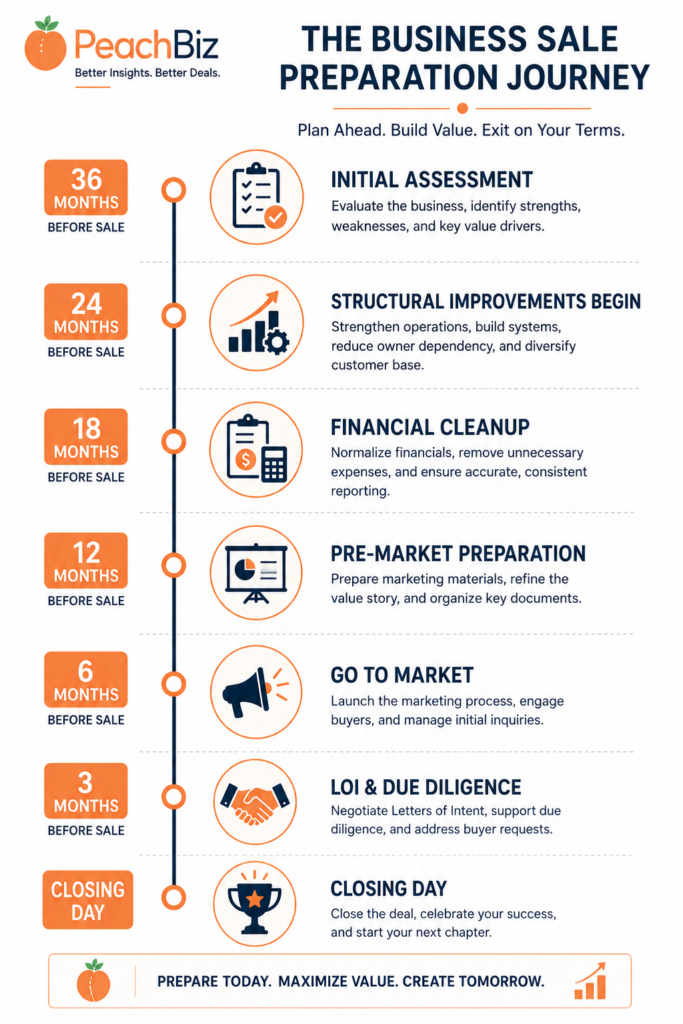
If You’re Starting from Scratch: 24–36 Months
If your business has multiple areas that need significant work — owner dependence is high, customer concentration is a problem, financials are messy, processes aren’t documented — you’re looking at a minimum of 24 months of focused preparation before you’re genuinely market-ready.
That’s not a discouragement. That’s a reality check that, if you hear it today and act on it today, gives you a clear runway to a dramatically better outcome than if you went to market unprepared.
Months 1–6: Assessment and triage. Run a full exit readiness assessment. Identify your top three issues. Begin financial cleanup — engage a CPA who understands business sales to normalize your financials and identify add-back opportunities. Begin basic process documentation.
Months 6–18: Structural improvements. Begin reducing owner dependence — elevate a key employee, transition sales relationships, extract yourself from daily operations gradually and deliberately. Begin customer diversification if concentration is an issue. Convert key customer relationships to written agreements. Resolve any legal or compliance issues.
Months 18–24: Pre-market preparation. Finalize financial documentation. Complete legal review. Confirm lease assignability or renewal. Build your CIM package with your broker. Begin the process of selecting your advisory team — broker, M&A attorney, CPA.
Month 24+: Go to market.
If You Have a Solid Foundation: 12–18 Months
If your business is operationally strong, financially documented, and doesn’t have severe structural issues — but you haven’t specifically prepared for a sale — you’re looking at 12–18 months to get genuinely deal-ready.
Months 1–3: Assessment and gap identification. Understand exactly what needs work and prioritize. Begin financial normalization and documentation cleanup.
Months 3–9: Targeted improvements. Address your two or three highest-impact gaps. This might be building out SOPs, transitioning a specific customer relationship, converting verbal agreements to contracts, or addressing a specific legal issue.
Months 9–12: Pre-market preparation. Finalize all documentation. Select your advisory team. Prepare your CIM. Get a professional opinion of value.
Month 12–18: Go to market.
If You’re Already in Good Shape: 6–9 Months
If your business already has clean financials, documented processes, a capable management team, and a diversified customer base — congratulations. You’re in the minority. Your preparation timeline is largely about documentation, presentation, and advisory team selection rather than structural improvement.
Months 1–3: Professional financial normalization. CIM preparation. Advisory team selection (broker, attorney, CPA). Opinion of value.
Months 3–6: CIM finalization. Buyer outreach strategy. Go to market.
Even in this best-case scenario, plan for 6–12 months of active marketing and deal process before closing. Well-prepared businesses still take time to sell — finding the right buyer, negotiating terms, completing due diligence, and navigating the financing and closing process all take time regardless of how well-prepared you are.
The Most Common Preparation Mistake
Sellers consistently underestimate how long the actual sale process takes once they’re on the market — and they start too late.
The most common version of this: a business owner decides in January they want to sell by December. They spend February and March finding a broker. They spend April and May getting their financials together. They go to market in June. The best buyer makes an offer in August. Due diligence takes until October. Financing closes in December — maybe. If anything goes sideways in due diligence, they’re now looking at Q1 of the following year.
That’s the optimistic scenario for a business that was reasonably prepared. For a business that wasn’t — where due diligence surfaces issues that trigger renegotiation, where the lender requires additional documentation, where the lease assignment takes two months to negotiate with a reluctant landlord — the timeline stretches further and the outcome gets worse.
The sellers who close on their terms, on their timeline, at or above their target price are almost always the ones who started preparing 18–36 months before they wanted to close. Not because they’re unusually patient — because they understood that the preparation work is what creates the outcome.
Building Your Deal-Ready Roadmap
Here’s how to take everything in this article and turn it into a practical, personal action plan.
Step 1: Know where you stand today. Run through the deal-ready benchmarks above and score yourself honestly in each area — financial, operations, customer, legal, and transition. Where are you strong? Where are the gaps?
Step 2: Set a realistic target date. Based on your gap assessment, what’s the earliest realistic date you could be genuinely market-ready? Add 12–18 months to that for the active sale process. That’s your realistic exit timeline.
Step 3: Identify your highest-impact improvement priorities. You can’t fix everything at once — and you don’t need to. Focus on the two or three improvements that will have the biggest impact on your valuation and marketability. These are almost always: financial documentation quality, owner dependence, and customer concentration.
Step 4: Build a 90-day action plan. The roadmap only works if it starts moving. What are the three specific things you’re going to do in the next 90 days? Assign deadlines, assign responsibility (you, your CPA, your attorney, a key employee), and put them on a calendar.
Step 5: Reassess every six months. Your deal-readiness is a moving target — your business changes, the market changes, your timeline shifts. Build in a formal reassessment every six months to track progress, update your valuation estimate, and adjust priorities.
👉 Start with your current valuation baseline — use our free Business Valuation Calculator to understand what your business is worth today and what it could be worth after targeted improvements.
👉 Use our EBITDA Growth Calculator to model the specific dollar impact of your most important improvement priorities — so your roadmap has real numbers attached to it, not just goals.
A Note on the Emotional Side of “Getting Ready”
We’d be leaving something important out if we didn’t acknowledge this: getting a business deal-ready is not just a financial and operational exercise. For most business owners, it’s also deeply personal.
Building something for 10, 20, or 30 years and then systematically preparing to hand it to someone else involves a kind of grief that doesn’t show up in any checklist. The process of extracting yourself from operations, transitioning customer relationships, and documenting institutional knowledge can feel like you’re erasing yourself from something you built.
That’s real. And it’s worth acknowledging rather than pretending the preparation is purely mechanical.
The owners who navigate this best are the ones who find meaning in the preparation process itself — who see building a truly transferable business as the final, most sophisticated expression of everything they built. The business that can run without you is, in many ways, the most impressive version of what you’ve created.
Getting deal-ready isn’t about leaving. It’s about finishing well.
Frequently Asked Questions
How do I know when my business is actually ready to sell?
Use the five benchmarks in this article as your readiness checklist: financial (three clean years), operations (passes the bus test), customer (no single point of failure), legal (nothing that surprises a buyer’s attorney), and transition (a plan that protects everyone). When you can honestly say your business meets those standards, you’re deal-ready. A professional exit readiness assessment from a broker or exit planner can give you an outside, objective confirmation.
Can I sell my business without preparing it?
Yes — but you’ll pay for it in price, terms, or both. An unprepared business attracts fewer buyers, generates lower offers, takes longer to sell, and is more likely to have deals fall apart in due diligence. The preparation work isn’t mandatory — it’s an investment with a very high return.
What’s the minimum timeline to prepare a business for sale?
If your business is already in good shape, six months of focused preparation is possible. For businesses with meaningful gaps to address, 18–36 months is more realistic. Trying to compress an 18-month preparation into six months almost always results in going to market before you’re ready — which costs more in price and terms than the time saved.
Do I need a broker to prepare my business for sale?
You don’t need a broker to begin the preparation work — the financial, operational, legal, and customer improvements described in this article can be led by you with input from your CPA and attorney. But engaging a broker or exit planner early in the process — even 12–18 months before your target market date — gives you professional market perspective on your preparation priorities and ensures you’re building toward what buyers in your industry actually want to see.
What happens if I have to sell faster than my ideal timeline?
Sometimes circumstances require a faster sale — health issues, partnership disputes, market timing, personal financial needs. In those cases, focus your limited preparation time on the issues that are most likely to affect SBA financability (clean tax compliance, no worker misclassification, assignable lease) and the issues most likely to surface in early buyer conversations (owner dependence, customer concentration). Accept that some issues will need to be disclosed and priced rather than fixed, and work with an experienced broker who can position the business honestly and find buyers who understand the tradeoffs.
The Bottom Line
Deal-ready is specific. It’s documented financials, demonstrable owner independence, a diversified customer base, clean legal standing, and a transition plan that gives a buyer confidence. It’s not perfection — it’s verifiability.
And getting there takes time. More time than most sellers expect, and more time than the sale process itself. The sellers who close on their terms are the ones who understood this early enough to do something about it.
You now know what deal-ready looks like. You know how long it takes. The only question is when you start.
👉 Start today with our free Business Valuation Calculator — know your baseline, understand your gaps, and build toward the exit you deserve.
Related Reading
- The 10 Factors Buyers Score Before They Make an Offer
- How to Run an Exit Readiness Assessment on Your Client’s Business
- Red Flags That Kill Deals Before the LOI: A Pre-Sale Checklist
- Why Your Asking Price and Your Business Value Are Two Different Numbers
- The 7 Value Drivers That Push Your Multiple Above the Midpoint
- Owner Dependency: The Single Biggest Value Killer in Small Business Sales
- Explore All Free PeachBiz Business Calculators