
Owner Dependency: The Single Biggest Value Killer in Small Business Sales

Here is a question that most business owners have never honestly answered:
If you disappeared from your business tomorrow — not gradually, not with a transition plan, but completely and immediately — what would happen?
For most small business owners, the honest answer is uncomfortable. Revenue would drop because key customers buy from you personally. Operations would stall because critical decisions require your judgment. Employees would flounder because their daily direction comes from you. Vendors would be confused because their relationship is with you, not with the business.
In other words: the business would be in serious trouble. Not because it’s a bad business — but because the business is you.
This is owner dependency. And it is, without question, the single most common reason small businesses sell below their potential — or fail to sell at all.
It’s also the value killer that sellers are most systematically blind to about their own companies. Because the same traits that make you an exceptional business builder — your relationships, your expertise, your judgment, your energy — are exactly the traits that create dependency. The strengths that built the business become the liabilities that limit what it’s worth to someone else.
This article is about understanding owner dependency clearly, recognizing it honestly in your own business, and — most importantly — doing something about it before a buyer’s advisor does it for you.
What Owner Dependency Actually Looks Like
Owner dependency isn’t a single thing. It shows up in three distinct forms, and most owner-dependent businesses have all three to some degree.
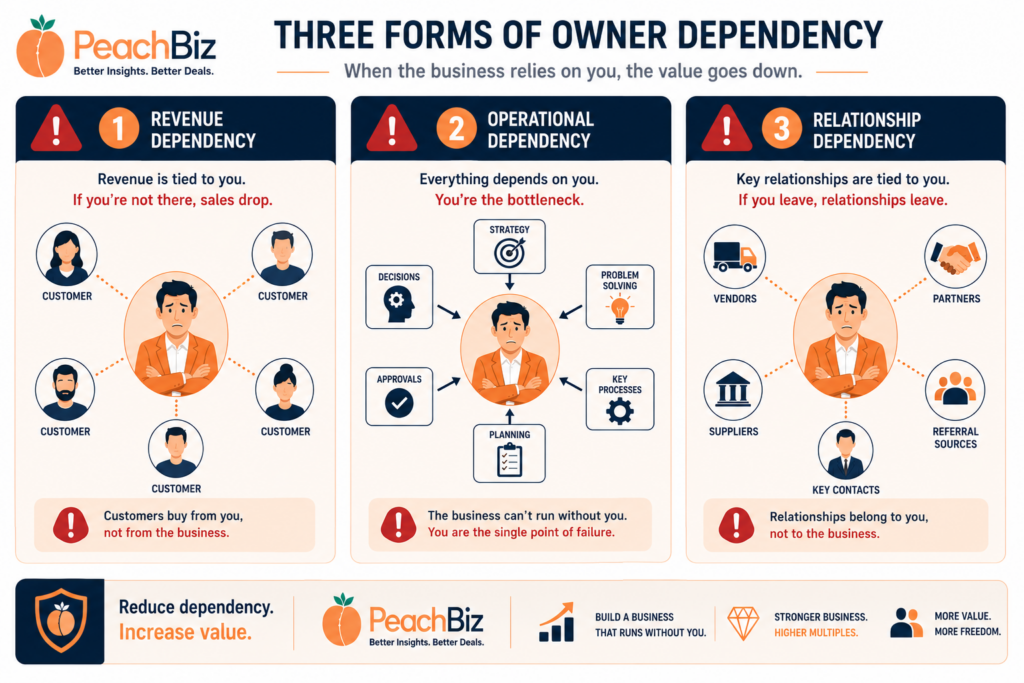
Form 1: Revenue Dependency
Revenue dependency means the business’s income is tied to the owner personally — customers buy from you, not from the business. Your name, your relationships, your phone number, your referral network are what generates revenue. When you leave, some meaningful percentage of those customers may leave with you — not out of disloyalty, but because their relationship was always with you personally, not with the business entity.
This is the most financially damaging form of owner dependency because it creates direct revenue risk for the buyer. They’re paying for a revenue stream that may partially evaporate the moment they own it.
Signs of revenue dependency:
- You are the primary or sole salesperson in the business
- Key customers call your personal cell phone rather than a business line
- New business comes primarily through your personal referrals and network
- Customers have expressed concern about what happens when you retire or step back
- You handle all pricing decisions and contract negotiations personally
Form 2: Operational Dependency
Operational dependency means the business can’t function at its current level without your daily involvement in running it. You make the critical operational decisions. You solve the problems that require judgment. You know the processes, the workarounds, the exceptions, and the institutional knowledge that makes the business work — and it lives entirely in your head.
A buyer who takes over an operationally dependent business faces a steep, risky learning curve. They’re not just learning a new business — they’re trying to reconstruct an operating system that was never documented and that leaves with the person who designed it.
Signs of operational dependency:
- Employees regularly defer to you on decisions they should be able to make independently
- You can’t take a two-week vacation without checking in daily
- Key processes exist only in your head and haven’t been written down
- New employees are trained by following you around, not by following a documented process
- The business has never operated successfully without you physically present
Form 3: Relationship Dependency
Relationship dependency means critical business relationships — with key vendors, strategic partners, landlords, referral sources, or institutional contacts — are personal to you rather than embedded in the business. When you leave, these relationships don’t automatically transfer. They have to be rebuilt from scratch by a new owner who doesn’t have your history, your trust, or your standing.
Signs of relationship dependency:
- Your best vendor gives you preferential pricing because of a personal relationship that predates the business
- Your primary referral source sends you business because of a personal friendship
- Your landlord gives you favorable lease terms because you’ve known each other for 20 years
- Key strategic partnerships were formed through personal connections that aren’t documented or formalized
Why Sellers Systematically Underestimate It
Here’s the uncomfortable truth: most business owners who have owner dependency don’t recognize the full extent of it. And there are specific, psychological reasons why.
You built the business by being indispensable — so indispensability feels like strength.
The habits and traits that created owner dependency were the same ones that built the business. Being the person everyone turned to, knowing every customer personally, making every important decision — these weren’t mistakes. They were the right moves at the right time. They built something real.
The problem is that what’s a strength in the building phase becomes a liability in the transfer phase. Recognizing that requires seeing your business through someone else’s eyes — specifically, through the eyes of someone who has to operate it without you.
You’re measuring the wrong things.
Most business owners measure their value by how much the business depends on them. That feels like proof of their importance and contribution. But buyers measure value by how little the business depends on the current owner. These are opposite metrics — and the seller who doesn’t understand that is heading into a valuation conversation with a fundamental misalignment.
The dependency is invisible from the inside.
When you’re in the middle of it, owner dependency feels like normal business operations. You don’t notice that every significant decision flows through you. You don’t notice that the business has never operated for more than a week without your direct involvement. You don’t notice that your key customer always asks for you specifically — because of course they do. That’s just how it’s always worked.
The buyer sees it immediately. Their advisor sees it before the first meeting is over. And they price it in.
How Buyers Measure Owner Dependency
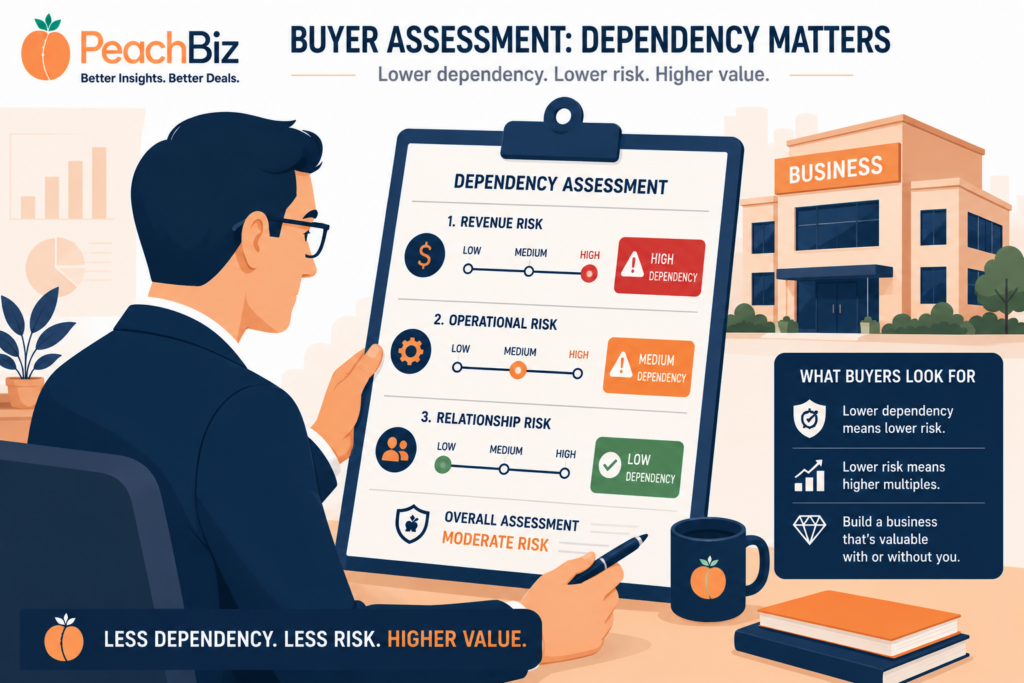
Buyers don’t just intuit owner dependency — they evaluate it systematically through a series of questions, observations, and conversations designed to quantify the risk.
During the initial review:
- What percentage of revenue comes from customers with whom the seller has a personal relationship?
- Does the seller appear to be the primary salesperson?
- How long has each key customer been with the business, and was the relationship established before or after the business was founded?
- What is the stated reason each key customer does business here?
During management interviews:
- What decisions do you make independently, and which ones do you take to the owner?
- Has the business ever operated successfully for an extended period without the owner present?
- What would happen to day-to-day operations if the owner wasn’t available for a month?
- Which customers have you personally developed a relationship with?
During customer reference calls:
- How did you first start working with this company?
- Who is your primary contact there?
- If the ownership changed, would that affect your decision to continue using them?
- Do you have a relationship with anyone on the team other than the owner?
The answers to these questions — and their consistency across multiple conversations — give a buyer a very clear picture of the dependency level. Inconsistencies between what the seller says and what employees and customers say are the most damaging outcome of this process.
How dependency translates to multiple:
Buyers don’t apply a fixed formula — but the general impact is significant. In most industries, a business with severe owner dependency (the owner is the primary salesperson, sole operational decision-maker, and holds all key relationships) trades at 0.5x–1.5x below what a comparable business with demonstrated owner independence would command. On a business earning $500,000 in SDE at a 3.0x–4.5x range, that dependency discount represents $250,000–$750,000 in lost value.
The Dependency Reduction Playbook
The good news: owner dependency is fixable. The bad news: it takes time — typically 18–24 months of consistent, deliberate effort to meaningfully reduce dependency and have it show up in the ways buyers actually measure it.
Here’s the playbook, organized by dependency type.
Reducing Revenue Dependency
Step 1: Stop being the primary salesperson.
This is the most important and most difficult step. If you are currently closing the majority of new business personally, your first priority is to develop or hire someone who can take over that role — and then genuinely give it to them.
This doesn’t mean you stop selling. It means you shift from being the salesperson to being the sales coach and strategic relationship manager. You introduce your team to your network. You bring them into client meetings. You let them close deals with you present, and then without you present.
Give this 12–18 months. The goal is not just to have someone else doing sales — it’s to have documented evidence that sales have continued at or near their current level without your direct involvement.
Step 2: Transition customer relationships deliberately.
Identify your top 10–15 customers by revenue. For each one, map out the relationship: Who introduced you? How long have they been a customer? Who on your team do they know besides you?
Over the next 12 months, deliberately expand the relationship. Introduce a key team member. Copy someone else on communications. Have another person handle the next service call or project. The goal is that by the time you go to market, your key customers know and trust at least one member of your team independently of you.
Document this process. Buyers will ask you to describe your customer transition plan — having a structured, documented approach is dramatically more credible than saying “I’ll introduce them during the transition period.”
Step 3: Build systemic customer acquisition.
Relationships-based selling is owner-dependent by definition. Diversify your customer acquisition toward channels that work independent of your personal network: inbound marketing, referral programs with documented referral partners, strategic partnerships formalized with written agreements, digital presence that generates inquiries directed to the business rather than to you personally.
Reducing Operational Dependency
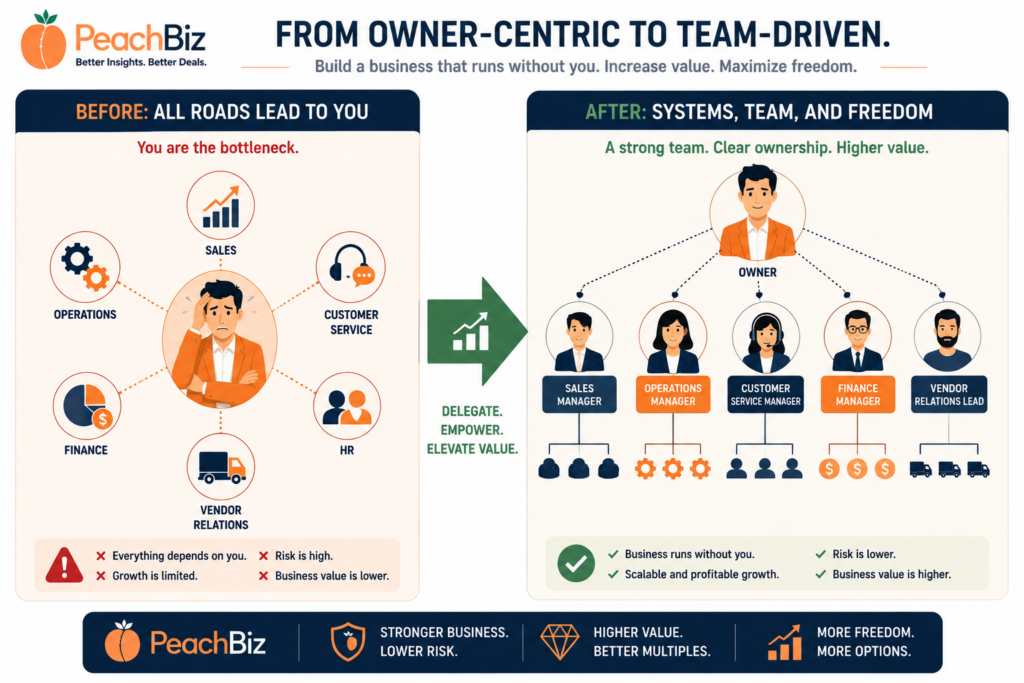
Step 1: Document your processes before you extract yourself from them.
The most common mistake owners make in reducing operational dependency is stepping back from processes they haven’t yet documented. The result is that nothing gets done right, everything falls apart, and they step back in — reinforcing the dependency rather than reducing it.
The correct sequence is: document first, then delegate. For every operational process you want to hand off, write it down in enough detail that someone can follow it without asking you questions. Then hand it off. Then stay out of the way while they learn it.
Step 2: Identify and elevate your number two.
Almost every business has one person — sometimes two — who could step into a more senior operational role if given the authority, the accountability, and the development. Identify that person. Invest in them. Give them a real title, real authority, and real accountability for results.
This isn’t just a staffing decision — it’s a value-creation investment. A business with a capable, tenured #2 who has demonstrated they can run operations independently is worth meaningfully more than one without. That person is what makes a buyer’s transition possible, and buyers will specifically ask about them.
Step 3: Implement decision-making frameworks.
One of the most practical operational dependency reducers is a clear framework for what decisions require your involvement and what decisions don’t. Define the categories explicitly:
- Decisions team members can make independently (within defined parameters)
- Decisions that require consultation but not approval
- Decisions that require your approval
Then enforce it — which means not getting pulled into the first two categories even when people try to involve you. Every time you make a decision someone else should have made, you reinforce the dependency you’re trying to reduce.
Reducing Relationship Dependency
Step 1: Formalize key relationships.
Personal relationships don’t transfer automatically. Contractual relationships do. For every critical business relationship that currently exists primarily as a personal arrangement — vendor pricing, referral agreements, strategic partnerships — work toward formalizing it in a written agreement between the businesses rather than between the people.
A vendor who gives you 15% better pricing because of a 20-year friendship will not necessarily give the same pricing to a new owner. A vendor who has a documented preferred supplier agreement with your business will.
Step 2: Create business-to-business touchpoints.
For key relationships where formalization isn’t possible (longtime referral sources, industry relationships), create regular touchpoints that involve your team rather than just you. Bring your operations lead to industry events. Have your sales manager call key referral sources quarterly. Make the relationship between the businesses — not just between the people — a demonstrable reality.
Step 3: Document the relationship context.
For every key external relationship, create a relationship brief: who the contact is, how the relationship was established, what the history is, what makes the relationship valuable, and what the new owner needs to know to maintain it. This document — however informal — transforms an invisible personal asset into documented institutional knowledge that transfers with the business.
The Timeline Reality
We want to be direct about something that gets glossed over in most discussions of owner dependency: you cannot fix severe owner dependency in three months before a sale. You can make surface-level improvements that sophisticated buyers will see through immediately. But genuine, measurable reduction in owner dependency takes time — specifically:
- 6–12 months to implement initial process documentation and begin transitioning customer relationships
- 12–18 months to demonstrate that sales have continued without your direct involvement
- 18–24 months to show that operations have run successfully with a capable manager leading day-to-day
- 24–36 months to have a documented track record of reduced dependency that shows up clearly in buyer conversations and employee interviews
This is why we consistently say that the best time to start reducing owner dependency is 24–36 months before your target sale date. Not because the process is slow — it isn’t. It’s because the evidence takes time to accumulate, and it’s the evidence — not your assurances — that buyers trust.
If you’re closer to market than that, start anyway. Even partial reduction is better than none, and a seller who is clearly in process of reducing dependency — with documented steps already taken — is more credible than one who says “I plan to address this during the transition period.”
What to Do If You’re Already Close to Market
If you’re 6–12 months from going to market and owner dependency is significant, your strategy shifts from “fix it” to “address it intelligently.” Here’s what that means:
Get honest about the revenue risk. Estimate realistically what percentage of revenue is genuinely at risk in an ownership transition. Not the worst case, not the best case — the honest case. Buyers will make their own estimate. Yours should be defensible and reasonable.
Build a documented transition plan. A detailed, specific plan for how you will introduce key customers to the new owner, transition key relationships, and provide operational support during the transition period is more credible than a vague promise. Write it down. Make it specific. Include timelines and responsibilities.
Price it appropriately. Owner dependency that can’t be eliminated before sale needs to be accounted for in pricing. A business with significant owner dependency priced at the top of its industry range will sit on the market. The same business priced to reflect its actual risk profile will attract buyers and close. Work with your broker to find the price that reflects both the business’s earning power and its transition risk honestly.
Consider deal structure accommodations. Earnout provisions tied to revenue retention post-sale, extended transition periods with seller involvement, or seller financing arrangements that give the buyer downside protection are all deal structure tools that can bridge the gap between a seller’s price expectations and a buyer’s risk assessment on an owner-dependent business.
👉 Use our free Business Valuation Calculator to get a realistic baseline value for your business — and understand how owner dependency is likely affecting your multiple.
For Brokers and Exit Planners: Having the Owner Dependency Conversation
Owner dependency is one of the most sensitive topics in a seller relationship — and one of the most important to address honestly and early.
Sellers often hear “your business is too dependent on you” as criticism of how they’ve built their company. Your job is to help them hear it differently: as the most valuable and actionable piece of information they can receive before going to market.
Frame it in dollar terms. “The dependency we’re seeing is likely costing you $200,000–$400,000 in valuation — and here’s specifically what we can do about it over the next 18 months.” That reframe — from criticism to opportunity with a specific dollar amount attached — changes the conversation from defensive to strategic.
The sellers who leave your initial consultation motivated to address owner dependency rather than defensive about it are the ones who will be your best clients — because they’re the ones who will do the work, come to market at the right time with a genuinely improved business, and close at a price that reflects the improvement.
See How to Run an Exit Readiness Assessment on Your Client’s Business for a structured framework for this conversation.
Frequently Asked Questions
Can I sell an owner-dependent business?
Yes — owner-dependent businesses sell every day. The question isn’t whether you can sell, it’s what the dependency costs you in price and deal structure. Businesses with significant owner dependency typically sell at the low end of their industry multiple range, attract a smaller buyer pool (buyers who are comfortable with higher transition risk), and often require seller financing or earnout provisions that extend the seller’s financial exposure post-closing. These are not fatal outcomes — they’re the market’s rational pricing of the risk.
How do buyers handle the transition risk of an owner-dependent business?
Several mechanisms: extended transition periods where the seller remains involved (6–18 months rather than the standard 60–90 days), earnout provisions where a portion of the purchase price is contingent on revenue retention post-sale, seller notes that give the buyer downside protection if revenue drops significantly, and price reductions that provide a margin of safety against transition losses. The more owner-dependent the business, the more likely the buyer is to require one or more of these structural accommodations.
What if my key employees might leave when I sell?
Key employee retention in an owner-dependent business is a specific buyer concern that overlaps with, but is distinct from, owner dependency. Address it with stay bonuses — agreements funded from sale proceeds that pay key employees to remain for 12–24 months post-closing. These are typically negotiated in the purchase agreement and funded at closing by the seller. A business where key employees have stay bonus agreements in place is demonstrably less risky than one where they don’t.
Is owner dependency always bad?
In the context of a business sale, significant owner dependency always represents a cost — either in multiple, in deal structure, or in time on market. In the context of building a business, some level of owner involvement is natural and appropriate, particularly in the early years. The issue isn’t that you’re involved in your business. The issue is when your involvement has become the only thing holding the business together — when the business is indistinguishable from a job rather than an enterprise.
How do I know if my business has owner dependency?
The most reliable test is the “vacation test”: take a genuine two-week vacation with no business contact — no calls, no emails, no texts. What happens? If the business operates smoothly, handles customer issues, and continues generating revenue without significant problems, your dependency is low. If it doesn’t, you have work to do. Most business owners who haven’t tried this are surprised by the answer.
The Bottom Line
Owner dependency is the value killer most sellers can see in other people’s businesses and least can see in their own. It’s built from the same strengths that built the business — which makes it invisible from the inside and obvious from the outside.
The path forward isn’t to feel bad about it. It’s to understand it clearly, measure it honestly, and start reducing it systematically — because every point of dependency you reduce before going to market is a direct improvement in your valuation, your buyer pool, and your ultimate sale proceeds.
The business you built is worth more than what your current dependency level suggests. The question is whether you give yourself the time and runway to prove that before a buyer’s advisor writes the number for you.
👉 Start with an honest baseline — use our free Business Valuation Calculator to understand what your business is worth today and what reducing owner dependency could add to that number.
Related Reading
- The 7 Value Drivers That Push Your Multiple Above the Midpoint
- The 10 Factors Buyers Score Before They Make an Offer
- How to Run an Exit Readiness Assessment on Your Client’s Business
- Red Flags That Kill Deals Before the LOI: A Pre-Sale Checklist
- How Customer Concentration Tanks a Valuation (And How to Fix It Before You Sell)
- What “Deal-Ready” Actually Looks Like — And How Long It Takes to Get There
- Explore All Free PeachBiz Business Calculators